Chotu, 40, runs a pakori thela (fritters stall) outside the temple at Lalbagh in Moradabad. He has watched people’s relationship with the nearby riverbank change.
“Earlier, people watched the volunteers clean; today, local people themselves feel responsible for keeping the ghat and river clean,” he says.
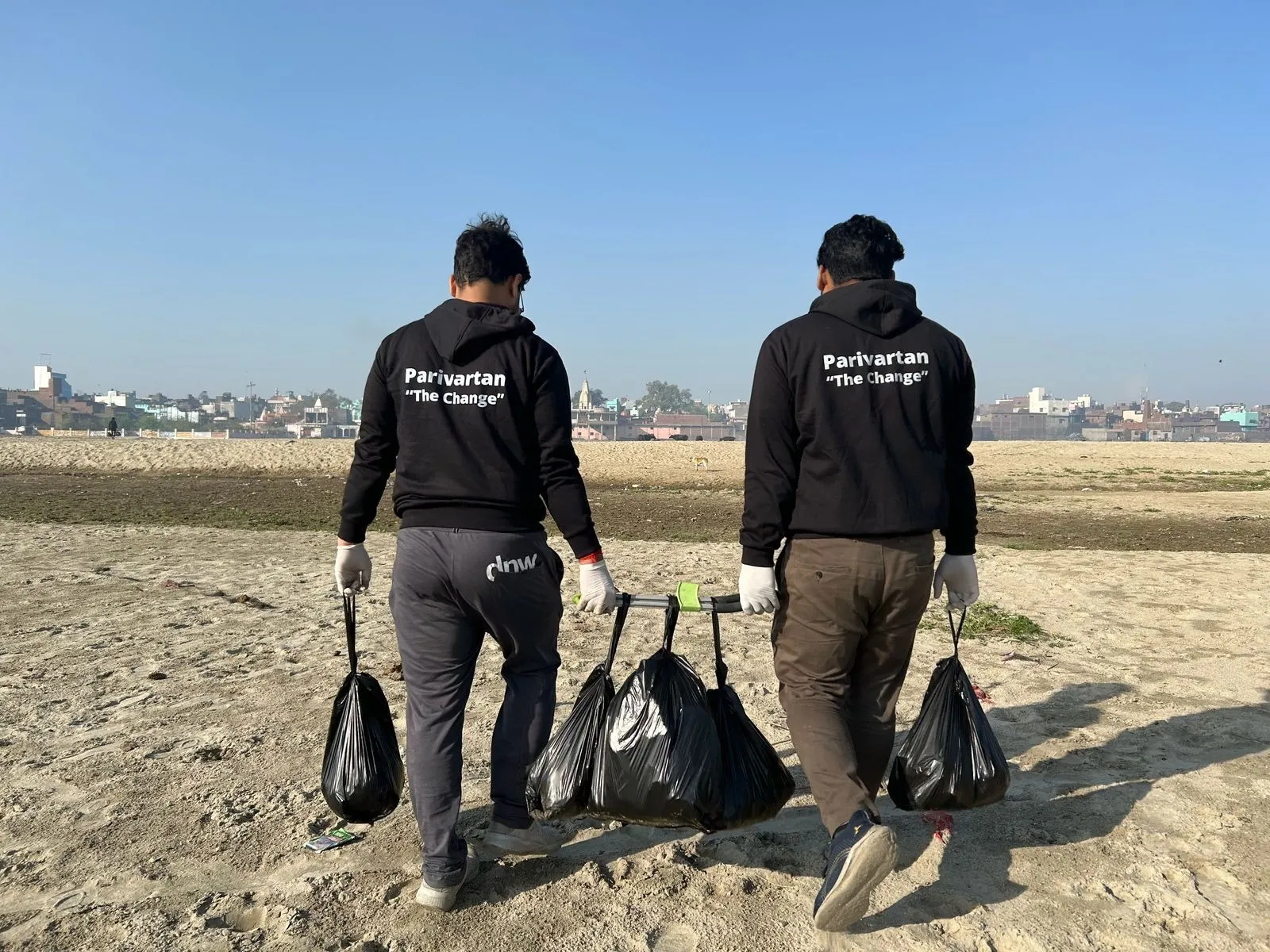
For Kapil Kumar, 35, who leads the Clean Up Ram Ganga Campaign, this willingness to take responsibility matters deeply. His team at Parivartan “The Change” reports completing more than 218 clean-up drives and removing over 1.2 lakh kg of waste, with more than 5,000 volunteers participating over the years.
Behind those figures are conversations with visitors, residents making space for equipment, and volunteers returning to a riverbank they have come to care about. Getting here took several attempts.
A teacher’s question took him beyond his textbooks
Kapil completed his B.Tech in mechanical engineering in 2013 and spent a year in the automobile sector. From 2014 to 2016, he pursued a PGDM while preparing for government examinations, including the UPSC Civil Services Examination. His UPSC preparation continued until 2017.
“During my UPSC preparation, studying sociology helped me look beyond individual issues and understand society, communities and the factors that influence social change. It gave me a much broader perspective on the challenges people face,” he tells The Better India.
In 2016, blogs he wrote to practise essays and answers drew responses from juniors and former college colleagues.
“They asked me, ‘Why don’t we do something on the ground?’ And that’s where it all began. We started with a few activities and gradually built from there,” he recalls.
A visit to a government school in Moradabad gave that suggestion a practical meaning. Kapil found leaking roofs, inadequate washrooms and children without proper chairs and benches. When he questioned the conditions, a teacher challenged him.
“People usually come here for surveys and other work, criticise the government and the administration, and then leave. But what can you actually do beyond criticism?” he recalls her asking.
She pointed him towards a child with an eye problem.
“So she asked me, ‘Can you take him to the hospital and help him get the treatment he needs?’ I took that on,” he recalls.
Kapil contacted the chief medical officer and helped the child receive treatment and spectacles.
“If you do something with genuine intention, without expecting anything in return, it gives you a different kind of satisfaction,” he says.
Kapil and his friends founded Parivartan in October 2016 and registered it in July 2017. Their early work included riverbank awareness, air pollution and women’s empowerment through street plays and role plays.
“There was no fixed project or particular cause in mind,” he says. “We felt that we wanted to do something about social issues. So, we would meet, discuss what we could do, make a plan, and then take it to the ground.”
“It was largely a process of trial and error,” he says.
Some members left as they completed engineering or MBA courses and chose other careers. Kapil continued with a smaller team, gradually recognising that he wanted to work in the social sector.
Why did the waste keep coming back?
In November 2016, Kapil sat beside the Ramganga during a riverside festival, watching plastic bags, flowers, clothes and household waste enter the water. He began talking to visitors about what they were discarding.
“We have a living river in our city. It was once the lifeline of the communities living along its banks. But today, industrial waste, sewage and all kinds of solid waste are being dumped into it,” he recalls.
The conversations showed him that people needed practical alternatives. The team explained how flowers and other organic offerings could be composted in a designated pit, while plastic and other non-biodegradable waste could go to municipal collection. Visitors responded positively.

On Earth Day, 22 April 2018, the team formally launched the Clean Up Ram Ganga Campaign. Three months of Sunday clean-ups at a ghat (riverside steps) were followed by a wall mural and an 11,000-signature campaign.
They carried the signatures on a cycle yatra (journey) from Moradabad to Varanasi, passing through Rampur, Bareilly, Shahjahanpur, Sitapur, Lucknow, Raebareli and Prayagraj. Yet the work at the riverbank exposed a problem.
“What we were doing earlier wasn’t sustainable,” he says. “We would clean the ghat for three months, but once we stopped, it would eventually return to the same condition.”
Between 2018 and 2020, the team stayed involved through monthly engagement, festival clean-ups and awareness activities, without a fixed weekly schedule. COVID-19 then interrupted public activities. Parivartan worked with the district administration and volunteers to provide essential supplies to marginalised communities.
Kapil also remembers seeing distant hills from Moradabad’s rooftops during the lockdown, when the air was clearer. The experience reinforced his interest in sustained environmental work.
“It made us realise that environmental work cannot be a one-time effort. The real difference comes when you keep showing up and continue the work,” he says.
This time, there would be no end date
On World Environment Day, 5 June 2021, the team began a new phase at Lalbagh Ghat. Household waste and discarded offerings littered the bank, with few awareness messages or conversations about pollution. Kapil wanted the clean-ups to become a regular commitment.
“We told our teammates and volunteers that this was not something we would do for a few weeks or months. We were in it for the long run, for the Ram Ganga,” he says.

“We keep track of the numbers, document our progress and assess the impact to understand how the campaign is making a difference,” he says.
He says Sunday engagement has continued since then, with awareness activities replacing physical clean-ups when flooding or excessive rain makes the riverbank unsafe.
In summer, volunteers generally work from around 6.30 am to 9 am; in winter, they start closer to 7.30 am. Kapil or a teammate briefs them before they begin.
“All the volunteers come together with their gloves and other equipment,” he explains. “I brief them on what needs to be done and what kind of waste we need to collect. If I’m not there, my teammates take over and guide everyone through the work.”
The focus is on plastic and other non-biodegradable waste. Depending on weather, season and footfall, a Sunday clean-up can yield around 300 to 700 kg, he says.
The team segregates waste wherever possible. Flowers and organic offerings go into the composting pit. Recovered idols are kept out of the river. Other inorganic waste is handed to the municipal corporation for treatment and disposal, with recyclable material sent for recovery where possible.
Alongside collection, volunteers speak to visitors about the available disposal facilities and ways to reduce waste. Those conversations have become central to keeping the bank clean.
Changing a familiar habit takes patience
“Behavioural change is a very tough thing,” Kapil says. During the Navratri mela (fair), he estimates that 15,000 to 20,000 people visit the nearby temple each day, increasing the pressure on the riverbank.
Some visitors told volunteers they were following practices passed down through their families. The team explained how they could continue observing their customs while using the waste facilities.
Kapil says most visitors now use the designated pit or other disposal facilities. Announcements from the temple also encourage people to keep waste and offerings away from the bank, reinforcing the volunteers’ message.

Mansi Mehrotra, 25, has been associated with Parivartan since December 2017. She joined after seeing waste around the river and recalls how much patience one conversation required.
“Raising awareness was only the first step. We realised that real change would come only when we took action ourselves,” she says.
During a clean-up, she met a man planning to immerse plaster of Paris idols. He initially resisted her explanation of their environmental impact. The team continued talking to him, and eventually he took the idols back.
“Sometimes, creating change requires patience, meaningful conversations and helping people understand why it matters,” she says.
Vikrant, 38, a waste collection vehicle driver with Nagar Nigam Moradabad, regularly visits the ghat and has witnessed the volunteers’ work.
“We have seen the change almost every week,” he says. “The difference is clearly visible to the naked eye.”
“I have watched these youngsters working every Sunday for years, and their consistency has influenced me as well,” he says.
Giving people a reason to return
The campaign’s participants include students, professionals, residents, National Cadet Corps (NCC) and National Service Scheme (NSS) volunteers, and people from social organisations and community groups.
Parivartan has more than 3,000 registered volunteers, while six full-time staff members work specifically on the Ramganga campaign. Kapil says staff join Sunday clean-ups as volunteers too.
“Every Sunday we reach there because we consider it our social responsibility,” he explains.
The team also wants people to enjoy their time by the river. After a week in offices or colleges, volunteers can spend time outdoors, talk to vendors, and watch people farming and gardening nearby. There are pets playing, picnics, river festivals and stand-up sessions after clean-ups.
“When people get the chance to come to the riverbank, take part in activities and observe the community around them, they really enjoy the experience,” he says.
Clean-ups also mark occasions such as Independence Day, Republic Day and Gandhi Jayanti. Over the years, participants have planted hundreds of trees, beautified public spaces and created awareness murals.
The campaign received India Book of Records recognition for the “Longest Cleanliness Drive on a Riverbank Organised by an NGO”. Kapil also sees its influence in volunteers’ choices elsewhere.
“I don’t think any of these volunteers would litter on a riverbank, whether it is the Ram Ganga or any other river. Some of our volunteers are also involved in beach clean-ups in Mumbai, while others are part of clean-up efforts in Dehradun,” he says.
Old newspapers help pay for the next clean-up
Keeping the work going requires funds as well as time. Through its SEHYOG initiative, Parivartan collects old newspapers, books, plastics and other recyclable material from households and well-wishers in door-to-door drives.
The material is sold to authorised scrap dealers, and the proceeds help fund the organisation’s social and environmental initiatives, including the Ramganga campaign.
Individual donors and well-wishers contribute towards cleaning materials, awareness activities and other expenses. Local support also helps volunteers organise clean-ups when the core team cannot attend.
“Even if no one from our team is able to come, you can still collect the tools and carry out the clean-up yourselves,” Kapil tells them.

Taking the river’s problems to the authorities
Kapil knows that removing solid waste addresses only part of the river’s pollution. Untreated sewage needs action beyond the Sunday clean-ups.
The team has submitted a 10-point action agenda and its 200-week campaign booklet to the National Mission for Clean Ganga and the State Mission for Clean Ganga. Kapil wants sewage treatment plants to function efficiently so wastewater from city drains is treated before entering the river.
“The Ram Ganga is the tributary of the Ganga, and cleaning the Ganga is not possible without cleaning the Ram Ganga,” he says.
His ambition is a model ghat where people can visit, observe their customs and spend time by the water while keeping the surroundings clean.

“For us, the greatest achievement has never been the kilograms of waste removed from the Ramganga,” he says. “It has been the change in people’s behaviour.”
That change already has a place in Chotu’s home, where the cleaning tools remain ready for whoever comes to collect them next Sunday.
All pictures courtesy Parivartan “The Change”.
Disclaimer : This story is auto aggregated by a computer programme and has not been created or edited by DOWNTHENEWS. Publisher: thebetterindia.com