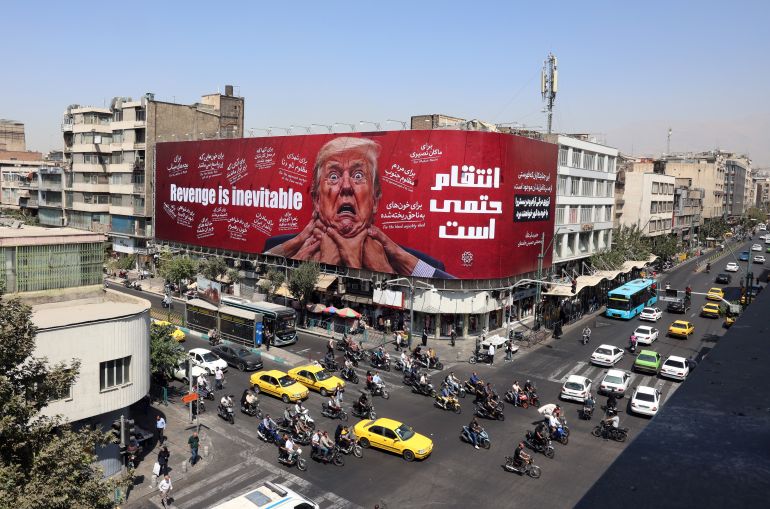
As the United States-Iran war drags on and talks remain stalled, Tehran is determined to move beyond a state of “no war and no peace”, parliament speaker and chief negotiator Mohammad Bagher Ghalibaf has told Al Jazeera.
Iran continues to assert control over which vessels may pass through the Strait of Hormuz, where attacks on tankers taking “unauthorised” routes have disrupted shipping.
Recommended Stories
list of 4 itemsend of list
Ghalibaf says Tehran remains open to a deal with the US to agree a ceasefire and the reopening of the strait, and has been waiting for Washington to respond to its terms for this to happen. “The ball is now in the American court,” he said.
Faced with the prospect of restarting an unpopular war or making concessions to Iran in order to secure a deal, experts say US President Donald Trump has for now chosen to ratchet up economic pressure. To this end, Washington has tightened sanctions, maintained its blockade on Iranian ports and announced an operation that Trump says will cut off overland routes Iran uses to transport advanced weapons and technology.
For now, full-scale fighting remains on hold, but a formal peace deal is still out of reach, with a fragile stalemate that may not hold for long, experts say.
“The current equilibrium is inherently unstable,” Ali Vaez, deputy programme director for the Middle East and North Africa at the International Crisis Group, told Al Jazeera. “Because what Washington considers a sustainable stalemate, Tehran sees as a slow-motion strangulation. Both sides are banking on the other’s pain threshold being lower than their own.”
Advertisement
“That is a dangerous wager,” he added.
How long can Iran hold out?
Tehran has laid down seven conditions before it will agree to a ceasefire and the reopening of the Strait of Hormuz, then restart peace talks through a Qatari mediator, and has been waiting for an official US response to its demands. They include the lifting of the US naval blockade on Iranian ports, sanctions relief, releasing frozen Iranian funds, ending hostilities on all fronts and formally declaring the war over.
Ghalibaf said these conditions had already formed part of the memorandum of understanding (MoU) reached with the US in Islamabad in June and must be implemented before Iran will re-enter negotiations with the US.
But Tehran’s push for a deal reflects the pressure the blockade and sanctions are placing on its economy, analysts say. The longer that pressure lasts, the harder it may become for Iran’s leaders to agree to terms they may struggle to defend at home.
“Iran wants relief from the siege, but after paying such a heavy price … its leaders cannot afford a settlement that looks like surrender,” Vaez said. “The more Washington demands capitulation, the more elusive a deal becomes.”
But there are still signs of movement. Qatar said on Tuesday it was “working tirelessly” to resolve the crisis and that both sides had made positive statements about diplomacy. A day earlier, after hosting Qatari Prime Minister Sheikh Mohammed bin Abdulrahman bin Jassim Al Thani at the White House, Trump said there was “momentum towards the end of this conflict”. US Secretary of State Marco Rubio, however, has described Iran’s demands as “unacceptable”.
Gerd Nonneman, a professor of international relations and Gulf studies at Georgetown University in Qatar, told Al Jazeera that the cost of keeping up this pressure could narrow Washington’s room for manoeuvre.
“The US side may very temporarily think the status quo is preferable to making significant concessions now, but that will never be a sustainable strategy as it is prohibitively expensive, both in terms of overall economic effects and of the cost of the military operation,” he said.
Iran’s main source of leverage in the standoff is the Strait of Hormuz, analysts say. By seeking to dictate which ships can pass and which routes they can take, Tehran can raise the cost of the stalemate for Washington and its Gulf partners. Ghalibaf told Al Jazeera the waterway would “never return” to its pre-war status.
Advertisement
That leverage was on display last weekend, when shipping slowed sharply following attacks on tankers. Just five commodity vessels crossed on Saturday, November 7, while trade intelligence firm Kpler recorded none on Sunday, November 8. That compares with 31 crossings over the previous weekend, the Reuters news agency reported, citing the firm’s ship-tracking data.
In a statement carried by the Tasnim news agency, Iran’s Islamic Revolutionary Guard Corps (IRGC) said a “massive explosion” on Wednesday night brought two supertankers to a standstill as they travelled along a route it said was unauthorised. The IRGC said the vessels were carrying more than four million barrels of oil between them.
Analysts say intermittent attacks on tankers allow Iran to destabilise shipping through the Strait of Hormuz, preserving its main source of leverage over Washington.
“Washington has the luxury of waiting, but it does not have the luxury of deciding how Tehran behaves while it waits,” Vaez said. “The paradox is that the more effective America’s pressure campaign becomes, the greater Iran’s incentive to break the impasse by force.”
How long can Washington wait?
Trump’s advisers are reportedly divided over what to do next. Rubio has argued that the economic pressure campaign is working, while US Vice President JD Vance has pushed for a negotiated deal, according to Axios. Treasury Secretary Scott Bessent, CIA Director John Ratcliffe and Trump’s adviser and son-in-law Jared Kushner have backed maintaining economic pressure, the outlet reported.
“While neither would like to return to a state of war, I think the US is slightly more keen than Iran on the current stalemate, as a result of the economic pressure inflicted by the naval blockade,” Albert Vidal, of the International Institute for Strategic Studies, told Al Jazeera.
The US midterm elections last week could also affect Trump’s calculations. When the new Congress takes office in January, Democrats could use their newfound control over spending to make it harder for the administration to sustain military operations, Vidal said.
“At the same time, the Trump administration’s window to conduct major operations may be closing, too, as Democrats might choose to use the power of the purse in the new Congress in January,” he said.
Vidal said shortages of ballistic missile interceptors could push Washington to limit any renewed fighting.
Iran, meanwhile, has signalled that it may retaliate against civilian infrastructure as well as US military bases in the region, he said. A decision to resume hostilities could therefore draw Gulf countries further into a war whose economic and human costs they are already bearing.
“The tragedy is that both sides know how to start another round of hostilities, but neither knows how to control or end it,” Vaez said.
Disclaimer : This story is auto aggregated by a computer programme and has not been created or edited by DOWNTHENEWS. Publisher: aljazeera.com