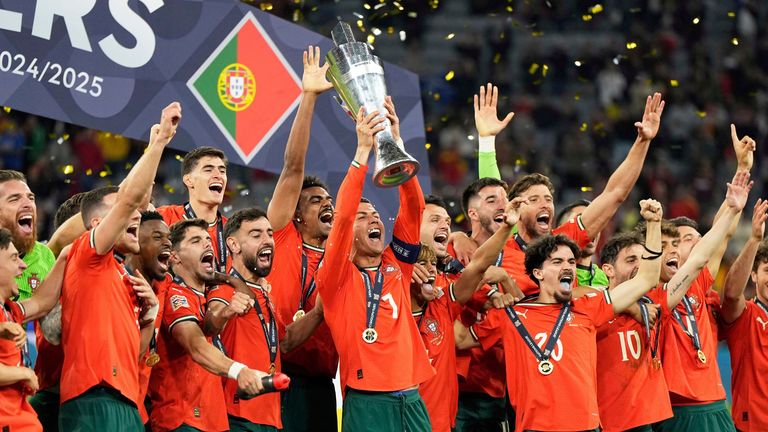
The UEFA Nations League is back for its fifth edition, with 54 European countries competing for silverware, promotion and a potentially crucial route to Euro 2028.
Portugal are the defending champions after beating Spain on penalties in the 2025 final, while England are looking to win the competition for the first time under Thomas Tuchel.
But there is more than a trophy at stake. Results can determine which division teams compete in during the next campaign, while performances could also have a significant impact on qualification for the European championship.
From how the format works to the promotion and relegation rules, here’s everything you need to know about the UEFA Nations League.
What is the UEFA Nations League?
The UEFA Nations League is an international competition involving Europe’s national teams, designed to replace many of the traditional international friendlies with competitive fixtures.
First introduced in 2018, the tournament gives nations the opportunity to compete against teams of a similar standard, with promotion, relegation and a trophy on offer.
The competition is divided into four leagues – A, B, C and D – with League A containing the highest-ranked nations.
Portugal are the most successful team in the competition, having won the title twice, in 2019 and 2025.
France and Spain have also lifted the trophy, in 2021 and 2023 respectively.
How does the Nations League work?
The 2026/27 Nations League features 54 nations divided into four leagues.
Leagues A, B and C each contain 16 teams, split into four groups of four. League D consists of six teams, divided into two groups of three.
Teams play each opponent in their group twice, home and away, with points determining the final standings.
Three points are awarded for a win and one for a draw.
The top two in each League A group qualify for the quarter-finals, while the winners of those ties progress to the Nations League Finals in June 2027.
The bottom sides and teams finishing in other promotion and relegation positions will face a different challenge, with their performances determining which league they compete in during the next edition.
How do promotion and relegation work?
Promotion and relegation are central to the Nations League, giving teams something to play for throughout the group stage, regardless of their position in the rankings.
The four group winners in League B will be promoted directly to League A, while the four group winners in League C will move up to League B.
Teams finishing bottom of their respective groups also face the prospect of dropping down a division.
However, the 2026/27 campaign features a slightly different system as UEFA prepares to change the competition format for 2028/29.
The two lowest-ranked fourth-placed teams in League A will be automatically relegated to League B.
The other teams involved in the League A/B promotion and relegation battle will contest play-offs.
These will involve the four runners-up from League B against the two lowest-ranked third-placed teams and the two highest-ranked fourth-placed teams from League A.
The winners will play in League A in 2028/29, with the defeated teams competing in League B.
A similar system operates between Leagues B and C, with the four bottom-placed teams in League B facing the four runners-up from League C.
The winners will play in League B in the next edition, while the defeated teams will drop into League C.
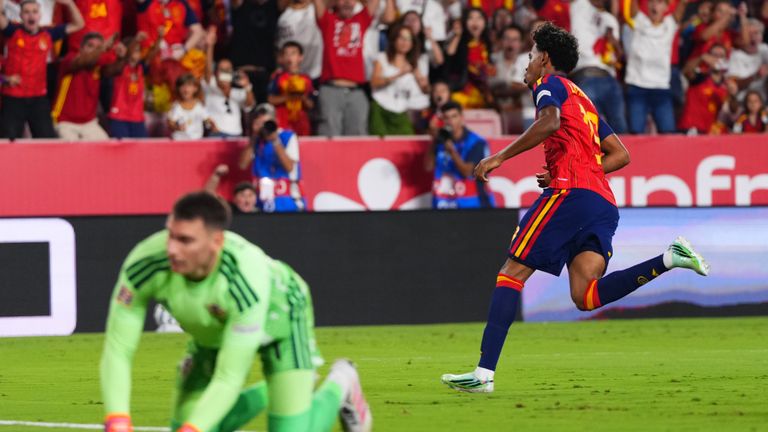
Spain’s Lamine Yamal celebrates after scoring his side’s opening goal during the Nations League match against Croatia
When are the 2026/27 Nations League finals?
The league phase runs from September to November 2026, with the final two rounds of group matches taking place during the November international break.
The League A quarter-finals, alongside the League A/B and League B/C promotion and relegation play-offs, will take place between March 25 and March 30, 2027.
The Nations League Finals will then be held between June 9 and June 13, 2027.
The tournament will feature two semi-finals, a third-place play-off and the final, with four nations competing to be crowned champions of Europe.
Where will the Nations League final be held?
The 2027 UEFA Nations League Finals will take place between June 9 and June 13, 2027.
The host nation and stadiums are yet to be confirmed by UEFA. The four teams that progress through the quarter-finals in March will compete for the trophy, with the semi-finals, third-place play-off and final deciding the champions.
When is the Nations League knockout stage draw?
The UEFA Nations League knockout stage and play-off draw will take place at 12:00 CET on Friday, November 20, 2026, following the conclusion of the league phase.
The draw will determine the quarter-final and promotion/relegation play-off ties, with teams from the same group unable to face each other in the quarter-finals.
The eight teams finishing in the top two of the four League A groups will progress to the quarter-finals, which will be played over two legs in March 2027.
The four winners will then advance to the Nations League Finals in June 2027, with the semi-finals, third-place play-off and final deciding the champions.
What about the Home Nations and the Republic of Ireland?
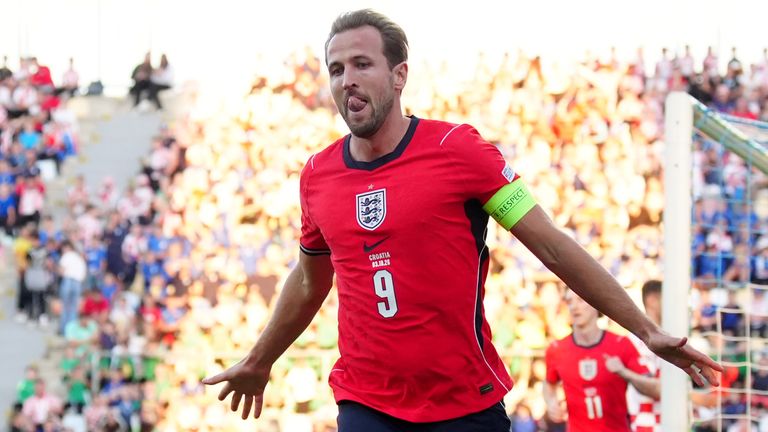
Harry Kane celebrates scoring for England against Croatia in the Nations League
The Nations League offers plenty of challenges for the five British and Irish nations, with England and Wales competing in League A, while Scotland, Northern Ireland and the Republic of Ireland are in League B.
England face Croatia and Spain, while Wales take on Norway and Portugal.
Scotland meet North Macedonia and Switzerland, Northern Ireland face Ukraine and Hungary, and the Republic of Ireland play Kosovo and Austria.
The results will determine who reaches the knockout stages, earns promotion or faces relegation.
What is changing in the Nations League from 2028/29?
The 2026/27 Nations League is the final edition to feature four divisions.
UEFA has approved a change to a three-league format for the 2028/29 competition, meaning League D will be scrapped.
All six teams currently competing in League D will automatically move up to League C.
The new structure will feature three leagues, each containing 18 teams split into three groups of six.
Teams will play six matches in the league phase, with the revised format designed to create a more streamlined competition.
The composition of each division will be determined by results in the 2026/27 Nations League.
League A will contain the eight quarter-finalists from the current edition, the two highest-ranked third-placed teams from League A, the four League B group winners and the four winners of the League A/B play-offs.
League B will include the two lowest-ranked fourth-placed teams from League A, the four defeated teams from the League A/B play-offs, the four third-placed teams from League B, the four League C group winners and the four winners of the League B/C play-offs.
League C will consist of the four defeated teams from the League B/C play-offs, the eight teams finishing third and fourth in League C, and the six teams currently in League D.
Does the Nations League affect Euro 2028 qualifying?
Yes.
The Nations League will play an important role in the qualification process for Euro 2028, which will be hosted by England, Scotland, Wales and the Republic of Ireland.
The final Nations League rankings will determine the seeding of nations for the European Championship qualifying draw.
The competition will also offer a potential second chance to reach the tournament through the play-offs.
Twenty-four teams will compete at Euro 2028. Twelve qualifying group winners and the eight best runners-up will secure automatic places, with the remaining runners-up entering the play-offs.
Nations League group winners who fail to finish in the top two of their Euro 2028 qualifying group will also be eligible for a play-off place.
Those places will initially be allocated to the best-ranked group winners from Leagues A, B and C. If additional places are required, they will filter down to the next-highest-ranked eligible teams.
The system means a strong Nations League campaign could prove decisive for countries who struggle in the traditional qualifying process.
Disclaimer : This story is auto aggregated by a computer programme and has not been created or edited by DOWNTHENEWS. Publisher: skynews.com