LONDON — In the legendary shopping district of Regent Street, the holiday lights are already ablaze, a host of illuminated angels spreading their sparkling wings above the passersby.
The sales and the Christmas wassailing have begun. On the telly, charities are asking for donations to bring the homeless off the streets into warmth and shelter.
All that was missing from festive London, that “good old city” in Charles Dickens’ words:
The humbug.
And on an early wintry wind, that absent element blew into town on Monday with the premiere of Johnny Depp’s big Hollywood return, as the 183-year-old miser Ebenezer Scrooge.
The premiere of “Ebenezer” in Leicester Square sent guests, stars and the film’s creative team walking down not an ordinary red carpet but through Paramount’s stylized version of a Victorian Christmastime street, with a sugaring of studio-effect snow and — déjà vu to the premieres of the “Pirates” franchise — worshipful fans massed against crowd barriers and straining for a glimpse of celebrities, principally Depp, who made his leisurely way along, obliging the clamor for selfies and signatures.
This was Depp’s first studio film in eight years (after his high-profile divorce from Amber Heard and the subsequent defamation trial), and Paramount splashed out to make it momentous, the finale to Depp’s earlier in-character appearances at Comic-Con in San Diego and in New York’s Bryant Park, where he did furious battle with a Christmas tree.
The first film version of “A Christmas Carol,” in 1901, was about six minutes long, and only half of it survives. Since then, we have had animated Scrooges, a Muppets-paired Scrooge, musical and theatrical and sadistic and parody Scrooges, sublime and ridiculous Scrooges (Patrick Stewart and Jim Carrey), George C. Scott’s Scrooge, almost as terrifying as the ghosts, and the best of all Scrooges, Alastair Sim, in the 1951 black-and-white film you’d have to bribe children to watch today.
Where is there room left to squeeze in another?
As “Ebenezer,” Depp makes his own room, a good deal of it. He puts fresh oxygen into those old lungs and new soul into that crabbed old heart. His is Jung’s Scrooge, a man whose Christmas ghosts are his own demons, buried year by year and layer by layer under his riches and his pride in his own avarice and parsimony, until they come forth and carry him off from his chilly bedroom on Christmas Eve. (There was a sprinkle of knowing giggles at the premiere when Scrooge imagines that he is being eaten by his own bed; more than a few people remembered Depp’s character being swallowed up by his own bed in his first movie, “A Nightmare on Elm Street.”)
Scrooge the literary character survives and revives as not only a man of Dickens’ time and place but as an archetype of our long and sketchy human history. Everyone knows a Scrooge. “Carol” has never been out of print, and has been translated into dozens of languages, some spoken by cultures without a tradition of a spiritual Christmas at all.
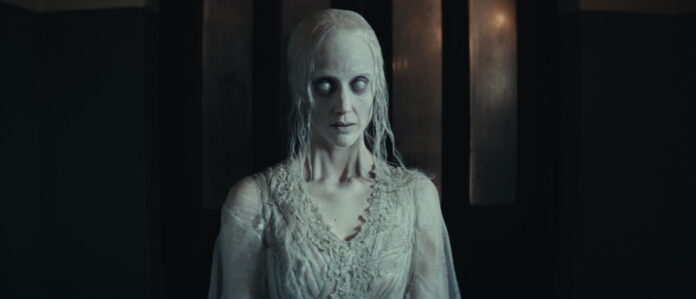
The book’s subtitle is “A Ghost Story of Christmas,” and director Ti West has knitted his horror-movie pedigree into “Ebenezer.” It earns its PG-13 rating with its ghosts worthy of the name — no namby-pamby, child-friendly ghouls here. Nor does West pull punches with his humans and their own casual cruelties. Scrooge is merely the worst of them, his money both enabling them and protecting him from them. The spirits tour Scrooge’s grim “butterfly effects” London with the man who’d pull the wings off butterflies if only to prove his indifference to them.
Andrea Riseborough plays Ghost of Christmas Past in “Ebenezer,” directed by Ti West (“Pearl”).
(Paramount Pictures)
Screenwriter Nathaniel Halpern takes a lot of frankly welcome liberties with Dickens’ canon. Otherwise, a by-the-book Scrooge film could have been, like the very first one, only six minutes long: greedy, greedy Scrooge, tsk tsk; Tiny Tim, so sad; ghost ghost ghost, oooh eeek; Christmas redemption miracle, God bless us, every one. Finis.
Instead, the film puts flesh on the bones of some characters who, in Dickens’ book, just pop in and out like straw men. The men “Ebenezer” rebukes as they come collecting for Christmas charity turn out to be gentlemen of some greed themselves.
And Dickens’ readers would have known exactly what Scrooge meant when he demanded to know whether the workhouses as well as Britain’s punitive poor laws and the notorious “Treadmill” were still operating, but modern readers would not.
So “Ebenezer” takes us to those wretched places to powerful effect. Dickens’ own father, his mother and some of his siblings had to spend a few months in a debtors’ prison over an unpaid bill to a baker, amounting to more than $4,000 today. Dickens pere got out only because his mother died and left him enough money to pay his debt. The ghostly glimpse of an alternate future for the Cratchit family, imprisoned and desolate, feels truer to Dickens than the glib sentimentality of Tiny Tim’s empty place at the family hearth.
It wouldn’t be a Depp film without his singular sense of humor, and here, Scrooge’s wit shows itself as childish, blowing raspberries, or insufferable in his Peter Pan “oh, the cleverness of me” arrogance. Scrooge does his lame best to joke and cajole his way out of his plight, and it’s when he tries to be witty and fails that the moment is at its pathetic funniest.

Johnny Depp plays Ebenezer Scrooge in “Ebenezer.”
(Jaap Buitendijk)
In the Trump age, it’s tempting to see Scrooge through a transactional filter: “I promise I will be more considerate and generous only if you promise not to let me die alone and unmourned, among people profiting from my death even though I have profited from the living.”
Not our boy Benny Scrooge. Depp takes him through the book’s calvary of the spirit, one ghost at a time, director West’s manipulation of the journey’s horror dragging us far into Scrooge’s nightmare epiphanies. Who has not awakened from a bad dream trying for those frightening moments to clear their heads and sort out what they dreamed versus what is real, or at least true?
The ending justly requires more of the audience than “A Christmas Carol” does, because it delivers more, much more than Scrooge’s bluff bonhomie and Tiny Tim’s death.
I found two historic newspaper reviews of “A Christmas Carol,” one on Christmas Eve 1843 and one the day after Christmas. London’s Morning Post didn’t much like it and said so, with snark: “Everyone has heard that there is but one step from the sublime to the ridiculous. This step Mr. Dickens annihilates, and serves up the two together …” Dickens’ “notions of Christian benevolence and sound national policy [are] inextricably involved with visions of bowls of punch … puddings … heaps of children, riotous in their mirth.”
“Though we do not like sound instruction to be mixed up with matter so exceedingly fantastical as that in which this ‘Christmas Carol’ abounds, yet we may hope that it may do some good, by encouraging generous and joyous feelings in those who will not seek them at a better source.”
The Sunday Dispatch delivered a kinder judgment of “a Christmas work, exceedingly amusing, and of the most beneficial tendency … [Dickens] wishes to show as practically as possible that the most permanent of human happiness is to be derived from our benevolent feeling toward others …”
Go ahead — try to call humbug on that. Just try.
More to Read
Disclaimer : This story is auto aggregated by a computer programme and has not been created or edited by DOWNTHENEWS. Publisher: latimes.com