Ulanqab, China — Off a major highway on the outskirts of Ulanqab, in the Chinese province of Inner Mongolia, Hereford cows roam through corn fields scouring the ground for any dried up remains of the recent harvest.
Hovering over the landscape are shiny new transmission towers linked by power cables that stretch along the plateau for as far as the eye can see. On the ridgeline, covered in snow, wind turbines spin, taking full advantage of the ever-blowing wind.
The energy pulsing from the remote Chinese region — a combination of renewables and fossil fuels — will soon power multi-story data centers being constructed on farmland as part of a sprawling AI data center construction boom.
The construction site is the size of a small American city. It is the biggest, and fastest growing infrastructure project anywhere in China right now.
This corner of Inner Mongolia was famous for generations for growing potatoes. Now, it’s fast becoming an AI hub, and Chinese officials hope the expansive, rugged landscape will help power the country’s ambition to surpass the U.S. as the global leader in artificial intelligence.
Baletu, a 72-year-old farmer, who has lived here for more than 40 years growing potatoes and corn, said the changes across his local landscape are positive.
“It doesn’t affect my farmland, not at all,” he told CBS News. “It’s good for the area.”
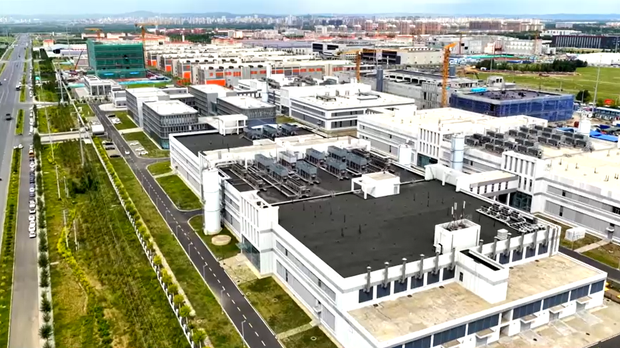
A short drive away, CBS News was able to see what all that wind power will soon be feeding. Trucks, cranes and thousands of workers are taking part in the construction project to create one of the biggest data centers anywhere in the world.
We drove miles down new roads with multistory data centers going up on either side. Even from the road it was easy to spot the countless racks that will hold servers, semi-conductor chips and cooling and exhaust fans.
There are dozens of data centers being built in Inner Mongolia, more than any other part of the vast nation. The reason they have chosen Ulanqab is because it offers cheap, abundant energy. Fossil fuels are still the main source of power here, but they also use renewables, including wind and solar.
Ulanqab is one of the most consistently windy locations in the province. The climate is also cold all year, which helps keep cooling costs down, and land and labor are more affordable in the remote region.
CCTV/Reuters 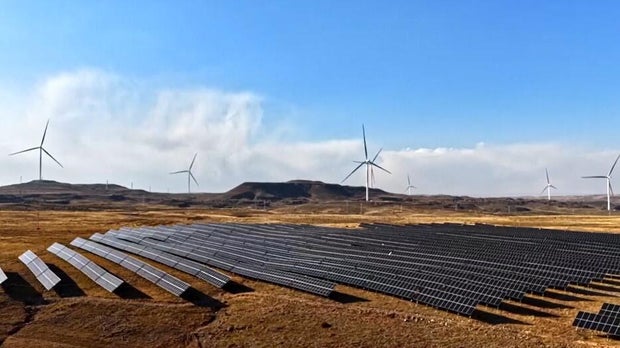
Experts cited by the Financial Times say data centers in China are built at about one-fifth of the costs incurred in the U.S., not least due to the much higher land and labor costs.
As many as 30,000 workers have been brought in from across China to help build the AI hub, and in a country experiencing an economic downturn and high youth unemployment, these mass infrastructure projects are very much welcome.
“Development is the best thing, especially when it provides job opportunities for many young people,” a local businesswoman who sets up a lunchtime food stall outside the construction site told CBS News.
While data centers in the U.S. face major community opposition, which could be emboldened by the “blue wave” of the Democrats’ stunning midterm election performance, there are few hurdles for Chinese developers.
While China’s government doesn’t generally tolerate protests of any kind, and it tightly controls messaging across all media, a United Nations survey last year found that as many as 80% of people in the country support data center construction. At least two-thirds of Chinese people use AI in their day-to-day life, as many embrace the technology and the infrastructure behind it.
Under President Xi Jinping, AI development has become a national strategic priority for China.
“There is no opposition to data centers in China. It’s never heard of, whereas in the U.S., it has become a huge movement against data center building in neighborhoods,” Henry Wang, founder and president of the Center For China and Globalization, told CBS News.
Huawei, Alibaba, Byte Dance, Deepseek, Baidu, Z.ai, ZData and VNET — China’s biggest AI companies — are all active in Inner Mongolia. In areas where construction has finished, fences are up and grounds are landscaped, and avenues through the humming data centers have been named after the AI tech giants.
While Chinese firms’ AI models are believed to be about six months behind their U.S. competitors, due largely to restrictions on the sale of high-end microchips, the gap is narrowing.
China has more than double the power generation capacity of the U.S., and some experts believe access to power, not chips, will ultimately be the deciding factor in the global race for AI dominance.
“Chips may not become the latest diving criteria,” said Wang. “It may be that power is the bottleneck, and whoever goes through that first gets the advantage. And right now. China has the edge.”
Disclaimer : This story is auto aggregated by a computer programme and has not been created or edited by DOWNTHENEWS. Publisher: cbsnews.com