In July 2005, just three months after Stephan Bonnar and Forrest Griffin helped commandeer some public interest in MMA with a slobber knocker for the ages at the original “Ultimate Fighter” finale, Frankie Edgar showed up in the South Bronx with a few butterflies in his stomach. At the stiflingly hot Jerome Boxing Club on Westchester Avenue, Edgar came in for a fight with a New York kid named Eric Uresk in what would go down as an unsanctioned, unofficial pro debut.
The fight would take place on a Sunday.
Advertisement
Edgar, who was 23 years old at the time with a solid wrestling background from his time at Clarion University of Pennsylvania, had to be back home to Toms River, New Jersey, to work on Monday morning. He was a plumber by trade, without the foggiest idea that in less than five years he’d be a UFC champion.
“I was training for three weeks, and I said, ‘All right, yeah, I’ll fight,'” he says. “I did not know my opponent, and all I knew was that we were doing one 20-minute round or one 15-minute round, something like that.”
MMA was illegal in the state of New York, but there were secret shows to be found throughout the city if one was willing to look. Underground fights. Unsanctioned gatherings that looked like something straight out of the imagination of Chuck Palahniuk, not quite with naked light bulbs hanging from damp ceilings, but with plenty of shadowy faces. The fights could be brutal. One kid lost his front teeth after getting sucker-punched during the touching of gloves earlier in the night, which functioned as a lesson for everyone.
Keep your hands up at all times and trust nothing.
Advertisement
“I mean, I didn’t weigh in, and I wore the same gloves that I’d been training in all week,” Edgar says. “They were still wet. I ended up being the main event, and the dude was from New York. I think he had a few fights, or the story was he was going to be a UFC guy eventually. We went after it, and I took some pretty big knees in the first sequence.”
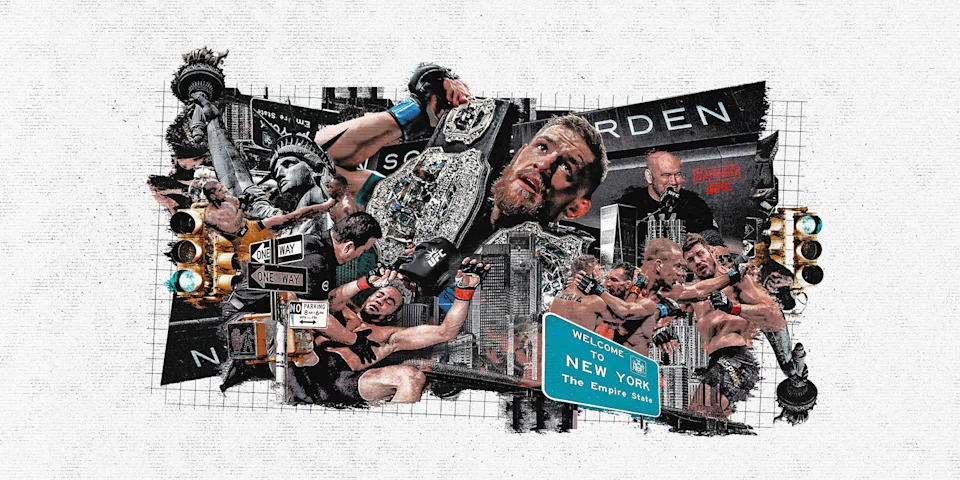
(Joseph Raines/Yahoo Sports illustration)
Those shots occurred in the clinch. Uresk drove a couple of knees right into Edgar’s face, which might’ve been enough to put away lesser fighters. This was the first real glimpse of Edgar’s heart, though. He took the shots, survived, then turned the fight around in his favor as the blood poured out of his nostrils.
“I think in two and a half minutes, I stopped him with a TKO, but I didn’t realize until after I left at the damage,” he says. “We went to the Portuguese restaurants in Newark to eat, and I went to the bathroom, I blew my nose. My whole face filled up with air, because I broke my orbital bone.”
Advertisement
That night Edgar was the main event because he’d sold the most tickets of anyone on the card. He made $160 for hawking 16 tickets at 10 bucks apiece to people he knew, all of whom made up his rooting section in the Bronx. His father was there, and he can be seen holding the ropes for Frankie in the footage that now lives online.
“My wife and my mother actually were there, too, they were flipping out,” he says. It was 90 degrees inside Jerome’s joint that day.
Thinking back on it, Edgar laughs at the memory of his face blowing up for the drive back to Toms River.
“That fight was in a ring, just like my fights early on,” he says. “The first time I stepped foot in a cage was my first fight in UFC. That was the first time I’d ever been in a cage.”
Advertisement
And the cage itself — that UFC’s world-famous Octagon — wouldn’t be allowed legally in the state of New York for another 11 years, some six years after Edgar emerged as an undersized champion with an oversized heart. When he finally fought in New York again, at UFC 205 in 2016, 10 years ago this month, he was 35 years old and well into his back nine.
New York was the last state to sanction a sport that returns Saturday as a multi-billion-dollar company with UFC 334, featuring the kind of event for which Madison Square Garden is renowned.
That is, a heavyweight title fight.
Hard to believe it’s been a full decade ago that UFC 205 arrived at the hallowed grounds. It’s harder to believe it took so long for the UFC to get there in the first place.
The long journey
When the UFC made it to New York in the fall of 2016, it felt like the last of the original taboos had finally been overcome. There was the infamous story of UFC 12: Judgment Day being moved at the literal 11th hour from Buffalo to Dothan, Alabama, in 1997, after then-Gov. George Pataki banned cagefighting the day before it was to take place. It was one of the lowest (yet most resilient) moments for the company, the Semaphore Entertainment Group, which chartered flights out of the Niagara Falls area in the middle of the night and trucked down the Octagon to roll with the punches.
Advertisement
Nearly two decades later, that ban hadn’t been lifted despite the UFC functioning as a $4 billion dollar business, which had legitimate superstars in Ronda Rousey and Conor McGregor, a major television partner with Fox, an apparel deal with Reebok (to the chagrin of many) and a rabid, ever-expanding global fanbase.
It was a functioning absurdity, of course.
It was all because New York State Assembly Speaker Sheldon Silver, a democrat who’d held ultimate sway in New York’s legislature for nearly four decades, kept refusing to allow the bill to legalize MMA to reach the floor for a vote. Silver had strong political ties to Culinary Local 226, a Nevada-based union with over 60,000 members and a vendetta against Station Casinos, which were owned by Lorenzo and Frank Fertitta, who also owned the UFC.
Beginning in 2007, the UFC began lobbying to legalize the sport in New York with annual trips to Albany.
Advertisement
Marc Ratner, the UFC’s vice president of regulatory affairs, personally traveled some 29 times to the state capital to make the case for MMA’s legalization, “usually,” as he recounts the seemingly futile exercise, “in the winter.”
“The frustrating part more than anything was that it had nothing to do with the sport,” Ratner told Uncrowned this week. “And as all know, it was a culinary union here and the hotel workers union in New York. And until the speaker was replaced, we couldn’t get a vote. We’d go all through all these different committees in the Senate and pass every time. And we’d get to the assembly and the speaker would say, ‘You don’t have enough votes.’ We never had a vote. And then after [Silver] left, the next year we had the vote and that’s when it was so overwhelming in our favor.”
Silver “leaving” was its own controversy … or its own poetic justice, depending on how you want to look at it. After being arrested in 2015 on corruption charges for accepting bribes and kickbacks, he resigned before doing a stint in federal prison. That was music to the UFC’s ears, and the lyrics were belting out loud and clear.
“Start spreading the news …”
Advertisement
“I would say I never thought it was a slam dunk [even after Silver left], but I was very confident,” Ratner says. “Because we’d gone through all these committees and different assembly people always told us they would support it, but they never had a chance to vote. So, I was confident, absolutely, but never overconfident.”
The New York Assembly passed the bill 113-25, and in April 2016, then-Gov. Andrew Cuomo signed the legalization bill into law at the UFC’s ultimate destination: Madison Square Garden.
The arena where “The Fight of the Century” took place between Muhammad Ali and Joe Frazier in 1971, and where Ratner sat ringside to watch Lennox Lewis battle Evander Holyfield in 1999. That was the Mecca where the UFC finally arrived, exactly 23 years after UFC 1 went down in Denver. UFC 205 would feature a historic bout between featherweight champion Conor McGregor and defending lightweight champion Eddie Alvarez.
It was the beginning of an era, the continuation of something long in place, and the end of an era all at once. Because though it was the zenith of “Mystic Mac” in the UFC, as he won his second division title by knocking out Alvarez in one of the most celebrated fights in UFC history, he’d never be the same inside the Octagon.
Advertisement
Still, what a party it was at 4 Pennsylvania Plaza that night. Three title bouts, with Stephen “Wonderboy” Thompson fighting welterweight champ Tyron Woodley to a draw, and Joanna Jędrzejczyk defending the women’s strawweight title against Karolina Kowalkiewicz.
New York’s Chris Weidman was on the card, some three years after he had a day named after him on Long Island for dethroning Anderson Silva. Khabib Nurmagomedov was on the prelims fighting Michael Johnson, and Jim Miller, in just his 25th UFC fight, outpointed Thiago Alves. This weekend he makes the walk for the 48th time.
There were celebrities, too. Madonna was there, Gordon Ramsay, Robert Craft and Triple H. Donald Trump Jr. was cageside, though his pops couldn’t be because he’d only been elected president four days earlier.
And of course, Edgar was there. His first time fighting in New York since that first fight of his in the Bronx. He beat Jeremy Stephens on the scorecards to close out the prelims.
Advertisement
“I definitely advocated for it,” Edgar says. “I thought it would’ve got legalized much sooner than it did. I thought, maybe it’s not going to happen here with the bureaucrats involved and how that goes. But yeah, when it happened, it was super cool. I’m glad that they gave me a spot on that card. I think I would’ve been pissed if they didn’t.”
It was 10 years ago that it happened, and now the annual November trips to Madison Square Garden have become one of the UFC’s biggest staples, and one that isn’t taken for granted.
“It was more than me [that worked on getting into New York],” Ratner says. “There were other people involved for our company. I always want to say that; you have to have a lobbyist. And his name was David Weinraub and associates. Because you just can’t walk into any assemblyman or senator’s office. Without them, it would’ve been really, really impossible.
“But our sales pitch through the years was always the same. This is a sport. It needs to be regulated. You have a wonderful commission here and you’re losing revenue. It’s on public TV, it’s on pay-per-view. Everybody can watch it here, so what’s holding you up? That was really most of my pitch.”
Advertisement
UFC 205 did nearly an $18 million gate, which at the time shattered the UFC’s all-time gate record. It was a vicarious thrill for the Fertitta brothers. By the time it took place, Zuffa had already sold the UFC to WME-IMG (later known as Endeavor) for $4.2 billion.
As wild as it seems, the UFC never did a show in New York during the Zuffa era, even though it was Zuffa that busted down the doors.
A legacy is forged
Over the years there have been memorable fights at MSG, the kinds of fights that make you forget that it used to be a forbidden fortress. At UFC 217, Georges St-Pierre won his second title by beating middleweight champion Michael Bisping, though that fight almost took a backseat to Rose Namajunas’s stunning upset of Jędrzejczyk that same night. It was where Jorge Masvidal beat Nate Diaz in the first ever BMF title fight at UFC 244, with the Rock wrapping the accessory around Masvidal’s waist.
Advertisement
MSG is where Alex Pereira beat Israel Adesanya to take the middleweight title, and where Jon Jones fought for the last time against Stipe Miocic. It’s where Islam Makhachev won his second title by dominating welterweight champion Jack Della Maddalena last year at UFC 322.
And it’s where Josh Hokit, the UFC’s bandana-wearing firebrand, will show up to face Ciryl Gane on Saturday night, to the same stage that the original bandana-wearing icon did it at WrestleMania I over 40 years ago. In 1985, Hulk Hogan and Mr. T took out Paul Orndorff and “Rowdy” Roddy Piper. From the Hulk to the “Incredible Hok,” there’s a lot of history in those MSG halls.
It took the UFC a long time to get invited to the party. Before it did, to watch live MMA in New York you had to catch it on television or at the underground shows nestled away in one of the boroughs or across the river in New Jersey. That smoker that Edgar fought at in 2005 feels like a million years ago.
Yet UFC 205 feels like yesterday for those who’d waited so long to see the UFC in New York.
Advertisement
“I remember very vividly going to the weigh-ins, and the Garden was packed,” Ratner says. “That next night, it was such just an unbelievable moment, maybe for me personally as much as anybody, because I had went through so much stuff. To look around, to realize we’re at MSG. And then when Conor first came into the cage, and the crowd got so excited … it’s just a wonderful memory.
“It was a culmination of all the time we put in.”
Disclaimer : This story is auto aggregated by a computer programme and has not been created or edited by DOWNTHENEWS. Publisher: Sports.yahoo.com