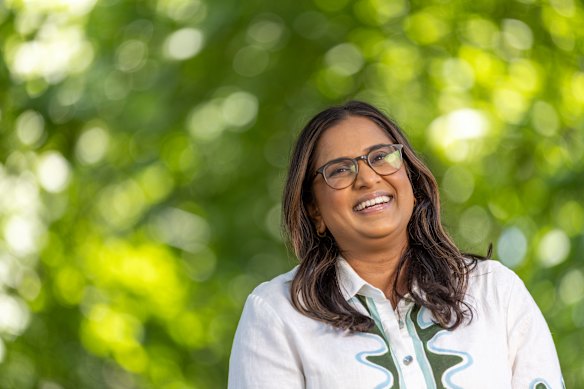
Kylie worked in coal, gas and mining. Now she’s running for the Greens
By her own admission, Greens candidate Kylie Rocha has worked in all the “bad things”.
Raised in Wheelers Hill, the self-described “maths and science nerd” studied mechanical engineering and economics at university before landing a job at one of Australia’s dirtiest power stations in Yallourn.
She has also had a stint in mining, worked on gas projects and spent time at other coal-fired power stations.
Now she’s trying her hand at politics. In this month’s state election, Rocha is standing in Hawthorn for the Greens, the party that is campaigning to phase out the fossil fuel industries where she cut her teeth.
Rocha doesn’t have any regrets, insisting her experience in the fossil fuel industry only strengthened her conviction that Australia needs an energy transition that supports workers and their communities.
After graduating from Monash University in 2008, Rocha entered the workforce as Kevin Rudd’s government was promising to tackle climate change.
“At that point I was naïve about politics. I thought the politicians would sort it out,” Rocha told The Age at a cafe in Glenferrie Road.
“It [Yallourn] was a great place to work for me as an engineer out of university … all of the things you learn at university at the one place.
“I loved it there.”
Rocha’s political awakening came almost a decade later, when she was headhunted by Tesla and moved to California. Working on automated systems controlling Tesla robots that build Elon Musk’s electric vehicles, she said she finally felt like she could use “her skills for good”.
Living in San Jose, she found herself at the centre of the clean energy transition. At the same time, Donald Trump’s polarising presidency was in its infancy.
“They were so much further ahead, there were charging stations and infrastructure and solar panels everywhere,” she said.
“You start asking questions like, why are we so far behind in Australia? What’s holding us back?
“When I came back I wanted to answer that question fully.”
Struck by wealth inequality and privatised healthcare in California, as well as Australia’s comparatively sluggish uptake of renewables, Rocha began searching for her “political home” back in Melbourne.
By 2019, she was inspired to join the Greens, attracted to the party by its refusal to accept corporate donations.
At the last state election, the Greens received 11 per cent of the primary vote. The latest Resolve Political Monitor surveys suggest that this time around, the Greens are on track to land a primary vote between 13 and 15 per cent.
Rocha is campaigning on rent controls, free public transport and returning energy infrastructure to public ownership. And she supports the planned closure of the Yallourn coal-fired power station in 2028.
“For me, the climate transition isn’t just a technical thing, it’s a people thing,” she said.
“We need to look at what places like the Latrobe Valley have provided the people of Victoria for so many years and is so crucial to where this state is. That strong, stable supply has been crucial to what we have been able to achieve.
“I think we have to recognise that and support people as we transition.”
While she doesn’t support opening up any more coal and gas mines, she doesn’t describe herself as “anti-mining” and insists critical minerals – such as lithium, nickel, cobalt – are essential to the clean energy transition.
“We need critical minerals,” she said. “I think we need to be honest about that.”
She said the Greens wanted mining companies to take more responsibility for the environmental impacts and minimise damage done to the land.
“I think with mining … we need to work with traditional owners, local groups to see if it is the correct place … but let’s talk about a local industry that can support Australian growth, productivity and supply the critical minerals we need to transition.”
“I know what it’s like to live near large industrial sites like mines and power stations, and proper environmental controls are required and should be as stringent as possible to protect residents and our precious natural environment.”
The social media app that could hold major voter sway in Ringwood
When Asian supermarket owner Hugh Do heard reports that a Vietnamese grocer had been fatally bashed in Sunshine, his first thought was: “That could be me.”
Then he realised he knew the victim. Van Viet Truong had arrived in Melbourne around the same time and set up his business around the same time as Do’s dad.
Speaking in his family’s shop in the heart of Ringwood, between serving customers and helping unload deliveries out the back, Do – a second-generation Chinese-Vietnamese Australian – tells me he feels increasingly on edge.
These candidates want to represent the west – without living in their electorate
Despite running for the seat of Sydenham, in Melbourne’s western suburbs, Liberal candidate Nathalie Moussi can’t call herself a local.
In fact, she owns a house in Torquay just minutes from the beach and says she splits her time between that property and another in Melbourne that’s outside the Sydenham boundary.
If she wins on election night, then she’ll move, she says.
‘You sweating?’ In Shepparton, One Nation and the Nationals face a community grilling
“You sweating?” Cecelia Cooper, the co-moderator of a multicultural candidate forum for Shepparton voters, asks Nationals candidate Shane Sali.
“Go easy on me Cecelia,” Sali says. “Never,” Cooper responds.
They’re both smiling, and some of the voters at the Door Bells – Migrant Women’s Network forum on Tuesday night with them, laugh too.
It’s a prelude to one of the first questions that opens the event, and sets the tone for the night.
Dumped, demoted and nearly bankrupted: Why Pesutto keeps coming back for more
If John Pesutto’s relationship with the Liberal Party was a romance, his friends would have staged an intervention years ago.
Over the course of their courtship, which began more than 30 years ago, the former opposition leader has been rejected, dumped and left with a multi-million dollar legal bill.
But the 56-year-old remains devoted to the party, convinced that this time it might be different.
How many followers does it take to fill a pothole? This electorate just found out
A notorious pothole in Melbourne’s east has been filled overnight after becoming a social media star in the run-up to the state election.
Sitting at the intersection of Mahoneys and Canterbury roads in Forest Hill and straddling the electorates of Glen Waverley and Ringwood, the pothole had been there since at least December, according to Google Street View images. Liberal candidate for Ringwood Nick McGowan says it dated back to at least mid-2025.
One local resident, whose identity The Age has not been able to confirm, created an Instagram page drawing attention to the problem on November 1, with the bio “just a pothole living my best life”. Since then, the account has gathered more than 550 followers and posted daily updates on the gaping hole.
‘Orange is the new black’: In Sydenham, race is very much on the ballot
About three-quarters of the way through her campaign stop in Deer Park last Monday, after she had railed against state debt, working from home laws and trans women playing sport, Pauline Hanson took some questions from the floor.
Taking unvetted questions from voters is always a risk, even at an event for One Nation faithful. But for Hanson, authenticity and vulnerability isn’t optional, it’s the entire brand.
Locals asked the One Nation leader about the greatest risk to Australia’s way of life (Islam, socialism, Marxism, “in that order”), crime, and Christian churches being converted to mosques.
Ousted Labor MP Will Fowles set to run again in new electorate
Less than three months on from delivering an emotional valedictory speech to the Victorian parliament, following what can only be described as a messy two terms in the lower house, outgoing Ringwood MP Will Fowles is gearing up to have another crack.
The 48-year-old’s name quietly appeared on the Victorian Electoral Commission website on Monday, where he is listed as one of 11 people running in the Melbourne seat of Preston.
When asked about the move to Preston on Monday, Fowles said he saw the November 28 election more as an advocacy opportunity, and felt there was “no greater symbol of government inaction on housing than the decade-long failure to deliver new homes at Preston market”.
How One Nation’s win in Farrer sounded the alarm in Shepparton
It was just six months ago in the regional electorate of Farrer that voters resoundingly chose David Farley to be their next elected official in Canberra and, in the process, delivered One Nation its first lower house federal MP.
Triggered by the resignation of former federal opposition leader Sussan Ley, the byelection result in Farrer not only broke 77 years of Coalition safety in the seat, but also sent an ominous warning to regional electorates across the border preparing for this month’s state election and staring down challengers from the populist minor party.
Taking in Albury, Griffith and Deniliquin, the expansive rural electorate of Farrer covers 126,563 square kilometres in the south-west corner of NSW. At its most southern point is the Murray River, where on the other side of the water sits the state electorate of Shepparton – an area that cuts plenty of similarities with Farrer.
From Pauline Hanson to John Pesutto, the election is already packing a punch
Last week, we heard from voters in Sydenham, a once safe Labor seat that formed part of the “red wall” of outer-suburban Melbourne electorates.
After years leaning left, voters told investigative reporter Liam Mannix that they feel increasingly ignored by the government, with infrastructure, roads and hospital wait times proving to be major issues.
In Ringwood, another seat currently held by Labor, the attack from the Liberals and a number of minor party and independent candidates is well and truly under way.
Reporter Bridget McArthur last week took us inside a lively candidate’s forum where the Family First candidate for the seat was sidelined by a colleague who insisted he speak on her behalf. We also heard from locals that some of the main concerns going into this election are potholes, affordable housing and crime.
Disclaimer : This story is auto aggregated by a computer programme and has not been created or edited by DOWNTHENEWS. Publisher: www.smh.com.au