TEHRAN – Beyond the celebrated destinations such as Isfahan, Shiraz and Persepolis lies another side of Iran, one of mountain fortresses, ancient rock carvings, little-explored archaeological sites, colorful islands and remote desert villages, to name a few, where traditional ways of life endure.
Stretching from the Caspian Sea to the Persian Gulf and from the Zagros Mountains to the central deserts, Iran boasts an extraordinary diversity of landscapes and cultural heritage, much of which remains outside conventional tourist itineraries.
For travelers willing to venture beyond the familiar routes, such lesser-known destinations offer a different perspective on Iran, revealing a country whose historical depth and natural diversity extend far beyond its best-known attractions.
Here is a selection of nine places worth discovering:
Alamut Valley: Castles in the heart of the Alborz
Set amid the rugged Alborz Mountains in northern Iran, Alamut Valley is a landscape of steep cliffs, green valleys, traditional villages and medieval fortifications. Its most famous landmark, Alamut Castle, which along with a satellite of other associated ruins, is now a UNESCO World Heritage site, occupies a dramatic rocky outcrop overlooking the surrounding terrain.
The fortress is closely associated with Hasan-i Sabbah, the leader of the Nizari Ismaili community who established his stronghold there in the late 11th century. Alamut subsequently became an important political and intellectual center of the Ismaili state and is often linked in historical accounts to the group known in Western sources as the Assassins.
The remains of the castle offer a glimpse into a turbulent chapter of medieval Iranian history, while the surrounding valley has attractions of its own. Numerous ruined fortresses are scattered across the region, reflecting the strategic importance of its mountainous terrain.
Alamut is also a rewarding destination for outdoor enthusiasts. Hiking routes pass through mountain villages and highland landscapes, with some longer trails connecting the interior valleys to the Caspian-facing slopes of the Alborz range.
Reaching the castle involves a scenic but winding journey from Qazvin, followed by a challenging uphill walk. The combination of history, mountain scenery and rural life makes Alamut an appealing destination for travelers seeking something beyond Iran’s major urban attractions.
Qara Kelisa: An ancient Christian sanctuary
In the mountainous countryside of West Azarbaijan province, near Chaldoran, stands Qara Kelisa, also known as the Monastery of Saint Thaddeus. Recognized as a UNESCO World Heritage property as part of the Armenian Monastic Ensembles of Iran, it is among the country’s most significant Christian monuments.
The monastery is traditionally associated with Saint Thaddeus, one of the apostles believed to have brought Christianity to the region during the first century. According to Armenian Christian tradition, Thaddeus was martyred in the area, and the monastery developed as an important pilgrimage destination.
Its architecture reflects centuries of construction, reconstruction and artistic development. Particularly striking is the contrast between its dark stone sections and lighter masonry, which explains its Turkish-derived name, meaning Black Church.
Beyond its architectural significance, Qara Kelisa remains an important center of Armenian religious heritage. Every year, Armenian pilgrims gather there for ceremonies commemorating Saint Thaddeus, maintaining a tradition that connects contemporary communities with the region’s ancient Christian history.
Its remote location, surrounded by mountains and open countryside, adds to its appeal. A visit offers a chance to explore an important dimension of Iran’s religious and cultural diversity.
Shapur Cave: A monumental Sasanian sculpture
Hidden in the mountains near Bishapur in Fars province, Shapur Cave is one of the more remarkable archaeological attractions of southwestern Iran.
Located in Tang-e Chogan, the cave is best known for its monumental statue of Shapur I, the Sasanian ruler who reigned from 240 CE to 270 and expanded the empire’s influence across much of the region.
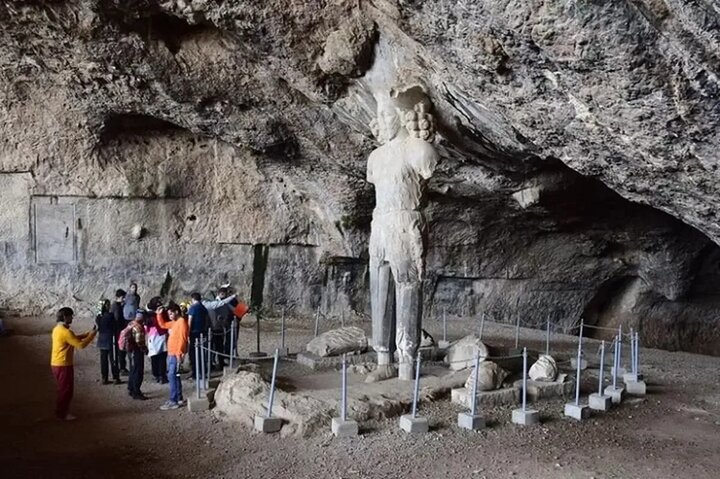
Carved from a natural limestone formation at the cave entrance, the statue stands approximately seven meters high. Its imposing figure, distinctive crown and elaborate hairstyle reflect the artistic traditions and royal imagery of the Sasanian period.
A view of Shapur Cave, southern Iran
Although parts of the sculpture have suffered damage over the centuries, it remains an extraordinary example of monumental rock sculpture from ancient Iran.
The cave itself is part of a wider historical landscape that includes Bishapur, a Sasanian city founded under Shapur I, and the rock reliefs of Tang-e Chogan, which depict royal victories and ceremonies.
Visitors can reach the cave from Bishapur, followed by a hike through the mountainous terrain. The uphill journey requires reasonable fitness, but the opportunity to encounter such a monumental ancient sculpture in its original natural setting makes it a memorable experience.
Kurangun: An ancient Elamite ritual landscape
For travelers fascinated by prehistoric and ancient civilizations, Kurangun in Fars province offers a remarkable encounter with one of Iran’s lesser-known archaeological treasures.
Located near Nurabad in Mamasani county, the Kurangun rock relief is carved into a cliff overlooking the Fahliyan River. Generally dated to the second millennium BC, it is attributed to the Elamite civilization, which flourished across southwestern Iran long before the rise of the Achaemenid Empire.
The central scene depicts divine figures seated on a throne, accompanied by rows of worshippers. Some of the figures wear distinctive horned headdresses, while the composition incorporates symbols associated with ancient religious beliefs.
One particularly striking element is the representation of flowing water, traditionally interpreted as a reference to a life-giving divine force.
The relief provides valuable evidence of Elamite religious practices, artistic traditions and cultural connections with neighboring civilizations in Mesopotamia.
Unlike the more frequently visited archaeological sites around Persepolis, Kurangun receives relatively little tourist attention. Its location above a river valley and its impressive antiquity make it an especially rewarding destination for those interested in the early civilizations of the Iranian plateau.
Babak Castle: A mountain fortress with a powerful legacy
High above the forests and mountains near Kaleybar in East Azarbaijan province, Babak Castle stands as one of northwestern Iran’s most striking historical fortifications.
Perched on a steep mountain ridge, the fortress is associated with Babak Khorramdin, a prominent leader of the Khorramdinan movement who resisted Abbasid rule during the ninth century.
Babak’s rebellion lasted for more than two decades and became an important episode in the history of resistance to the Abbasid Caliphate. His stronghold in the mountainous region offered a strategic defensive position, making it difficult for opposing forces to approach.
Although the fortress is associated with Babak, archaeological evidence and architectural studies suggest that its origins may extend to the Sasanian period, with subsequent occupation and modification.
Today, the castle attracts visitors not only for its historical associations but also for its spectacular setting. Reaching the ruins requires a demanding climb along a mountain trail, but the views across the surrounding forests and highlands make the effort worthwhile.
For travelers interested in history and hiking, Babak Castle offers an opportunity to combine both in one of Iran’s most scenic northwestern regions.
Izeh: A forgotten center of Elamite heritage
In Khuzestan province, the city of Izeh offers an extraordinary concentration of archaeological remains associated with the ancient Elamite civilization.
Often overlooked by visitors travelling to southwestern Iran, the region preserves rock reliefs, inscriptions and archaeological sites that provide important insights into a civilization that flourished thousands of years ago.
One of its most significant attractions is Eshkaft-e Salman, also known as the Tarisha sanctuary. The site contains four rock reliefs, two inside a natural cave and two outside it, alongside an important Elamite cuneiform inscription.
Dating to the late second millennium BC, the carvings depict religious and ceremonial scenes. Among their notable features is the representation of a royal woman standing alongside a male figure, offering valuable evidence of women’s presence in royal and religious settings in ancient Elam.
The sanctuary’s setting, with its natural rock formations and mountain surroundings, adds to its archaeological significance.
Izeh is also an excellent starting point for exploring other Elamite monuments scattered throughout the region, making it a worthwhile destination for travelers interested in the ancient history of southwestern Iran.
Gonbad-e Kavus: A masterpiece of medieval brick architecture
In Golestan province, northeastern Iran, the historic city of Gonbad-e Kavus preserves one of the most impressive examples of early Islamic architecture in the country.
Its landmark, the Gonbad-e Qabus Tower, is a UNESCO World Heritage property and among the tallest historic brick towers in the world.
Completed in 1006 during the reign of Qabus ibn Voshmgir of the Ziyarid dynasty, the structure rises approximately 53 meters above its foundations. Its cylindrical brick body is crowned by a distinctive conical roof, creating an elegant silhouette visible from a considerable distance.
The tower is notable not only for its height but also for its sophisticated engineering and geometric design. Constructed entirely of brick, it demonstrates the architectural achievements of Iranian builders during the early Islamic centuries.
Although commonly believed to have served as a tomb, its precise original function remains a subject of historical discussion.
The monument also recalls the importance of the ancient city of Gorgan and its connections with trade routes linking Central Asia and the Iranian plateau.
For visitors, Gonbad-e Kavus provides an opportunity to explore a remarkable architectural landmark away from Iran’s better-known historical circuits.
Hormuz Island: A geological wonder in the Persian Gulf
Off the southern coast of Iran, Hormuz Island is a destination unlike almost anywhere else in the country.
Located in the Persian Gulf near Bandar Abbas, the small island is famous for its extraordinary geological formations, colorful soil and unusual coastal landscapes.
Often described as a natural geological museum, Hormuz features hills and cliffs displaying striking shades of red, orange, yellow and ochre. Its mineral-rich terrain has created a landscape that can appear almost otherworldly, particularly around its salt formations and caves.
Among its best-known attractions is the Valley of Statues, where wind and erosion have shaped rocks into unusual forms resembling animals and other figures. The island also has salt caves, dramatic coastal cliffs and beaches with distinctive colored sands.
One of its most recognizable sights is the Red Beach, where iron-rich soil gives the shoreline and surrounding landscape a vivid reddish appearance.
Hormuz has also become increasingly popular among Iranian independent travelers and backpackers, attracted by its relaxed atmosphere, local culture and distinctive natural environment.
However, its fragile ecosystem deserves careful treatment. Visitors should avoid removing colored soil or disturbing the island’s geological formations, which are part of its natural heritage.
Mesr Desert: Silence beneath a spectacular night sky
For those seeking solitude and the beauty of Iran’s desert landscapes, Mesr village in Isfahan province offers an unforgettable experience.
Situated in the Dasht-e Kavir region, the small settlement is surrounded by extensive sand dunes and open desert terrain. Its traditional architecture and peaceful atmosphere provide a striking contrast to the busy urban centers of the country.
Mesr has become a popular destination for domestic and international travelers interested in desert experiences. Activities include walking across sand dunes, camel riding, off-road excursions and exploring the surrounding desert landscape.
Yet the real attraction often comes after sunset. Away from major sources of artificial light, the desert offers impressive opportunities for stargazing, with clear nights revealing an expansive sky filled with stars.
The village has also developed a range of traditional guesthouses and eco-lodges, allowing visitors to experience rural hospitality while exploring the surrounding environment.
For travelers wishing to understand the quieter side of Iran, Mesr offers something increasingly difficult to find in modern life: open horizons, silence and a close connection with nature.
Golestan National Park: A refuge for Iran’s wildlife
In northeastern Iran, Golestan National Park protects one of the country’s most diverse natural landscapes.
Established in 1957 as a protected area and later designated a national park, it is recognized as Iran’s oldest national park. The protected territory encompasses forests, grasslands, mountainous terrain and river valleys, supporting an impressive variety of wildlife.
Among its inhabitants are brown bears, wild boar, gazelles, red deer, ibex, jackals and the elusive Persian leopard. The latter is one of the region’s most significant large predators and an important symbol of Iran’s wildlife heritage.
The park’s ecological diversity is partly due to its geographical position between the Caspian region and the drier landscapes of northeastern Iran. This transition creates a variety of habitats within a relatively compact area.
Beyond its wildlife, the wider region is also home to communities with distinctive cultural traditions, including Turkmen populations whose livelihoods have historically been connected with pastoralism and seasonal movement.
For nature lovers, Golestan offers opportunities for wildlife observation, photography and exploration of some of Iran’s most beautiful forest and mountain scenery. Visitors should follow park regulations and use authorized routes, particularly in areas important for wildlife conservation.
AM
Disclaimer : This story is auto aggregated by a computer programme and has not been created or edited by DOWNTHENEWS. Publisher: tehrantimes.com