From a damning harassment study and surging conscientious objectors to banned Chinese EVs and armed bath toys, Germany’s rapid military expansion is experiencing some very public growing pains.
For Germany’s foreign residents, the inner workings of the Bundeswehr rarely top the list of daily concerns – although that may be changing for dual citizens and people thinking of naturalising.
But even for those with no intention of ever lacing up a pair of combat boots, Germany’s armed forces have been impossible to ignore over the past few days.
As Berlin scrambles to expand its military in response to European security threats, the institution is suffering from acute, and very public, growing pains.
More money and constant talk of conscription have invited scrutiny – unearthing uncomfortable truths, forcing snap reactions to modern espionage threats, and inspiring some questionable public-relations experiments.
Will conscription return?
The week kicked off with Germany’s governing coalition indulging in one of its favourite pastimes – arguing about whether the country needs to bring back mandatory military service.
Over the weekend, Defence Minister Boris Pistorius (SPD) insisted that the current voluntary system is working, pointing out that troop numbers have hit a 13-year high of roughly 190,000.
But his conservative CDU/CSU partners are unconvinced. CSU leader Markus Söder demanded the reinstatement of “genuine conscription,” while senior CDU MP Norbert Röttgen dismissed Pistorius’s optimism as premature, saying the army had merely completed “the first five kilometres of a marathon.”
READ ALSO: Germany prepares civilian service model foreshadowing return of conscription
A damning report and surging opt-outs
There are signs that recruiting more soldiers may prove tricky.
On Wednesday, new figures revealed that applications for conscientious objection have nearly tripled since June, reaching 16,869 so far this year as young people pre-emptively opt out of future service.
Hours later, Pistorius presented a bleak study on unreported sexual misconduct in the ranks. Surveying over 8,000 troops, it revealed that 72 percent of women soldiers and 31 percent of men had experienced verbal sexual harassment, with younger women and non-heterosexual men most affected.
Pistorius pledged “zero tolerance” and unveiled a 34-point action plan featuring an independent 24/7 counselling centre, recurring prevention training, and specialist disciplinary lawyers.
Critics countered that an external investigative body was needed to break a culture of cover-ups.
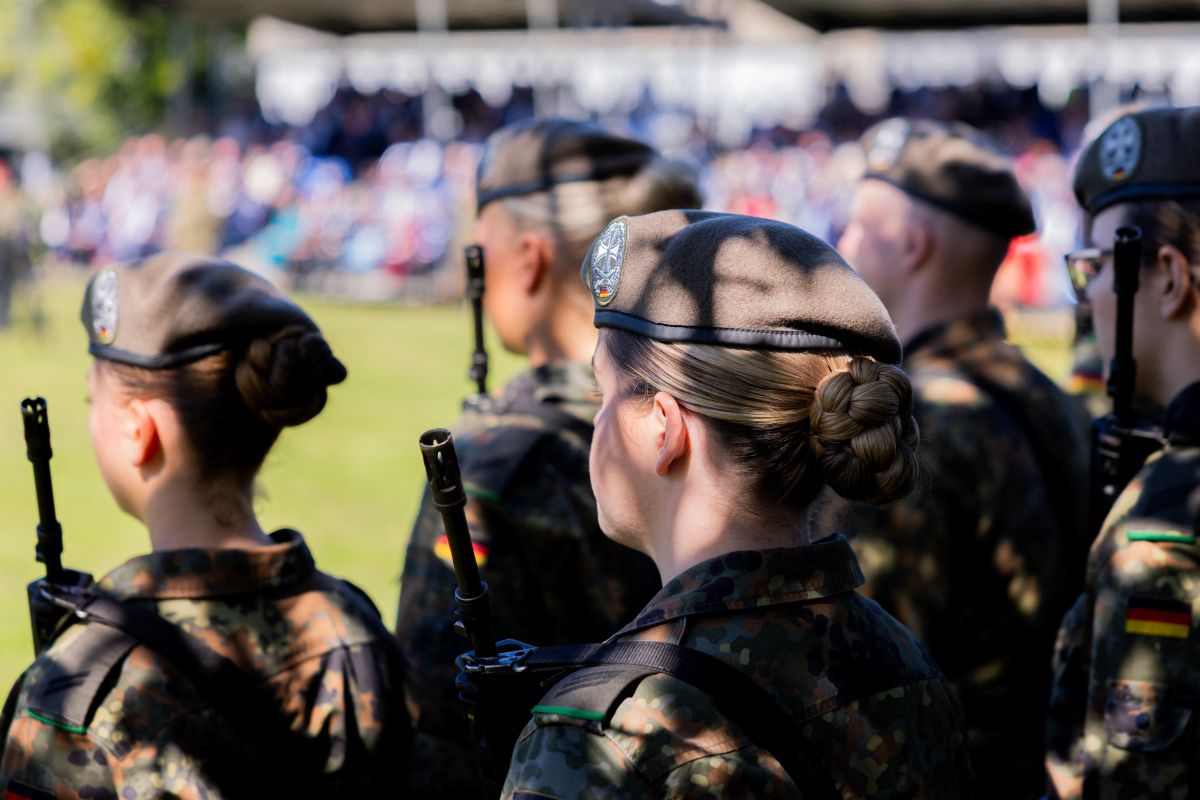
Women soldiers from the Bundeswehr’s Guard Battalion take part in the ceremonial handover of command at the North Rhine-Westphalia Regional Command in September. Photo: picture alliance/dpa | Rolf Vennenbernd
Camouflage bath toys
Perhaps hoping to distract from the gloom, the Bundeswehr launched an official online merchandise shop this week to make the military “more visible and approachable.”
Alongside standard hoodies, baseball caps, and “no-frills” milk chocolate, shoppers can snap up a camouflage-patterned rubber duck clutching the army’s new G95 assault rifle.
The armed rubber duck sold out almost immediately, and the website promptly crashed under the traffic.
But not everyone saw the funny side. Left Party leader Sören Pellmann accused the military of trying to smuggle its advertising “into the bathtubs of toddlers” and inappropriately trivialising a dangerous profession.
READ ALSO: How do Europeans view Germany’s military build-up?
No Chinese drones – or cars – on base
One thing you won’t find in the Bundeswehr shop is a Chinese-made drone.
On Wednesday, the Defence Ministry confirmed it is banning inexpensive, off-the-shelf Chinese drones previously used for target practice, replacing them with European models to prevent sensitive data from leaking to Beijing.
The espionage crackdown extends to the car park, too. Certain vehicles made by Chinese manufacturers such as BYD, Geely, and NIO are reportedly now barred from entering secure zones and sensitive installations due to fears their onboard cameras, radar, and microphones could be used for surveillance.
In many cases, soldiers who drive Chinese electric cars will reportedly have to park outside the gates and walk in from now on.
A €110 billion payday
Despite the PR missteps and internal turmoil, the Bundeswehr ended the week with its wallet intact.
Following an all-night parliamentary reconciliation session that wrapped up at 6 am on Friday, politicians signed off on the federal budget for 2027, locking in €109.75 billion for the Defence Ministry – topped up by nearly €30 billion from a special military fund.
READ ALSO: How Germany is reforming its spy agencies
Disclaimer : This story is auto aggregated by a computer programme and has not been created or edited by DOWNTHENEWS. Publisher: thelocal.de