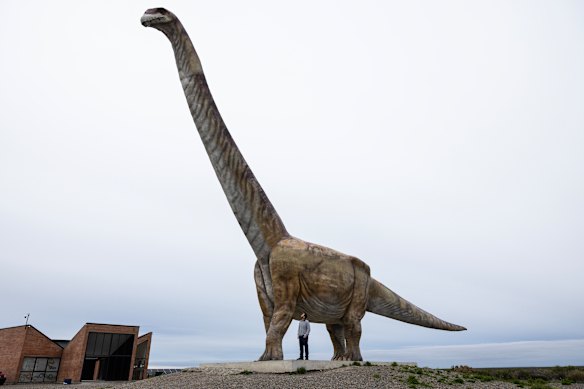
A fossil hunt in a remote Argentinian province has revealed a skeleton critical to the story of biology’s grandest experiment.
Dr José Luis Carballido, diviner of bones and hunter of Earth’s most colossal creatures, is an animal of the field. His hide is a navy hardshell jacket, zipped against the unrelenting winds of the Patagonian badlands. A geological hammer – one side blunt for splitting rocks, the other a metal talon – hooks into a fold of his jacket so the handle sticks up from his shoulder for easy unsheathing, like a Viking’s battleaxe.
Striding through the bone-coloured hills of Bryn Gwyn, a 40-million-year-old fossil field in Argentina’s remote Chubut province, he stoops and, with the sharp side of his hammer, conjures miracles from the shale. He flips out a tooth from a cousin of the megalodon shark. Then comes a disc resembling a ring of dehydrated pineapple; a sliver of the ancient shark’s spine. He fills our palms with fragments of mouth plates prehistoric stingrays used to grind up crabs, back when this moonscape, gnarled with thorns as long as toothpicks, was a shallow sea. There are ribs from the ancestors of river dolphins. The fist-sized vertebrae of small whales. Primeval penguin bones.
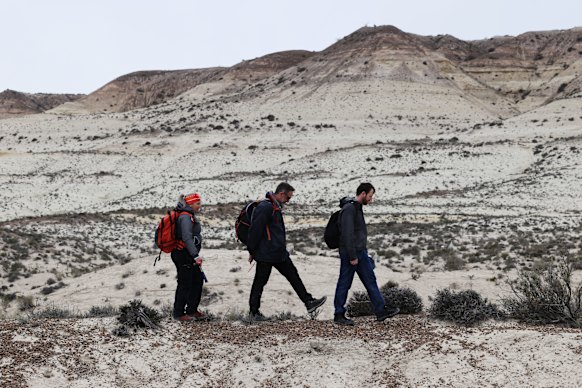
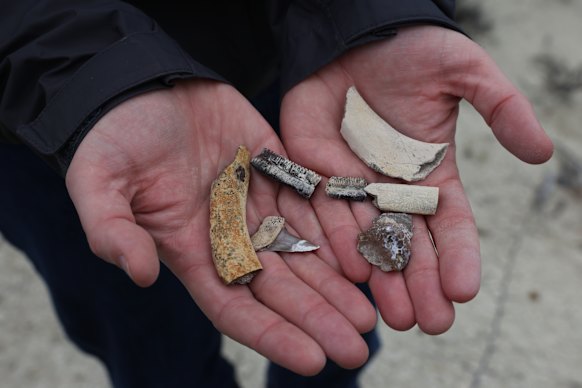
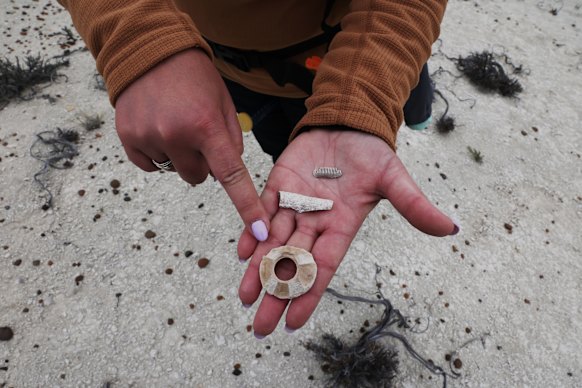
As Carballido’s hammer has revealed, Argentinian Patagonia is rife with fossils. Carballido’s trick is tracking down where the most complete and enormous lie. “It’s not very scientific,” he grins. “It’s a feeling, like the people who look for water.” He crosses his hammer over his forearm to create an X, mimicking divining rods.
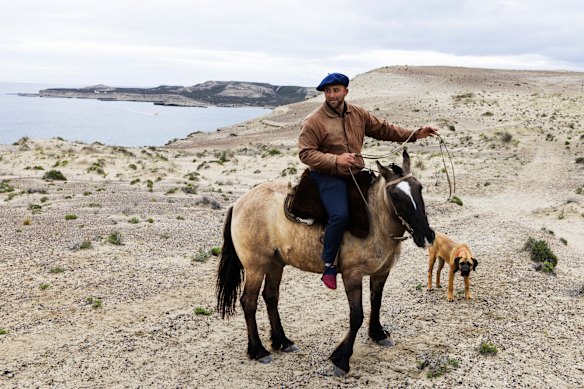
The institution he works for, the nearby Museum of Palaeontology Egidio Feruglio (MEF), frequently receives reports of fossils unearthed by the wind and spotted by the region’s gauchos – Argentina’s beret-doffed horsemasters, who roam these remote plains as shepherds and ranch hands.
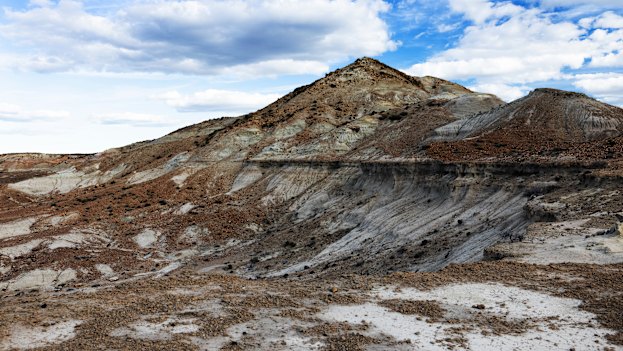
Palaeontologists don’t automatically get excited at such reports, especially in fossil-rich Patagonia. But when Carballido visited one of these prospective excavation sites in 2020, north of a nowhere town called Paso de Indios in the desolate steppe halfway between the Andes and the Atlantic, his instinct shivered. The knobbed end of a thick femur jutted from a hillside. Beside it lay a broken tibia – the “shinbone” that joins a femur. The proximity of the bones hinted that what lay deeper in the rock could be a fossil-hunter’s goldmine: articulated dinosaur bones, arranged together as they would have been in life. Rods crossed in his mind. But he didn’t yet dig.
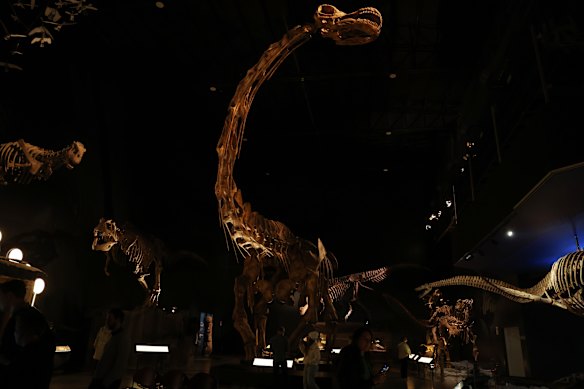
A few years later, Carballido began talking with Dr Matthew McCurry, curator of paleontology at the Australian Museum, while planning the Sydney installation of MEF’s roving exhibition called Dinosaurs of Patagonia. At the centre of the show is Carballido’s blockbuster discovery, the goliath he unearthed and described to global fanfare in 2017: Patagotitan mayorum – a leading candidate for the largest animal to ever walk the Earth. Nine metres tall and more than 30 metres long, the 57-tonne member of the “titanosaur” clade defied gravity and thermodynamics to pose evolution’s fiercest challenge to the limits of physics.
Amid wargaming how the enormous sauropod skeleton would fit into the museum – an issue now solved – the palaeontologists raised the possibility of gathering fresh fossil material to add to the exhibition. Carballido asked if McCurry could help excavate those bones that intrigued him near Paso de Indios in 2020. “It was a little bit nerve-racking, flying somewhere where you don’t speak the language, you’ve never met the people in person, you’re in a remote area,” says McCurry, a blue-eyed, short-bearded paleontological polymath who once earned a living as a mechanical bull operator before dedicating his career to science. “It’s quite heavy work, especially when collecting a really big fossil like a dinosaur. And the scientific outcomes were always a bit high-risk.” Such risks included flying such a long way and finding nothing valuable beneath the surface.
But things quickly became exciting when they began excavating in March last year. The rock layer itself dated to a mysterious phase of the Cretaceous – the final age of the dinosaurs before an asteroid felled their kingdom – which we know precious little about. The bones belonged to a sauropod, the thick-legged, tiny-headed, plant-hoovering behemoths with necks as grand as spires, made famous by Jurassic Park’s majestic brachiosaurus herds.
Carballido realised, from the shape of facets on the vertebrae, that a new species was on their hands – a possible early relative of Patagotitan. The dinosaur died between 110 and 115 million years ago, perhaps in a gentle, braided stream. It was a time when moist oceanic winds nourished a humid forest lush with conifers, ferns and ginkgos, before the volcanically violent rise of the Andes transformed these lands into the arid plains of the steppe.
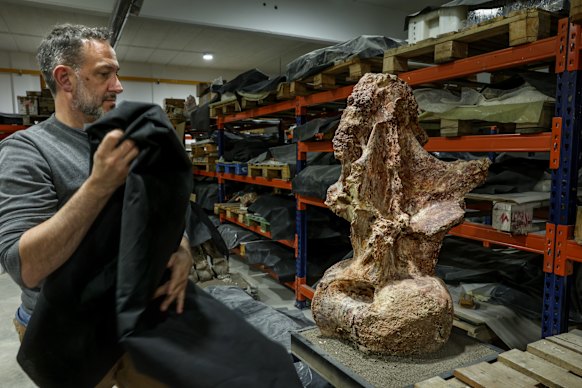
As the excavation team dug around the 1.6-metre femur, more treasures emerged: an articulated length of the dinosaur’s tail. Parts of its front and back limbs. Most of its pelvic girdle, including the sacrum, a large triangular plate wedged between the wings of the pelvis, also known as the “holy bone” because it shields the reproductive organs and was used in the sacrificial rites of some ancient cultures. It was the first complete sauropod sacrum ever found in the region, and as it emerged, Carballido’s face lit up. “There were a lot more bones than we realised,” McCurry says. “That means it’s a lot more scientifically important.”
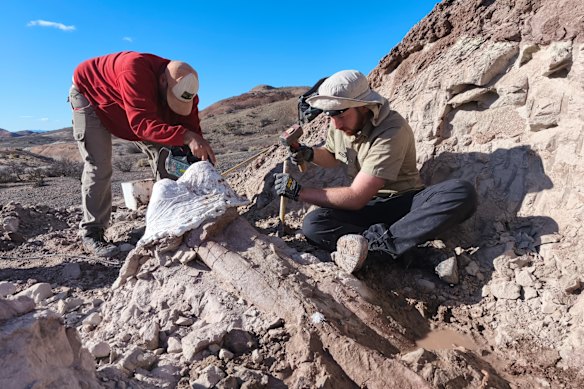
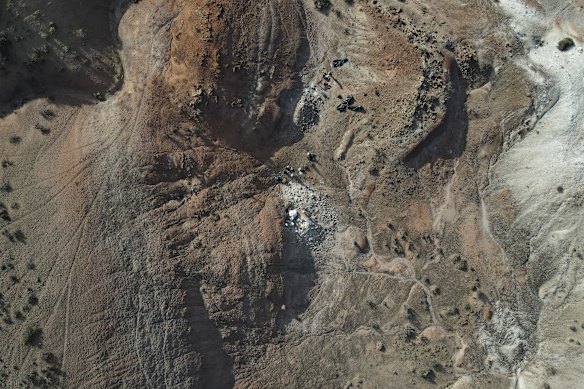
The reason Carballido offered to work with McCurry, the Australian expert suspects, is that they’re both “reasonably chill”. Fieldwork is not for the highly strung. It is painstaking, back-breaking, nail-biting and unglamorous. McCurry calls it “type 2 fun”: gruelling in the moment but satisfying when it’s done. McCurry shows a video of the excavation team after a 12-hour day of having their teeth rattled by handheld jackhammers: someone, to lift the mood, is blasting electronica and running a disco light. Coloured orbs skate across exhausted bodies slumped silently against the walls. Type 2 fun.
Extracting fossils can be meticulously slow, but at other times the action unfolds at pace. At the palaeontology field in Bryn Gwyn, we watch a group of trainee field technicians scramble across a hillside, obeying instructions barked in rapid-fire Spanish. Paintbrushes, broomsticks and chisels are at work in the grave of an ancient cetacean (whale or dolphin). The group’s intense focus is sporadically thrown off by a primordial-looking stick insect crawling through the action. The students treat the bug as gingerly as a live grenade; when disturbed, it spews a noxious chemical that fouls the air and blinds the eyes. Just another hazard of working in the badlands.
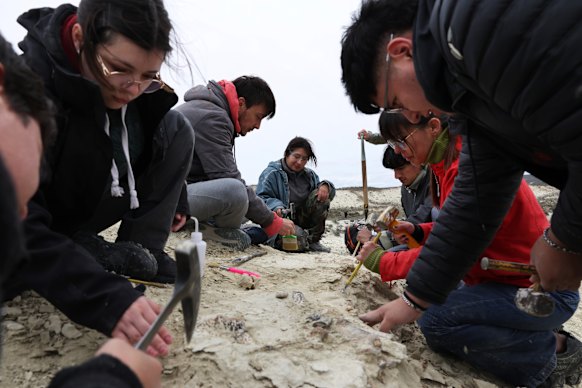
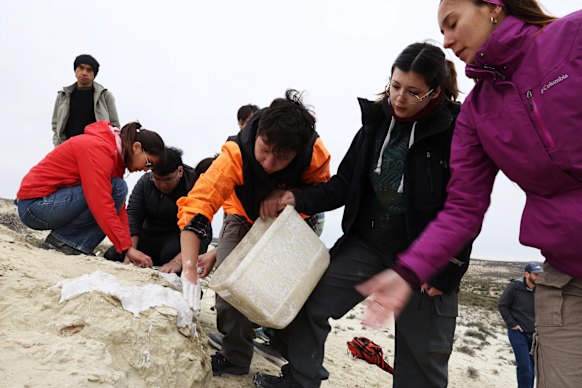
Thankfully, the air is sharp with a different scent: nail polish remover. The crew drench the bones in acrylic resin dissolved in acetone, which soaks into and stabilises the porous fossil. Working fast, they layer wet strips of toilet paper over the bone like papier-mâché. Then come buckets filled with a slurry of plaster, which they scoop up in fistfuls and slather over the paper, forming a thick, hard shell. White-crusted fingers pass around a cup of mate (“mah-tay”), the bitter Argentinian tea sipped through a communal straw that seems to fuel a nation. The operation creates a “field jacket”: a giant, white, protective egg built around a fossil so it can be transported safely back to the lab.
The jacket containing the sauropod sacrum, which now lies in the museum ready for analysis, weighed two tonnes. McCurry has returned to Argentina to scan and scrutinise the bones with Carballido to piece together where this creature fits in the story of titanosaurs, the group which gave rise to the biggest land animals of all time. The project holds the potential to shed crucial new light on how evolution pulled off its most extreme experiment.
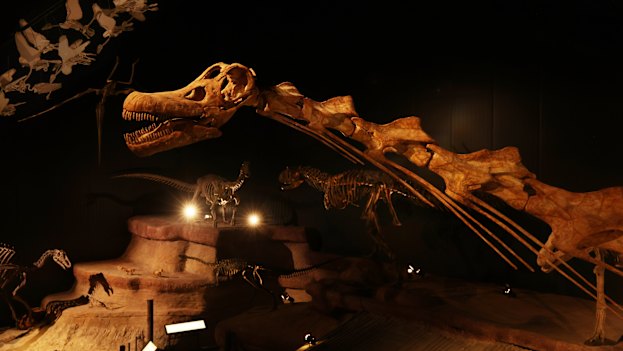
To understand why Patagotitan’s gigantism evolved, we must look to theropods – the bipedal, carnivorous, vicious killers that include velociraptors and history’s most iconic apex predator, Tyrannosaurus rex. The T. rex didn’t yet exist when Patagotitan thundered the Earth 100 million years ago, but other terrors bloodied the wet Cretaceous forests and marshlands of Patagonia.
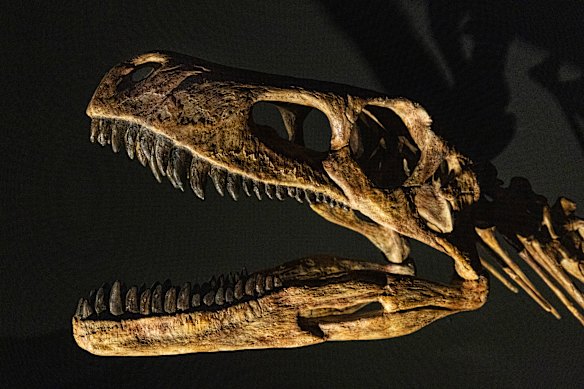
In 1995, close to McCurry and Carballido’s recent sauropod site, a monster emerged: Tyrannotitan chubutensis, a massive meat-eater that reached a comparable size to T. rex, at 12 metres long and 4 metres tall at the hip. Living in a world stalked by bus-sized hunters packing skulls crammed with 60 blade-like and replaceable teeth, other dinosaurs had to evolve ways of avoiding Tyrannotitan-mediated murder. They could get really fast. Become excellent at hiding. Develop thick-skinned “armour” and flock in herds. Or grow to the size of gods.
Patagotitan opted for the latter strategy to spectacular effect, but it came at a cost: a body that size is a logistical nightmare. When you’re the weight of 14 African elephants, simple processes become Sisyphean feats. Eating enough food and getting enough oxygen. Not overheating (the bigger your body size, the more difficult it is to relinquish heat). Maintaining the skeletal architecture to withstand the crushing force of gravity weighing on 57 tonnes of flesh and bone. There’s a reason the world’s biggest animals, blue whales – shorter than Patagotitan but heavier by weight – evolved in the ocean, where buoyancy negates much of gravity’s tyranny.
Sauropods had some extraordinary adaptations to cope with being giants. Their lungs were fashioned in the hyperefficient style of modern birds. Unlike our lungs, which inflate with each breath and uptake oxygen only when we inhale, dinosaur lungs were fixed and rigid. Air cycled through in one direction, so fresh air never mixed with stale breath and oxygen constantly gushed into the bloodstream. It’s this “superlung” system that allows birds today, such as the bar-tailed godwit, to span the Pacific Ocean on their death-defying migrations, often in oxygen-poor altitudes. Sauropod lungs also worked in concert with air sacs that honeycombed their skeletons, which made breathing even more efficient, helped shed metabolic heat and significantly lightened the weight of their bones.
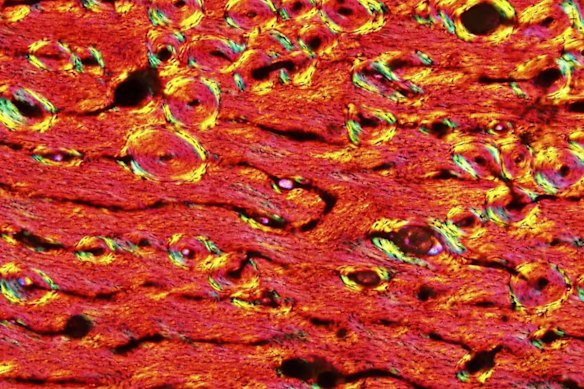
Microscopic analysis of mineralised structures within a young titanosaur’s femur reveals a dense web of nutrient-delivering blood vessels, similar to fast-growing mammals such as whales. This, scientists believe, is evidence the titanosaurs grew astonishingly quickly, dashing the idea, imported from reptiles, that the dinosaurs grew slowly over decades like crocodiles. “It’s crazy because when you see an animal so large, people used to think that they lived for 300 years,” Carballido says back at MEF, standing among hunks of titanosaur vertebrae as big as barbecues. “But the oldest one that we know is around 60. Hold this.”
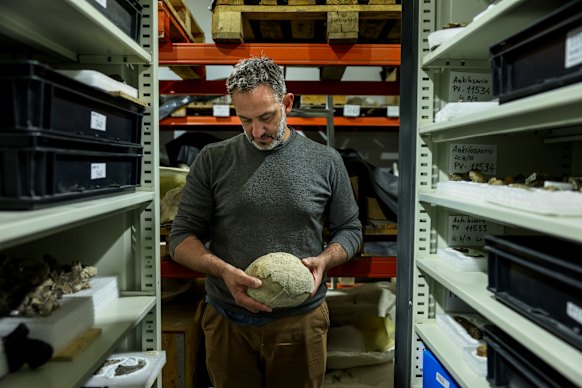
He disappears into the museum’s backstage collection, which holds 42,000 fossils, and I am left manhandling a sauropod egg the size of a soccer ball. Its hatchling couldn’t have been much larger than a chihuahua. And yet, from eggs such as this one emerged babies that swelled to the size of buildings in just 15–20 years. The phenomenal growth rate makes sense, given the goal was to spend as little time as possible with a body small enough to fit between a predator’s jaws.
About 60 Tyrannotitan teeth were found alongside the six Patagotitan specimens Carballido famously unearthed between 2012 and ’15 with colleague Dr Diego Pol. Initially, due to bite marks on the sauropod’s tail, they believed the Patagotitans had been killed by the carnivores. Histological analysis, however, showed the sauropods were young adults, still growing but already the size of semitrailers and too large for Tyrannotitan’s jaws. At that size, only one dinosaur could have posed a threat: another Patagotitan. “They were at the age and at the moment of the year when males fight each other to be the dominant one of the group,” Carballido speculates. “Probably, the specimens that we found were those who lost the fight.” Those Tyrannotitan teeth, then, may have been the result of a scavenging smorgasbord rather than an active kill.
At a similar time to Patagotitan rose Argentinosaurus – believed to be even bigger, but it’s hard to say unequivocally given we only have a handful of their bones. At another site, Carballido is excavating the bones of another new titanosaur that may be 5 to 7 per cent bigger again. Something about this time period, the “Albian” age between about 100 to 113 million years ago, made the gigantic possible. The biggest titanosaurs also only occurred in a restricted band of the mid-latitudes, far from the equator. Carballido believes tropical forests may have been too hot for the giants. McCurry is pondering another theory he’s keen to discuss with paleobotanists: that the latitudes titanosaurs occupied had uniquely phosphorus-rich vegetation, which acted like fertiliser for their fast-growing bones.
Titanosaurs shrank towards the end of the dinosaurs’ reign into species such as Saltasaurus, which grew to 8.5 metres and weighed only 2.5 tonnes; positively pocket-sized, by sauropod standards. The trend violates an idea called Cope’s law. “The idea with Cope’s law is that everything gets bigger through time until there is an extinction event,” McCurry says. “But it’s not the case with sauropods. It seems like it’s happening in a peak during the middle Cretaceous.”
The exact factors behind the giants’ rise and fall remain under scrutiny. But you needed it all for biology to achieve its grandest, meatiest megalith: the perfect climate, ideal latitude, lush vegetation and ferocious predators. Kaboom. Patagotitan.
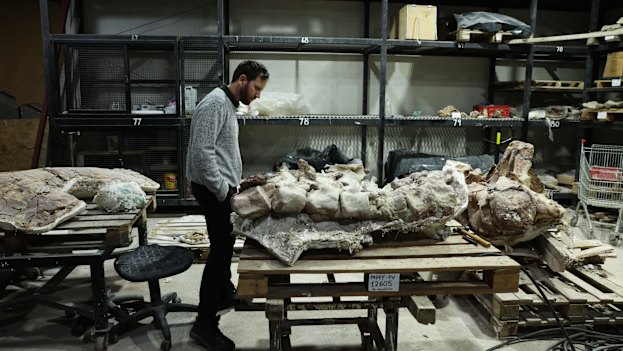
The new sauropod bones excavated by McCurry and Carballido are spread across the institute’s laboratory, a dusty workshop strewn with bloodthirsty-looking skulls, buckets of ribs and boulder-sized fossils that could crush a Corolla. It’s a place that shows the study of dinosaurs remains a hotbed of discovery. A new dinosaur species is coming from the earth once a week, and cutting-edge technologies are pushing the limits of what fossils can teach us. We learned only recently from preserved pigment structures that Diplodocus sauropods had sensationally speckled skin, and Australian-led research out this month has uncovered fossilised red blood cells in the 115 million-year-old bones of a Brazilian feathered theropod.
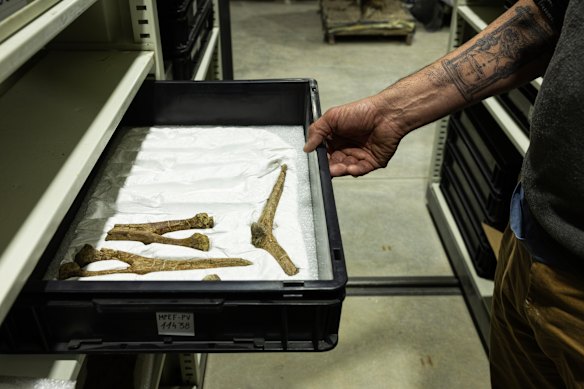
Carballido hands over a chevron bone, a Y-shaped structure the length of my forearm and shaped like a crude slingshot, that would’ve carried a rope-like vein down the sauropod’s tail. In a crate nearby are two caudal vertebrae – almighty slabs of the beast’s tail – and its clublike femur, all bound for display in Sydney. The sacrum of the new species lies in the centre of it all, splayed open and demanding reverence like the eldritch slab of an ancient altar.
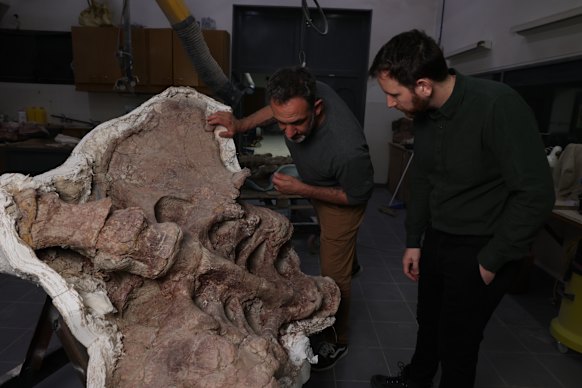
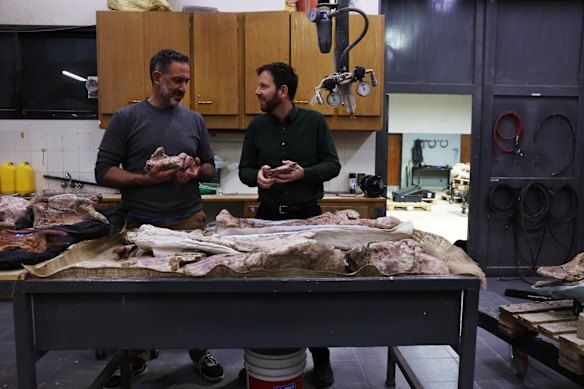
Over the next week, McCurry and Carballido painstakingly code every bump, curve and knob of these bones and feed the numbers into a phylogenetic character matrix, which converts morphological elements of a skeleton into code. By comparing the matrix to other Gondwanan sauropod species from both Australia and South America, they can calculate where a new species fits on an evolutionary tree.
What they have discovered is not just a primitive Patagotitan relative. They suspect this dinosaur marks the first branch on the evolutionary tree that led to titanosaurs. The critical opening chapter in the odyssey of biology’s grandest juggernauts.
“We need to get a little bit more data into the phylogeny to have it for certain,” McCurry says when we meet up in Buenos Aires after his week of rapid analysis at MEF. “But it’s looking good. There’s all these characters within the pelvis which show it’s probably got quite a wide stance, which is a pretty characteristic titanosaur thing. It’s potentially one of the reasons they were able to feed really efficiently, because they had a large area for their internal organs and stomach.” That wide stance allowed for the sauropod’s engine – the fermentation tank of its gut – to grow fat and supercharged, so it could slowly strip every iota of nutrition from vast amounts of vegetation it gorged upon from the top of the canopy. “It means titanosaurs, when they first evolved, had these traits. And we didn’t necessarily know that.”
Before the palaeontologists can name and describe the new species, they must recover the rest of the fossil. At least a scapula and a humerus remain buried. But funding such expeditions, of late, has been difficult.
In Buenos Aires, a few days after visiting Chubut, traffic is at a crawl. We inch past a protest on the edge of detonation: soon rocks will fly and police will return fire with tear gas, water cannons and rubber bullets. The demonstrators are raging against right-wing populist President Javier Milei’s cuts to universities and education. Science funding in Argentina has plummeted by 50 per cent since 2023. Professors’ pay has plunged below the poverty line and world-class experts, such as Carballido, have found themselves kneecapped with little funding for fieldwork.

Meanwhile, Australia’s premier science body, the Academy of Science, has been up in arms over the fact that spending on research and development has crashed to the historic low of 1.69 per cent of GDP, below the 2.7 per cent average among OECD nations.
That’s forced researchers of all stripes to get creative. McCurry and Carballido, for their part, are gunning for funding from the Department of Foreign Affairs and Trade, which operates a diplomatic grants program called the Council on Australia Latin America Relations (COALAR). The idea is to run more joint expeditions, cross-pollinating Australia’s analytical know-how with the expertise of Patagonia’s field technicians – and hopefully fund the rest of the sauropod dig on the side.
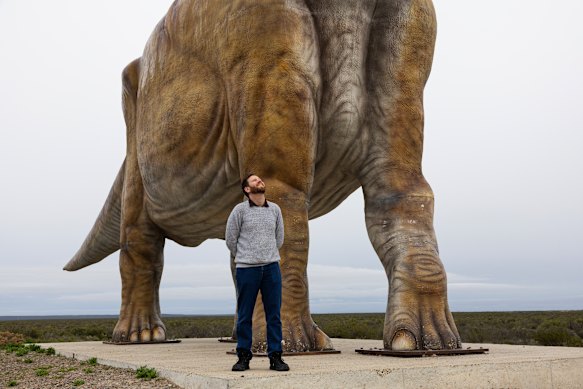
In Chubut, times in the province are tough as the profits of traditional industries, including sheep farming, wane. Amid the downturn, the paleontology museum has become a beacon of tourism and economic activity, and the institution’s regional city of Trelew has embraced the dinosaur theme with gusto.
A mock fossil site decorates the walls of the baggage claim at the airport and a model raptor snarls in a corner. Walk outside the arrivals hall and on the steppe’s flat, dry horizon, you’ll spy a looming model Patagotitan. Stand beneath it and you can imagine a primordial mammalian part of you quivering with the memory of scuttling around the feet of giants. All around, the Patagonian wind blows, spiriting away sand and time to offer the bones of gods to the air.
Angus Dalton and Louise Kennerley travelled to Patagonia courtesy of the Australian Museum and Adventure World. Dinosaurs of Patagonia opens on November 28.
Read more from Good Weekend magazine:
Get the best of Good Weekend delivered to your inbox every Saturday morning. Sign up for our newsletter.
Disclaimer : This story is auto aggregated by a computer programme and has not been created or edited by DOWNTHENEWS. Publisher: www.smh.com.au