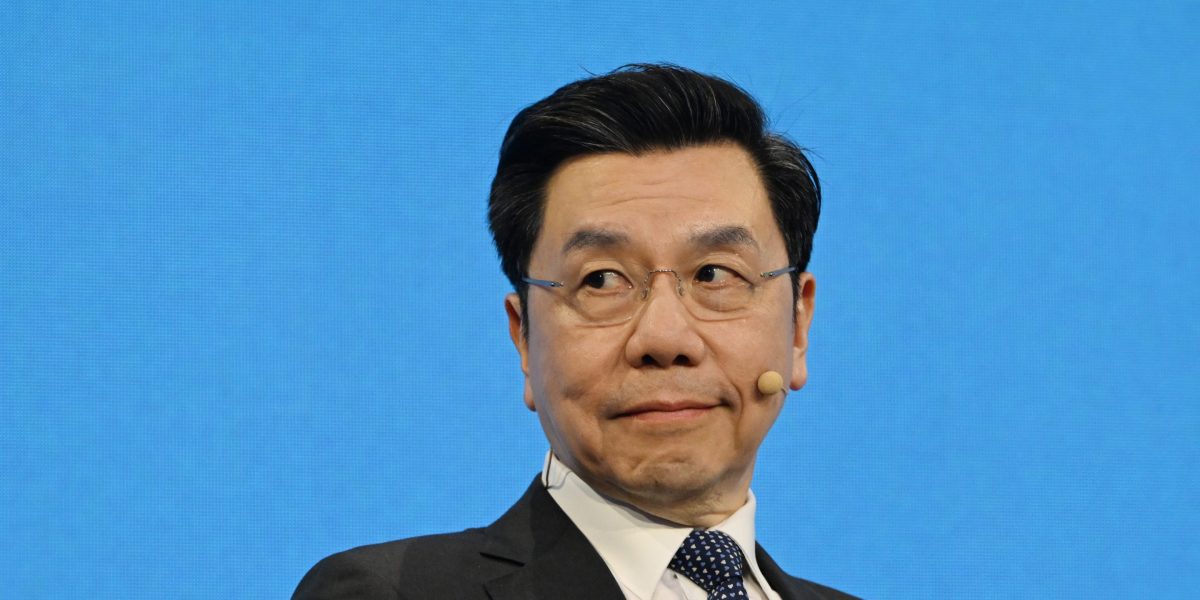
Despite years of U.S. efforts to gain an edge over China in the AI race by restricting its access to the most advanced chips, one AI pioneer says America’s efforts have instead helped create a new generation of Chinese AI models that are quickly catching up to their American counterparts.
Kai-Fu Lee, an AI entrepreneur and former president of Google China, said in a Fortune Daily interview that U.S. export restrictions on the most powerful American chips have shaped Chinese companies’ strategy of building competitive AI models with fewer resources.
In response to these limits, which American companies don’t face, Chinese AI developers have built open-weight models that Lee estimates are now just six to 12 months behind those created by some of the biggest American AI companies, including OpenAI as well as Anthropic—which is reportedly preparing to go public as early as next week.
Yet when Americans think about China and the motivations of Chinese companies, they’re often getting some key things wrong, Lee said. In an interview with Fortune Daily published this week, he detailed three of the biggest misconceptions about China’s AI industry that he says have taken hold in America.
Profit motive
One of the biggest misconceptions about Chinese companies is that they are more focused on winning the AI race and becoming the first to develop artificial general intelligence (AGI)—widely considered the ultimate goal of AI development—than on building profitable businesses. That assumption is incorrect, Lee said.
“Chinese companies are born to make money. That’s the primary purpose,” Lee said. “It’s not so much to win AGI or win the race.”
He compared questions about the profitability of the current wave of Chinese AI developers like DeepSeek with those surrounding other Chinese tech companies like Pinduoduo, Meituan, and ByteDance. These tech giants’ business models were also initially questioned before they became some of China’s biggest companies.
“You may reasonably doubt China’s ability to do a breakthrough, which is valid. [The] U.S. is way ahead on that, but never doubt Chinese ability to find a way to make money,” he said.
Motives and competition
A second misconception, Lee said, is that China’s embrace of open-weight models and open-source technology is part of an organized government effort to compete with America.
Instead, Lee said, market competition has driven the shift. He pointed especially to DeepSeek, a Chinese startup that stunned American AI companies in early 2025 by releasing a highly capable AI model by the same name that it claimed was trained using significantly less computing power than its American competitors.
“Chinese companies are venture funded just like the American companies,” Lee said. “They just want to serve their investors.”
Beijing has played a significant role in shaping the country’s AI industry. Investors with ties to the government participated in more than 140 Chinese AI deals in 2025, Fortune reported earlier this year, citing a Pitchbook analyst note.
China’s president, Xi Jinping, has also encouraged AI development in China. In 2025, Xi called for the country to develop “an independent, controllable, and collaborative artificial intelligence basic software and hardware system.”
Lee said in the interview that American companies have good reasons to spend more, including attracting the world’s best researchers and giving them enough computing power to experiment.
A different playbook
The third misconception, Lee argued, is that U.S. export controls are the main reason Chinese companies have shifted toward models that require less computing power, while American companies pour billions into data centers.
He argued that Chinese companies are naturally more frugal because they have different priorities than their American counterparts.
“The Chinese companies are naturally parsimonious; not just the startups,” he said, adding that “prudence and survival instinct” are more important to them than the pursuit of AGI.
That contrasts with the American approach, which emphasizes spending heavily on computing power to attract top researchers and accelerate AI development. Because of their resourcefulness, Chinese companies can develop and operate models for as little as one-tenth the cost of their American competitors, making their products attractive to businesses that don’t want to pay premium prices for AI services.
Despite the growing competitiveness of Chinese AI developers, American companies still produce more top-tier models and higher-impact patents, according to a Stanford University study. OpenAI and Anthropic are also the world’s most valuable AI companies.
OpenAI was valued at $1.25 trillion in a November funding round and is eyeing a potential IPO in 2027. Anthropic, meanwhile, is preparing to go public as early as next week in what could be one of the largest IPOs in history, seeking a valuation of up to $1.4 trillion.
Still, when DeepSeek showed it could compete with America’s leading AI developers, it helped boost the hopes of Chinese AI developers. Before DeepSeek, these developers believed their country was years behind the U.S. After DeepSeek showed off its model in 2025, sentiment shifted, he said.
“It’s a national pride thing, so people say, ‘Okay, we thought we were never going to catch up. Now we have a shot.’ So, it was quite a special moment,” he said.
Disclaimer : This story is auto aggregated by a computer programme and has not been created or edited by DOWNTHENEWS. Publisher: fortune.com