
When I was a child, my parents liked all our dogs to have pups. Sometimes the litters coincided and we would have 20 or so puppies stomping through various bowls of porridge dotted about our old orchard block. One of my earliest memories is when one night, as the youngest, and therefore smallest, member of the family, I was asked to climb into the narrow underworld beneath the house to check on one of our cocker spaniels, Mash, giving birth to her latest litter.
I lay flat on my belly watching on as the tiny eye-shut creatures slipped into the world in clear plastic-like sacs of maternal film. My eyes widened at how mucky and wet and yet magnificently slick it all was, and, as Mash began to lick the coats of her babies clean, I think I understood that the membrane dividing my species and hers was likewise pretty flimsy indeed.
We were all creatures of the earth, born of flesh and blood and grown on milk. To watch the newborns begin to drink from Mash’s teats with an efficiency somehow already known to them was to understand, in that dark yet luminous childhood space under the house, how connected the world really is.
Because dogs are by far our oldest domesticated animal companions, they have been furnishing us with these kinds of everyday revelations for many thousands of years.
In Thomas Laqueur’s new book, The Dog’s Gaze, he traces the specific roles dogs have played in the history of Western art where, at least since the Paleolithic images on the walls of the Chauvet cave in the Ardéche region of France, they have been the chief companion species of our pictorial imagination. Interestingly, no dogs are actually depicted among the animals on the Chauvet walls. Instead, Laqueur tells us, on the floor of the cave are the “traces of canid pawprints next to human footprints made as they stood together c. 25,000 BCE and looked at art from c. 10,000 years earlier”.
So there they stood, as companion species, the dog and the human, and so it continues. Laqueur, an American cultural historian whose previous books include both a history of mortal remains and of masturbation, soon reorients this side-by-side vignette to explore how the dog has so often been used by artists as a surrogate presence of themselves in their work.
Despite being limited to the Western canon, Laqueur’s overview of dogs in art history is extensive. He shows how, from the footprints of Chauvet through to the masterworks of Van Eyck, Veronese and Durer, to the modernism of Franz Marc, Berthe Morisot and Lucian Freud, there has so often been, as there is in life, a dog acting as witness to the scene, a dog teaching us how to look, where to look, and where the meaning might lie.
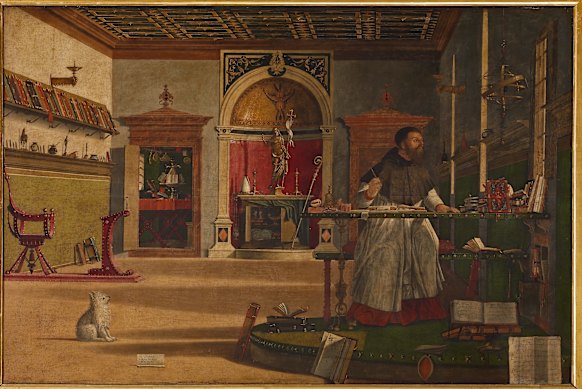
That the dog’s gaze is depicted by artists as not only that of a loyal protector, as in Edward Landseer’s The Old Shepherd’s Chief Mourner (1857), but as an independent and unsentimentalised actor, as in the groundbreaking realism of Gustave Courbet, is coupled by Laqueur with the fact that the placement of dogs in paintings has often been to generate mirror-like implications of human vanity or absurdity. Thus, the dogs’ kinship with the artists themselves, and not only as studio companions. Laqueur shows how in key paintings, such as Carpaccio’s St Augustine In His Study (1502) or Velazquez’ Las Meninas (1656), the act of using the dog’s presence as an existential parenthesis, or even just as a symbol of forbearance, points to the always relational truth of dog and artist, and of our intervolving multispecies existence more generally. In short, we are never alone.
A strength of Laqueur’s chronology is how the dog’s gaze acts as a portal to the changes in our cultural history. For instance, by the time we get to Goya’s El Perro (1820) and Turner’s Dawn After The Wreck (1841), both of which depict solitary dogs dwarfed by the scale of potentially dystopian surroundings, it is clear that the psychological isolation of an oncoming modernity will be inflicted on other species.
This idea also lies at the heart of Anna Heyward’s debut memoir, Living With Freddie, her account of living in a fifth-floor New York City walk-up with a rescue Italian greyhound as her companion. We watch on, clenched with both fascination and horror, as the insatiably biophilic presence of poor flat-bound Freddie cracks open Heyward’s hyper-urban and heavily digitalised 21st-century life.
Her obsessive attempts to ameliorate Freddie’s separation anxiety sees her world turned on its head. Her partner leaves, her career pathway is transformed, and all the progress she has to show for it is that after months of constantly monitored entrainment, Freddie can spend barely two whole minutes on his own. In her mania to do the right thing by the dog while keeping her job, she hires walkers from the internet and tracks their progress via an app which shows her live simulations of Freddie taking a shit in the park. She sets up cameras around her apartment so she can monitor him in her absence and, very sadly, eventually ends up sedating him just so she can go to work.
Living With Freddie is an excruciating account of how its author tried but failed to incorporate her rescue dog into her decidedly dog-unfriendly lifestyle. While it is a painful story to read, especially for dog lovers from more down to earth environments, it is also a hard book to put down. Heyward’s finely distilled descriptive writing goes a long way to redeeming her illustration of how the human-animal relationship can these days go so sickeningly wrong.
In this sense it updates the chronology of our cohabitation with dogs where Laqueur’s less personal and more historical lens leaves off. Neither book is particularly skillful at integrating research into the structural momentum of their narratives but they do both spend many pages surveying pertinent studies in philosophy, literature, ethology and animal behaviourism. Heyward in fact eventually ditches her job in the art world to study animal behaviour at a university vet school.
Interestingly, both writers share an interest in Charles Darwin’s work while also highlighting the thesis of loneliness that John Berger explores in his seminal essay, Why Look at Animals? Given that not dogs per se but our relationship with them is the true subject of both these books, I was surprised that neither of them spent more time on current thinking in the fields of post-humanism and animal studies, in the work, for instance, of Vinciane Despret, Bruno Latour and Donna Haraway.
Haraway’s book, When Species Meet, which Laqueur mentions in his end-notes has been formative for him, points us back to the way that not only our art but our language itself is stocked with salient reminders of the inescapably entangled nature of our lives on earth.
It’s worth remembering then that not only does our English word “species” derive from the Latin specere, meaning “to see, or look at”, but in the very same tangle of etymological roots lies respicere, the origin of the word “respect”, a reciprocal quality requiring us to “look back at, to regard”. In other words, to properly meet the gaze.
Laqueur and Heyward’s books show in very different ways that the dog’s gaze has never been a one-way transaction. Or perhaps, as I learnt under the house all those years ago, it has never been a “transaction” at all. It is something far more intimately kindred than that. Respect for the dog is inseparable from respect for ourselves.
The Dog’s Gaze by Thomas W. Laqueur is published by Allen Lane ($85). Living with Freddie by Anna Heyward is published by Hachette ($35).
What else is happening in the book world?
 Gregory Day is a former coach of the Moriac Apricots. He is also an award-winning novelist, poet, essayist and musician based in Victoria, Australia.
From our partners
Disclaimer : This story is auto aggregated by a computer programme and has not been created or edited by DOWNTHENEWS. Publisher: www.smh.com.au