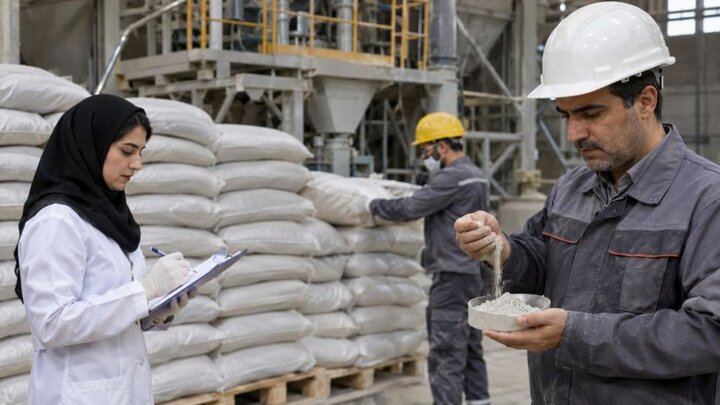
TEHRAN- This article examines Iran’s bentonite industry, highlighting recent production data, major industrial applications, and export potential. It explores the role of bentonite in drilling fluids, foundry operations, construction, iron ore pelletizing, and absorbent products.
The article also explains key quality specifications, technical documentation, processing requirements, and supply chain considerations that international buyers should evaluate when sourcing bentonite from Iran.
Iran is an established producer of industrial minerals, including bentonite, a clay material used in manufacturing, engineering, and processing. According to the U.S. Geological Survey (USGS), Iran’s bentonite production was estimated at 1.3 million metric tons in 2024, compared with 1.31 million metric tons in 2023 and 1.34 million metric tons in 2022.
USGS data also record production of 715,000 metric tons in 2020 and 1.15 million metric tons in 2021. These figures indicate the scale of domestic production, not export volumes. Domestic demand, processing capacity, product grade, and logistics determine what is available to international buyers.
Why bentonite matters to industrial markets
Bentonite is a naturally occurring clay primarily composed of minerals from the smectite group, particularly montmorillonite. Its ability to absorb water, swell, bind particles, and form suspensions makes it useful across several industrial processes.
Sodium and calcium bentonite are two commercially important varieties. Sodium bentonite generally has greater swelling capacity, while calcium bentonite is selected for applications where its particular adsorption and binding properties are suitable. Performance depends on mineral composition, exchangeable cations, processing, and application conditions; buyers should assess test results against their process requirements.
Major industrial applications
Bentonite serves different functions across industries, and each application requires specific material properties.
Oil and gas drilling: Bentonite is used in water-based drilling fluids to suspend cuttings, support borehole stability, and help control fluid loss. Buyers commonly assess viscosity, filtration properties, particle size, and swelling behavior.
Foundry and metal casting: As a binder in molding sand, bentonite contributes to mold strength and casting quality. Moisture content and green compression strength are important evaluation parameters.
Construction and civil engineering: Selected grades are used in slurry-supported excavation, borehole operations, and sealing applications, where swelling behavior and low permeability can be important.
Iron ore pelletizing: Bentonite binds fine iron ore particles into green pellets before further processing. Binding performance, moisture requirements, and particle-size distribution can affect pellet quality.
Cat litter and absorbent products: Bentonite is used in absorbent products, including cat litter. Relevant properties include absorption, clumping performance, granule size, and dust generation.
No single grade is suitable for every application.
Quality specifications and product consistency
For industrial buyers, a product description is not a substitute for technical specifications. Depending on the intended use, evaluation may include:
• Montmorillonite content, to characterize mineral composition.
• Moisture content, which affects storage, handling, and processing.
• Particle-size distribution, which influences dispersion and product behavior.
• Free swelling index, to assess expansion under defined test conditions.
• Viscosity and filtration properties, particularly for drilling-fluid applications.
• Binding performance, for foundry and pelletizing uses.
Acceptance limits vary by application. Buyers should define the required grade, test methods, target values, and tolerances before requesting quotations.
Documentation is equally important. A Certificate of Analysis (COA) reports test results for a specific batch; a Technical Data Sheet (TDS) summarizes product properties; and a Safety Data Sheet (SDS) provides handling and safety information. Where necessary, independent testing and pre-shipment inspection can help verify compliance with agreed specifications.
Test methods and measurement conditions should accompany results; otherwise, swelling and viscosity values may not be directly comparable.
From production to international supply
Natural resources alone do not guarantee a dependable supply. Processing, quality control, packaging, and transportation all affect whether a product reaches the buyer in the required condition.
Depending on the target grade, processing may include drying, grinding, screening, and particle-size classification. Packaging should protect the material from moisture and contamination during storage and transport. Buyers and suppliers should also agree in advance on order quantity, packaging type, inspection responsibilities, delivery terms, and required shipping documents.
A competitive offer depends not only on price but also on product consistency, documentation, packaging, and delivery reliability.
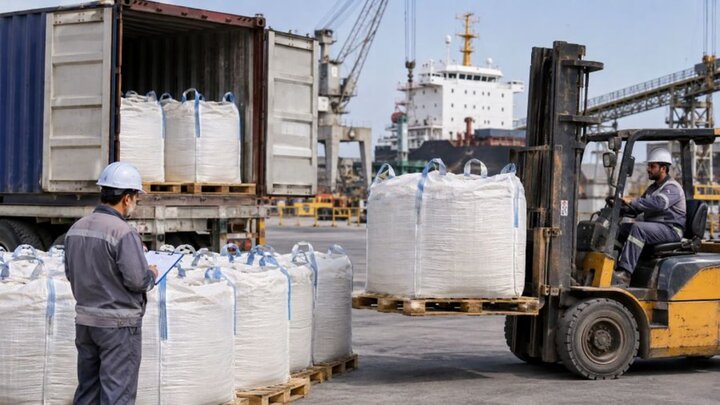
Iran’s bentonite export potential
Iran’s reported production provides a substantial domestic base for the industrial use and potential international supply of bentonite. However, export potential cannot be established from production figures alone. It depends on the availability of suitable grades, processing capabilities, domestic consumption, quality assurance, logistics, and destination-market requirements.
Different buyers prioritize different characteristics. A drilling-fluid operator may focus on viscosity and filtration performance, while a foundry buyer may place greater weight on binding properties. Suppliers and trading companies therefore need to communicate product specifications clearly and match each offer to the buyer’s intended application.
Before ordering, buyers should confirm the grade, batch documentation, packaging, quantity, and applicable trade terms.
Vornaco and international bentonite sourcing
As an international trading company active in industrial minerals, Vornaco works with businesses evaluating bentonite sourcing options for industrial applications. Buyers can review Vornaco’s bentonite supply solutions and discuss product specifications, bulk order requirements, packaging, and delivery arrangements according to their needs.
Conclusion
Iran’s bentonite production and the mineral’s range of industrial applications provide a basis for participation in regional and international supply chains. Dependable sourcing requires application-specific specifications, consistent quality, clear documentation, suitable packaging, and coordinated logistics.
Disclaimer : This story is auto aggregated by a computer programme and has not been created or edited by DOWNTHENEWS. Publisher: tehrantimes.com