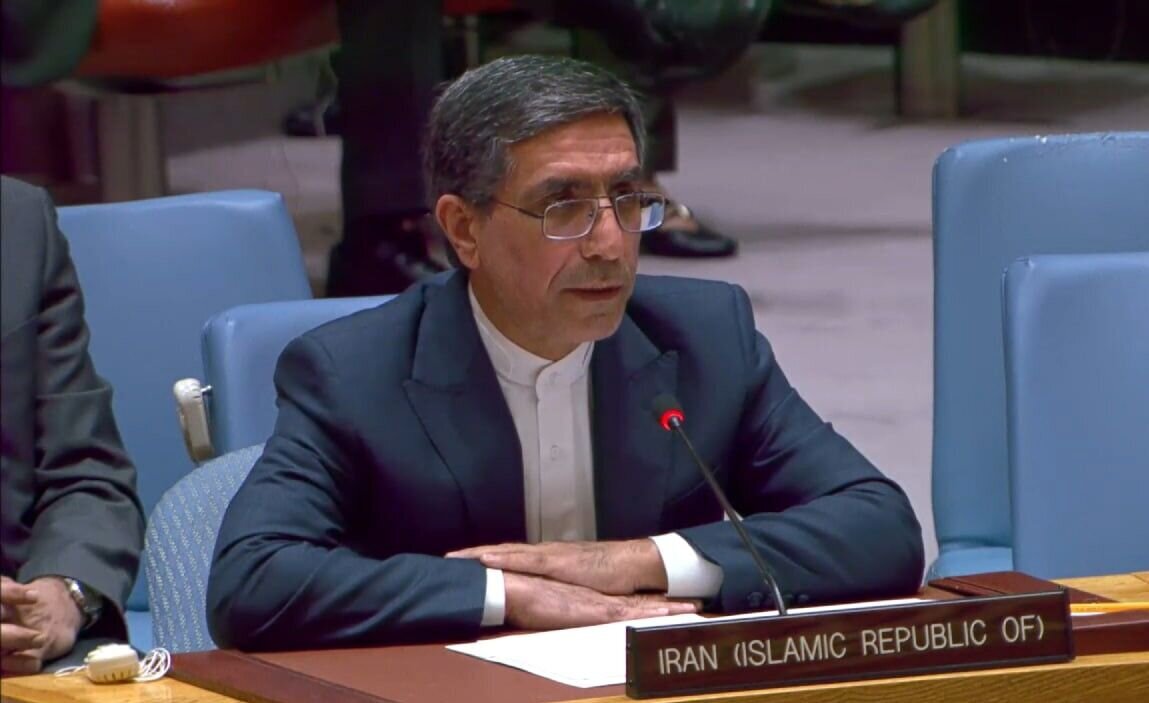
TEHRAN – Iran has called on the United States to immediately end its aggression against the country, lift its maritime blockade and provide credible guarantees against further attacks, warning that any renewed US-Israeli aggression would be met with an immediate and decisive response.
Addressing a UN Security Council meeting on the situation in the Middle East in New York on Friday, Gholamhossein Darzi, Iran’s Ambassador and Deputy Permanent Representative to the United Nations, said insecurity in the Persian Gulf and around the Strait of Hormuz was a direct consequence of US-Israeli military aggression and Washington’s unlawful measures against Iran.
Darzi said the United States had launched wars of aggression against Iran on June 13, 2025, and again on February 28, 2026, in flagrant violation of the UN Charter and fundamental principles of international law.
He said the two rounds of aggression had claimed more than 5,000 lives, including 254 children and 251 women, while extensive attacks had targeted civilians and civilian infrastructure, including hospitals, bridges, industrial facilities, airports, transport networks and energy installations.
Referring to the February 28 attacks, Darzi said two waves of US Tomahawk missiles had struck a school in Minab, killing 168 children. He also cited a US strike on Lamerd Stadium that killed at least 21 civilians, including children, and wounded around 100 others.
The Iranian envoy further condemned threats by US officials to destroy Iran’s power plants and bridges, describing such threats and attacks on civilian infrastructure as violations of international humanitarian law and war crimes.
He stressed that Iran’s military response had been undertaken in accordance with its inherent right to self-defense under Article 51 of the UN Charter, targeting US military facilities, bases and assets in the region used to launch attacks against Iran.
Turning to maritime security, Darzi said the insecurity surrounding the Strait of Hormuz stemmed directly from the aggression against Iran, attacks on its ports, maritime installations and commercial vessels, and the military and maritime blockade imposed on the country.
He described the blockade as an attempt to collectively punish a population of 90 million, warning that depriving civilians of food, medicine and other essential supplies constituted a grave violation of international humanitarian law and could amount to war crimes and crimes against humanity.
Darzi also held accountable countries that had facilitated the attacks by making their territories, airspace, military bases and logistical and intelligence infrastructure available to the United States and Israel.
He emphasized that Iran remained committed to peace and stability in the Persian Gulf, reiterating Tehran’s position that regional security arrangements should be established by the countries of the region themselves, without foreign interference and in accordance with international law.
The Iranian diplomat said the presence of foreign military forces and US bases in the region had become a major source of insecurity, instability and tension, posing serious risks to maritime safety.
On UN Security Council Resolution 2817 (2026), Darzi said Iran rejected the measure as politically motivated and adopted through a one-sided process that overlooked the root causes of the crisis and failed to recognize Iran’s inherent right to self-defense.
He argued that the resolution had undermined the principles of the UN Charter by failing to identify the United States and Israel as the aggressors, adding that no Security Council resolution could deprive a member state of its right to defend itself against an armed attack.
Darzi also reiterated that Iran had never ruled out diplomacy, but said repeated US military actions and threats during previous rounds of negotiations had created profound distrust and raised serious doubts about the prospects for renewed talks.
He said Washington must demonstrate its commitment to a diplomatic solution by ending its aggression unconditionally, providing credible guarantees against further attacks, respecting Iran’s sovereign rights and lifting the maritime blockade and other unlawful unilateral coercive measures.
“Any renewed war of aggression by the United States and the Israeli regime will be met with an immediate and decisive response,” Darzi warned, adding that Iran would take all necessary measures to protect its people, national security, vital interests and territorial integrity.
Addressing Yemen, the Iranian envoy categorically rejected ‘baseless accusations’ against Iran, reaffirming Tehran’s support for Yemen’s sovereignty, unity, independence and territorial integrity.
He called on the Security Council to adopt a balanced approach that takes account of realities on the ground, respects the Yemeni people’s right to determine their own future and addresses the root causes of the conflict.
Darzi also criticized certain Persian Gulf states for facilitating US-Israeli military operations against Iran by providing access to their territory, airspace and military and logistical facilities. He said such actions violated the UN Charter and international law and entailed state responsibility, including an obligation to provide full reparation for the material and moral damage caused to Iran and its people.
Disclaimer : This story is auto aggregated by a computer programme and has not been created or edited by DOWNTHENEWS. Publisher: tehrantimes.com