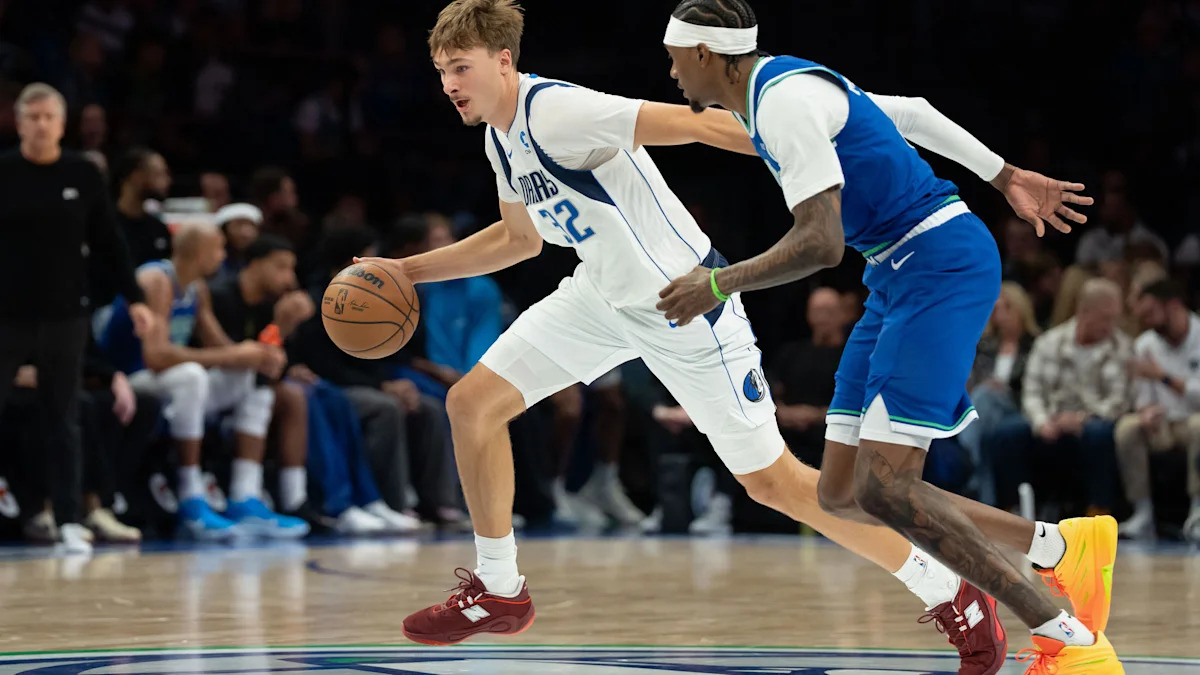
The Dallas Mavericks saw their three-game winning streak end in a crushing defeat on Thursday night at Target Center. Minnesota Timberwolves guard LaMelo Ball and backup Bones Hyland combined for 11 three-pointers as the Timberwolves scored 133 points to beat Dallas 94. This loss dropped the Mavericks to a 7-5 record and marked their worst performance of the season by a wide margin.
Coach Dusty May admitted after the game that his team could not match the intensity of the Minnesota squad. The Timberwolves dominated the paint with 74 points and forced 19 turnovers from Dallas. This loss highlighted major issues with Dallas defense and ball handling that will require immediate attention from the coaching staff and players alike.
Advertisement
Minnesota Defense Disrupts Every Dallas Play
The primary reason for the loss was the aggressive pressure applied by the Minnesota defense. Dallas coach Dusty May stated that the Timberwolves were extremely disruptive with their point of attack defense and activity on and off the ball. He noted that Minnesota deserved to win the game based on their defensive effort alone. The Timberwolves entered the game ranked first in the league for defensive efficiency, allowing only 106.1 points per 100 possessions.
Dallas struggled to get clean catches against this pressure, especially in pick-and-roll situations. According to Synergy Sports data, the Mavericks earned just 0.524 points per possession when Minnesota kept one defender on the ball handler. This pressure forced Dallas into 19 turnovers, with 10 of those coming directly from steals. The Timberwolves also blocked seven shots and held Dallas to just 37.2 percent shooting from the field.
May explained that the team speed and intensity of Minnesota made it difficult for Dallas to sustain any offensive rhythm. He pointed out that having two rim protectors behind the perimeter defenders was a luxury that Dallas could not overcome. The Mavericks failed to make enough better screens or increase their pace to counteract the defensive schemes used by the Timberwolves throughout the night.
Advertisement
Cooper Flagg And Kyrie Irving Struggle To Score
Key Dallas players Cooper Flagg and Kyrie Irving combined for only 22 points on 9-of-23 shooting during the game. The quiet performance in Minneapolis was especially disappointing for these two players, who had combined for 78 points three nights earlier in a win over the Indiana Pacers.
Irving recorded a minus-36 rating, which was the worst mark on either team and reflected the struggles of the Mavericks while he was on the court. Neither player saw action in the fourth quarter as the game was already out of reach. May observed that Minnesota possessed a single body before crossing half-court, a circumstance that stopped Dallas from utilizing that focus to create offensive opportunities in other areas.
The lack of scoring from these primary options forced other players to step up, but the overall team shooting remained poor. Dallas finished the game shooting just 27.1 percent from three-point range, converting only 13 of 48 attempts. This inability to score efficiently against a top-tier defense left the Mavericks unable to keep pace with the high-scoring Minnesota offense.
Advertisement
Bones Hyland And LaMelo Ball Lead Minnesota Attack
Minnesota guard Bones Hyland scored 24 points off the bench while LaMelo Ball added 22 points and nine assists for the Timberwolves. The two guards combined to hit 11 of their 16 three-point attempts, providing the perimeter scoring that Dallas could not match. Hyland made several shots off the bounce from three-point range, exploiting the defensive lapses of the Mavericks.
During the second quarter, Ball helped build a lead by hitting two step-back three-pointers from 25 and 27 feet within 1:16. The Timberwolves entered the third quarter with a 15-point lead and extended it significantly as Dallas could not stop the bleeding. By demonstrating excellent ball movement and unselfish play, Minnesota ended with 33 assists on 52 field goals.
Coach May praised the depth of the Minnesota team, noting that their second unit injected a lot of life into the starters. The Timberwolves scored 133 points on 57.8 percent shooting from the field.
Advertisement
Third Quarter Collapse Turns Game Into Blowout
The game effectively ended when Minnesota outscored Dallas 36-17 in the third quarter. After Jaden McDaniels contributed eight points and six rebounds in the period, the Timberwolves had already opened the half with a 10-1 run to establish a 77-53 lead. This quarter turned a competitive game into a 39-point loss for the Mavericks.
May said the most disappointing aspect of the game was the way Dallas responded to the runs made by Minnesota. Once the floodgates opened, the explosive speed and athleticism of the Timberwolves overwhelmed the Mavericks. The team failed to make stops when it mattered most, allowing Minnesota to extend their lead to as many as 44 points.
Dallas managed to cut the deficit to one point early in the second quarter but could not sustain that energy. The Timberwolves answered a Dallas run with a timeout and then closed the half on a 24-10 run. This inability to respond to runs and maintain defensive intensity for four quarters was a major factor in the blowout.
Advertisement
Dallas Fails To Match Physical Play Style
Minnesota dominated the physical aspects of the game, scoring 74 points in the paint and winning the rebounding battle 50-38. The Mavericks allowed the Timberwolves to score 12 points off their eight turnovers in the first half alone. This physical dominance continued throughout the game as Minnesota controlled the interior and the glass.
From the outset, Naji Marshall observed that the game was physical at the point of attack, finishing with 13 points and four assists. He admitted that Dallas did not do enough early in the game and that Minnesota punched them in the mouth. Marshall emphasized that the team needs to get more physical and put more pressure on the ball to stop Minnesota from getting comfortable.
The Mavericks also struggled with their spacing and screening, running only six handoffs and logging just one possession off screens all night. Marshall suggested that better screens and more pace were necessary to counter the defensive pressure. The lack of physical engagement allowed Minnesota to dictate the tempo and style of the game from the opening tip.
Advertisement
Coaching Criticism Of Team Response To Runs
Coach Dusty May was critical of how his team reacted to the runs made by the Timberwolves. He stated that the response to the runs was the most disappointing thing about the game. May felt that if the Mavericks could have sustained their small-ball lineup performance, the game could have been closer at halftime.
May explained that the team became impatient once Minnesota started making shots. He noted that the Mavericks gave up easy baskets by falling asleep on defense, which allowed the Timberwolves to hit step-back threes. These mistakes put Dallas in a tough spot that they could not recover from during the game.
The coach also mentioned that the team was not connected on the defensive end. He said that the players needed to help each other out and communicate better on the court. This lack of connection led to open looks for Minnesota and a breakdown in the defensive scheme that Dallas had prepared for the game.
Advertisement
Rebounding Disadvantage Hurts Dallas Effort
The Mavericks were outrebounded by a significant margin of 50 to 38, which gave Minnesota extra possessions and scoring opportunities. This rebounding disparity allowed Minnesota to control the pace of the game and limit Dallas’ second-chance points.
Minnesota finished with 26 fast-break points, taking advantage of the turnovers and missed shots by Dallas. Although the Mavericks tallied seven blocks and nine steals, their lack of team rebounding meant these individual defensive efforts were insufficient. The inability to secure defensive boards led to easy transition baskets for the Timberwolves.
Minnesota controlled the glass as Jaden McDaniels supplied 16 points and nine rebounds. The rebounding advantage allowed Minnesota to maintain their lead and prevent Dallas from mounting any comeback attempts. This statistical gap highlighted the physical dominance of the Timberwolves over the Mavericks on Thursday night.
Advertisement
Future Outlook For Dallas Mavericks
The loss drops the Mavericks to a 7-5 record as they begin a three-game road trip. The team must address the defensive issues and improve their rebounding to remain competitive in the Western Conference. Coach May emphasized the need for better communication and physical play in upcoming games.
Players like Naji Marshall and Zaccharie Risacher, who scored 22 points off the bench, showed flashes of potential but the team as a whole could not match Minnesota. The Mavericks need to find a way to generate clean catches and leverage their attention on offense to avoid similar blowouts in the future.
Minnesota improved to 9-3 and has won five straight games, proving they can win without Anthony Edwards and Donte DiVincenzo. The Mavericks will look to bounce back in their next game on the road, but they must fix the defensive lapses that led to this 39-point loss.
Disclaimer : This story is auto aggregated by a computer programme and has not been created or edited by DOWNTHENEWS. Publisher: Sports.yahoo.com