What in the World, a free weekly newsletter from our foreign correspondents, is sent every Thursday. This is an excerpt. Sign up to get the whole newsletter delivered to your inbox.
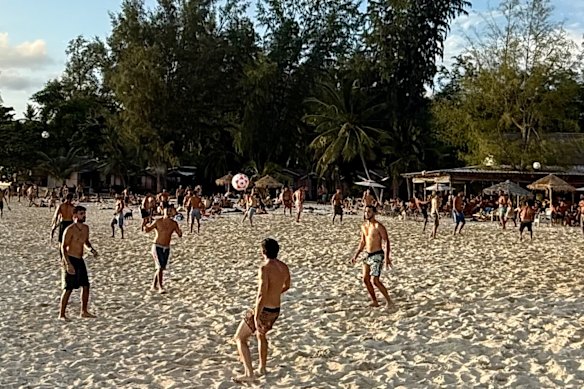
Koh Phangan: It’s sundown on the blissful Thai island of Koh Phangan and the beach at Srithanu is swarming with impossibly bronzed 20-somethings with the physiques of gymnasts.
Women in bikinis are dipping in the glassy sea or lounging with a cocktail and smoke by the Flamingo Bar. The blokes are shirtless and clustered in loose circles playing keep-it-up with soccer balls. It’s a cracking scene.
Me, I’m bumbling over the soft sand with a sunburnt nose and pasty-skinned limbs wrapped in pants and a T-shirt.Harry, my Thai colleague, meanwhile, is the only Asian face on the beach.
It is young Israelis who make up most, if not all, of the few hundred loungers, ocean-dippers and soccer ball-kickers.
The route is long-established but only since the October 7, 2023 Hamas-led terrorist attacks has it become so busy, Israelis and local Thais tell us.
Like Australians to Bali, Brits to Mallorca and Americans to Cancun, Israelis come to Koh Phangan, Koh Samui and Phuket, in the south of Thailand. Many are fresh from nearly three years of mandatory military service during their government’s ensuing war in Gaza.
“After two or three years of serving, and all the missiles we get from the Arabs, we are looking for a peaceful place,” says one young man who hails from the northern Israeli city of Haifa, which has been shelled by militant group Hezbollah, listed by the Australian government as a terrorist organisation.
Thailand and Israel have good relations. More than 40 Thai migrant workers were among those killed in the October 7 attacks – a point of solidarity.
Here is safety, camaraderie and sun. Thailand has become a haven for Israelis to heal, and sometimes prosper; and, increasingly, for some locals and Bangkok-based nationalists this is a problem.
Resentment has spawned a “Take Back Thailand” campaign that is sometimes spilling into explicit antisemitism.
In September, a couple of hundred protesters gathered outside the Israeli embassy in Bangkok bearing slogans such as “Keep Zionist Expansion out of Thailand” and “Thailand is Not Your Promised Land”.
Another protest forced the cancellation of a Rosh Hashanah event in Phuket. The Bangkok Post quoted unnamed protest organisers espousing the antisemitic trope that, “These Jews are staying inside their mansions”.
This is all very novel for Thailand, so Harry and I spent a few days at Srithanu, the heart of Koh Phangan’s Israeli community, to hear firsthand what is going on.
Is it the toll in Gaza? Maybe this has added something, but it is not front of mind for locals. The issues are of the kind many lower-income nations grapple with when tourism from wealthier nations is a linchpin of the economy: balance, business and behaviour.
“The local Thai people, there are few left,” explains Lerd, the Thai owner of a motorcycle rental business in Srithanu. “It’s Burmese and Israelis. But the Burmese are just the workers – they speak better English than Thais, and are harder working.
“I worry about our future generations here.”
A couple of years ago, a Chabad house, one of seven in Thailand, opened on the Srithanu’s main strip, drawing even more Israelis, locals say. It serves as a kind of spiritual and community centre, a place where Jews can gather and feel connected and protected by security. The centres offer free kosher meals on the Friday Sabbath and, judging by the taxi-load of newly arrived tourists filing through the gates, accommodation too.
Two more 7-Elevens popped up after it opened. A local restaurant next to one of them closed and reopened as a visa consultation business.
Perhaps naively, we thought the Chabad house was open to anyone, and wandered in for a Wednesday lunch, until the Thai security guard asked to see my passport and Harry’s ID. He then politely requested we leave. No worries here, though notions of exclusivity peeve some Thais. It is, after all, still Thailand.
The managers of the Chabad house declined an interview.
“One of the problems is cultural,” says Pattharachai Ruengsri, a Srithanu restaurant owner. “They [Israelis] don’t adapt their behaviour.”
He and others perceive entitlement – shouting at night, spurious complaints about food, arguments about bills and aggressive haggling. It sounds a bit like the problems with Australians in Bali, only without the killing, fighting and large-scale drug importation.
“It [Israeli tourism] has been good for my business,” Pattharachai says.“But I need to be aware of behaviours. It is not discrimination, it’s about individual behaviours. The other issue is, it may be keeping away other foreigners.”
Government figures released to local media reportedly show almost 70 per cent of 4761 businesses on the island have some level of foreign investment. Israeli investors top that list, followed by the French.
While most are believed to operate above board, some are suspected of using a paid-off Thai proxy to serve on paper as the majority shareholder. It’s a way to skirt complex bureaucracy, capital requirements and foreign ownership restrictions. Chinese, Europeans and Australians setting up in Thailand, where cash often speaks louder than the rules, do it all the time.
Thailand has been cracking down on the scheme under nationalist Prime Minister Anutin Charnvirakul, with special attention paid to Koh Phangan, Koh Samui and Chabad houses.
”Foreigners should arrive on Koh Phangan as happy visitors and must not be here to take over occupations from local people and cause them trouble,” Charnvirakul said in May on a visit to see for himself the enforcement blitz, which authorities allege uncovered illegal business structures.
The operation shut down a daycare centre catering to mostly Israeli families and some people were arrested. It opened again a couple of months ago, this time with the correct paperwork.
“We treat the kids really well. Maybe that’s why Israeli parents like us,” says Thai Pratumptip Yooin, who says she owns 100 per cent of the business. “We teach English here. Many kids cannot speak Thai.”
She recounts one hysterical rumour that the buildings held caches of Israeli weapons. “You can check,” she says. I tell her it is not necessary.
Tel Aviv University published a report this year warning of antisemitism being normalised since the war in Gaza, pointing to 2025 as the worst year for such attacks in more than 30 years.
Non-Jewish Australians don’t have to think about these sorts of things when abroad.
We ask another young holidaymaker at Flamingo Bar why so many Israelis come to Koh Phangan. He replies that “the answer is in your question”.
“This is a safe option. In Europe, for example, it’s not that safe – people ask questions, they say I’m a murderer … I tell them, ‘Let’s live in peace’.”
The pro-Palestine cause does not resonate in Thailand the same way as in Australia, particularly in chilled-out Srithanu, but it is part of the soup.
“There are two lenses,” says Pattharachai, the restaurant owner, of the war in Gaza. “One is that they [Israelis] are the victims. The other is that killing children is wrong. I feel angry sometimes. I know many Israelis would not like that, either. But maybe some of them do.
“Some will also sit here and look at the news of the war. They will cry when there has been a strike on their home. They will hug and support each other. I’ve seen it. Deep inside, you really feel sorry for them.”
Earlier this year, a French national and his Thai wife operating a private zoo on Koh Samui made news by displaying a Free Palestine sign and later, alleging harassment, barring Israelis from entry. The Frenchman, along with an Israeli man convicted of threatening him, were ordered to leave the country.
On Koh Phangan, another French national was accused of beating a 62-year-old Israeli mother and her daughter, leaving both in hospital, after asking their nationality.
“It sucks that when people ask where you’re from you have to hesitate,” says 36-year-old Ohad Lalot, who is holidaying in Srithanu on his way home from a long stint travelling in Australia.
“I didn’t choose for there to be a war. Sometimes [on trips overseas], when I say I’m from Israel it leads to very interesting conversations. Some people can also be aggressive, even though they don’t know anything about me other than I was born in Israel.”
Now even in Land of Smiles, the safe space for travelling Israelis is narrowing.
Get a note directly from our foreign correspondents on what’s making headlines around the world. Sign up for our weekly What in the World newsletter.

From our partners
Disclaimer : This story is auto aggregated by a computer programme and has not been created or edited by DOWNTHENEWS. Publisher: www.smh.com.au