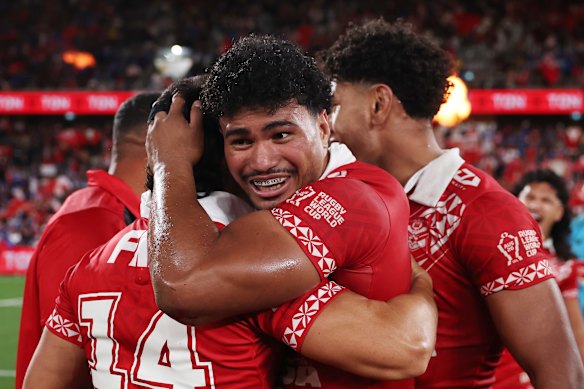

It is difficult for young NRL players of Pasifika or New Zealand heritage who are expected to carry a torch for the family but at the same time hold ambitions to step away from their shadow.
Changed eligibility rules have thrown up multiple challenges, including threats to the future of the Kangaroos, who play the Kiwis in the World Cup final on Sunday.
Consider the case of 22-year-old Roosters premiership player Robert Toia, who represented Queensland and Tonga this year. Kangaroos coach Kevin Walters received a long text from the young centre late on the day before the NRL grand final, in which Toia declared his World Cup allegiance to Tonga – reneging on an earlier undertaking to Walters to represent Australia if selected.
Walters was disappointed with Toia’s decision, particularly because it followed the defection days earlier of Titans and Maroons winger Jojo Fifita to Tonga in the World Cup. However, he understood that Toia, with a grand final to play the following day, wanted to clear his mind of the competing loyalties and the family pressure.
“I don’t hold any grudges,” says Walters. “They need to go where their heart is. I said that to both of them. There is a lot of pressure from their Polynesian families. But that’s OK. They are just doing what is best for them.”
The passion of many NRL players, like Melbourne’s Eli Katoa, for their ancestral homelands, such as Tonga and Samoa, is almost endemic, while others face relentless pressure from their extended family to represent the land of their fathers – despite the pay disparity of $850 per game compared with the Kangaroos receiving $40,000 for the tournament.
New International Rugby League board eligibility rules will allow more players like Toia to elect to play for countries other than Australia. Under the rules in place for this year’s World Cup, players are eligible to be selected by the country where one of their grandparents was born. But the IRLB this week extended the criteria to cover the birthplaces of eight great-grandparents, meaning the supply of NRL players to Pacific countries competing in future World Cups will cover the next generation of players.
Casey McLean, a 20-year-old centre, was born in Blacktown, plays for Penrith, represented NSW in Origin this year and will play for New Zealand in Sunday’s World Cup final. As the number of homegrown players of Pasifika and New Zealand heritage approximates half the NRL population, the eligibility rules both ensure the best players are available for the code’s big money earner, State of Origin, while also making international rugby league more competitive and therefore more lucrative in terms of TV rights.
The rules, however, run the risk of redistributing NRL talent among the World Cup countries, rather than growing it at both grassroots level in the emerging countries and in Australia itself. As players in the NRL increasingly commit to New Zealand, Tonga, Samoa, Fiji and England, the numbers in the pool available for the Kangaroos diminishes.
The NRL threatens to become the English Premier League, whose riches attract the world’s best soccer players, reducing the availability of positions for players of English background. Significantly, England has not won a FIFA World Cup since 1966.
Walters recognises the development problem ahead. “We need to have more avenues for players eligible only for Australia,” he says. “We need Australia to develop big forwards and probably wingers as well. The Polynesian players develop a bit quicker than the guys of Australian heritage only.”
Pointing to the size difference at junior levels, he adds: “We also need to ensure Australian kids stay in the game.”
Walters concedes this year’s World Cup exposed the Kangaroos’ lack of depth in middle forwards. Australia’s starting props against Samoa in the World Cup semi-final were Tino Fa’asuamaleaui, who represented Samoa at the 2019 tournament, and Keaon Koloamatangi, who played for Tonga at the 2022 iteration.
Both switched their allegiance to Australia and were desperately needed in the early clashes against Samoa. As it transpired, with Patrick Carrigan coming off the bench and running 163 metres, Australia won the battle up front. “We won the middle metres,” says Walters. “It was a real focus for us and will be in the final against New Zealand, with their big pack.”
The IRLB has not yet resolved whether to categorise Tonga and Samoa as Tier 1 countries, which would require players to commit to them permanently. A 12-month grace period is being considered, allowing players to finally declare their permanent allegiance. It also allows the board time to consider whether there are any unintended consequences of the changed eligibility rules.
Toia was born in Auckland but moved with his large family to Brisbane at age six. Toia agonised over his decision to play for Tonga before informing Walters. He may now be required to choose again.
The IRLB must question whether they are exerting too much stress on young players who are already besieged by pressure from their extended families. Some may choose not to play at all.
News, results and expert analysis from the weekend of sport sent every Friday. Sign up for our Sport newsletter.
 Roy Masters is a Sports Columnist for The Sydney Morning Herald.Connect via email.
From our partners
Disclaimer : This story is auto aggregated by a computer programme and has not been created or edited by DOWNTHENEWS. Publisher: www.smh.com.au