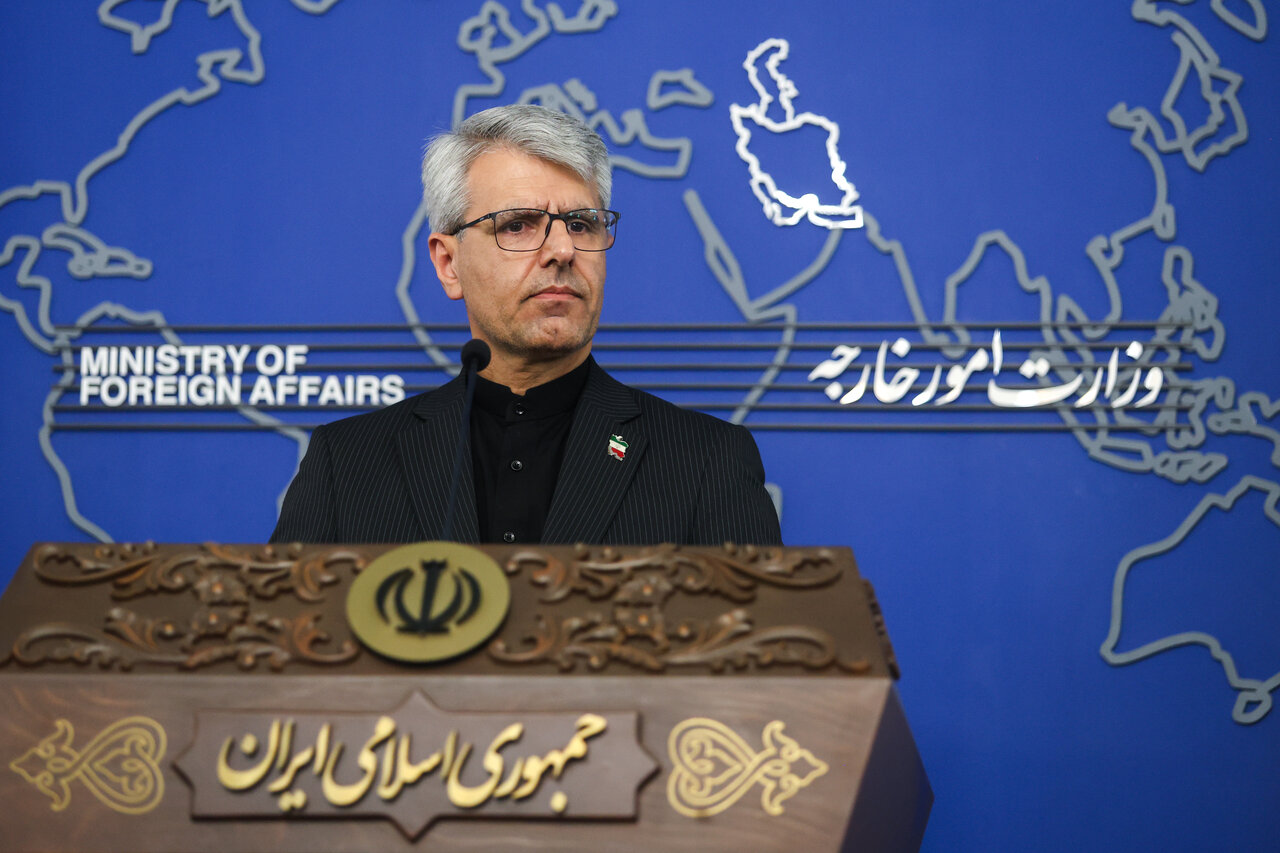
TEHRAN – Iran has warned that any renewed military aggression against the country will be met with a forceful response, while criticizing the International Atomic Energy Agency (IAEA) for a ‘biased approach’ under US influence, saying the agency’s conduct has undermined its credibility and further strained relations with Tehran.
Speaking at his weekly press conference on Sunday, Foreign Ministry Spokesperson Esmaeil Baqaei stressed that Iran would not leave any military attack or act of aggression unanswered, emphasizing that the country relies on its own capabilities and does not place its hopes in other parties.
“We will not leave any military attack or aggression unanswered, and we have proven this in practice,” Baqaei said, adding that Iran’s continued use of diplomatic channels should not be interpreted as dependence on or reliance upon any other country.
Commenting on US statements regarding negotiations, he said Tehran was not concerned with internal disagreements among American officials but maintained that Washington had stripped diplomacy of its fundamental purpose.
Diplomacy, he noted, is intended to prevent tensions and resolve disputes, whereas the United States has turned it into an instrument for setting ambushes and launching surprise attacks.
“The world views US diplomatic claims with suspicion,” Baqaei said, noting that Iran’s bitter experience in dealing with Washington makes it imperative for the country to take past events into account.
US priorities under fire
Baqaei also criticized US officials over their handling of domestic infrastructure problems, including disruptions to the country’s aviation system. He said American officials had attributed the flight disruptions to aging equipment and outdated infrastructure.
He questioned whether the American public would not ask why the government had failed to modernize its navigation systems while allocating resources to purchasing weapons and carrying out attacks that killed people in Iran.
The spokesman further accused US officials of showing little concern for their own citizens, arguing that their primary preoccupation was supporting the Zionist regime, whose actions in the region, he said, have been characterized by killing and violence.
Baqaei’s remarks came amid repeated warnings by senior Iranian military commanders that any renewed aggression against the country would trigger a decisive response.
On Friday, Commander of Iran’s Islamic Revolution Guard Corps (IRGC), Major General Ahmad Vahidi, warned that even the slightest act of aggression against Iran would be met with devastating and painful strikes, urging adversaries to learn from their repeated defeats.
Chief of Staff of the Iranian Armed Forces Major General Ali Abdollahi has also said that Iran’s previous retaliatory strikes were only the beginning, stressing that the country possesses the capabilities to deliver far more devastating blows if aggression resumes.
Iran questions IAEA’s credibility over its approach to nuclear issue
Turning to Iran’s relations with the IAEA, Baqaei sharply criticized the agency’s recent conduct and a report by its Director General, Rafael Grossi, accusing it of pursuing a one-sided approach under US influence.
He said the agency faced a structural problem in the way it prepares and publishes its reports, describing the shortcoming as one that must be addressed and suggesting that its continued persistence appeared deliberate.
According to Baqaei, the IAEA has continued along its previous course despite the influence of the United States and its biased approach. He warned that the agency’s one-sided report against Iran had damaged its credibility and would entail consequences for which it must accept responsibility.
“Creating pretexts to intensify the atmosphere surrounding Iran’s nuclear program has served no purpose,” he said.
The spokesman also pointed to opposition from two permanent members of the UN Security Council, Russia and China, to the approach reflected in the report, saying the issue had exposed divisions within the Council.
He noted that one significant aspect of Grossi’s report was its acknowledgment that military attacks against Iran had created an unprecedented situation. However, Baqaei argued that the agency should have explicitly identified US and Israeli military aggression as the principal cause of those circumstances.
“Unfortunately, following these attacks, the IAEA has ignored this bare fact,” he said.
Baqaei stressed that no improvement in relations between Iran and the agency could be expected while the current circumstances and the IAEA’s approach remained unchanged.
Addressing the Treaty on the Non-Proliferation of Nuclear Weapons (NPT), he said any decision concerning Iran’s position on the treaty would be made by the country’s relevant institutions.
“As long as we remain a member of the NPT, we are committed to its obligations,” he stated.
Return of inspectors must take security circumstances into account
Responding to the IAEA’s call for the return of its inspectors to Iran, Baqaei said the agency could not make such a request without considering the background and circumstances surrounding the suspension of inspection activities.
He pointed out that the IAEA had itself acknowledged in its report that US and Israeli aggression had disrupted access for its inspectors.
“The IAEA must decide whether it wants to be a technical body or remain under the influence of certain countries,” he said.
Baqaei added that the disruption of the agency’s activities in Iran was a direct consequence of US and Israeli acts of aggression, as well as the IAEA’s silence in response to those attacks.
A few days earlier, Iran’s Mission to the UN Office in Vienna had also criticized resolutions adopted by the IAEA Board of Governors against Iran, describing them as legally and technically flawed.
The mission argued that normal safeguards activities could not resume under the abnormal conditions created by attacks on Iran’s safeguarded nuclear facilities.
In a post on its X account, the Iranian mission said the Board’s decisions had been adopted through an abuse of process, while the attacks had disrupted inspection activities and forced the agency to withdraw its inspectors.
It also cited Grossi’s acknowledgment that the attacks had created unprecedented circumstances, disrupted inspections and made it necessary to take Iran’s security concerns into account.
Disclaimer : This story is auto aggregated by a computer programme and has not been created or edited by DOWNTHENEWS. Publisher: tehrantimes.com