1945
Harry Grabiner, the longest-tenured executive in White Sox history and certainly one of the longest-running employees overall, resigned as GM of the club. While not really formally holding a GM title, Grabiner had run the White Sox in tandem with three generations of Comiskey ownership, dating back to 1915. He first caught on with the team in 1905, selling scorecards; the 15-year-old got the job after noticing owner Charles Comiskey working the Comiskey Park infield after a rainstorm and asking if he could help out. By 1916, Grabiner was the team secretary (the de facto GM), at just 26. In 1939 upon the death of Comiskey’s son, Louis, the will stipulated that Grabiner was guaranteed another 10 years of employment in running the White Sox. However, Grabiner’s health was in decline, forcing his leave six years later.
Grabiner would soon return to baseball, as part of Bill Veeck‘s ownership group in Cleveland. Meanwhile in Chicago, sabermetrics pioneer Les O’Connor took over the club for the next three seasons.
Advertisement
Also on this day came some administrative news of a different sort. With Hall of Fame voting at this time occurring just once every three years, just one player and two people overall had been elected to the Hall of Fame over the previous five years. With a massive pileup of worthy players were clogging the ballot, Cooperstown decided to hold a runoff election in order to get more players into the Hall — but the move was ineffective, as no one reached the necessary 75% for election. That included legendary White Sox hurler Ed Walsh, who received just 137 of 247 (55.5%) of votes, finishing third overall on the ballot.
1948
After six years with the White Sox (interrupted right in the middle by three seasons lost to military service in World War II), Taffy Wright was sold to Philadelphia. Wright logged 12.5 in his White Sox career, was an average or better player in four of six seasons, and earned MVP votes in three. By 1948, with the right fielder’s WAR winnowed down to 0.5 over a full season of play, Chicago cut ties. He would play one subpar season for the Athletics and would not see the majors again, although Wright would stay active in the minors until 1956, at age 44.
1951
In an outrageous turn, White Sox outfielder Minnie Miñoso lost the American League Rookie of the Year award to Gil McDougald of the New York Yankees, 13 votes to 11.
There are two objectionable areas in particular, when reviewing this hack voting. First is the fact that Miñoso finished much better than McDougald in MVP voting, which drew from a bigger and better spread of voters, 120-63. Miñoso finished fourth in the AL and actually received one first-place vote of the 22 ballots cast. McDougald finished ninth, with just 63 votes. Among all hitters who were “serious” candidates (i.e. Top 10 on the ballot), Miñoso’s WAR was highest, at 5.4 (McDougald sat at 4.5).
Advertisement
Second was the pure stats breakdown. Beyond the WAR advantage, Miñoso had the best OPS (.922) among Top 10 finishers, and also led the league in steals, with 31. Miñoso also led McDougald in basically every offensive category besides home runs (10, to McDougald’s 14).
1972
After accomplishing one of the greatest individual seasons in franchise history and barely missing the Triple Crown, White Sox first baseman Dick Allen was named the MVP of the American League by the Baseball Writers Association of America.
Allen led the league with 37 home runs, 113 RBIs, a .603 slugging percentage and 99 walks. He led the Sox with a .308 batting average, drove in 19 game-winning runs, stole 19 bases, scored 90 runs and was only .0005 points shy of leading all AL first basemen in fielding. He was the overall MLB leading vote-getter for the All-Star team.
In the MVP race, Allen garnered 21 of 24 first place votes, for 321 points. Joe Rudi of the A’s was second, with 164 points.
2000
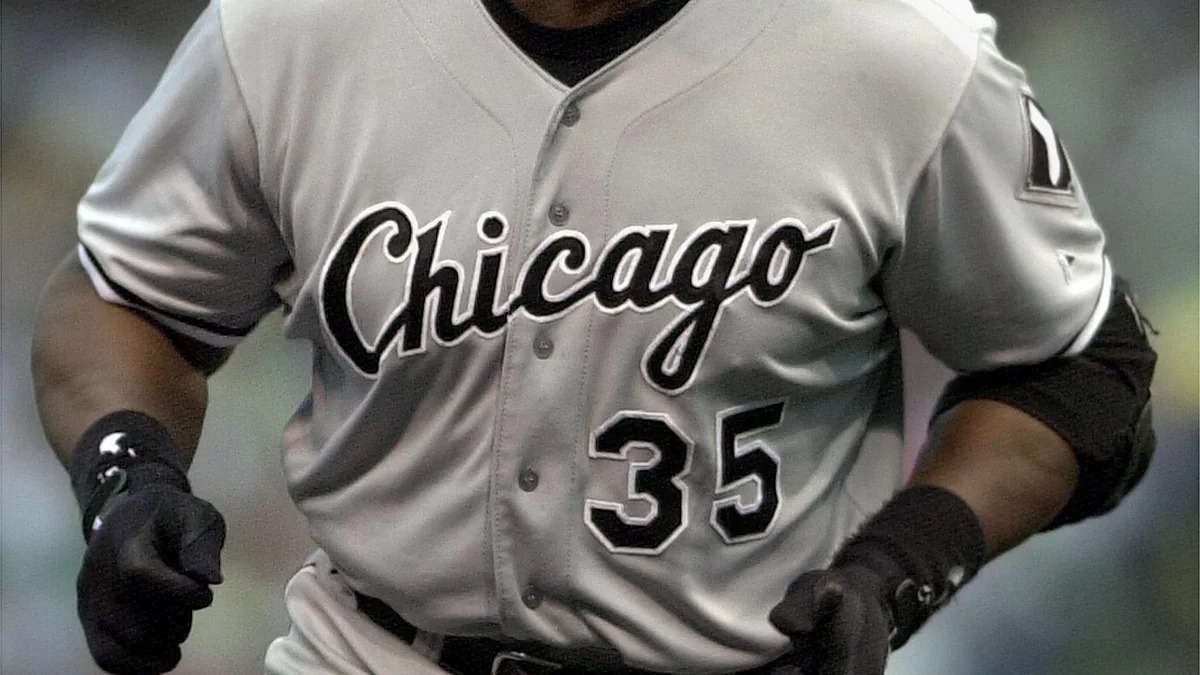
Jason Giambi edged out Frank Thomas for AL MVP, 371 votes to 285. Giambi hit .333 with 43 homers, 137 RBIs and 7.8 WAR, while the two-time White Sox winner batted .328 with 43 homers, 112 RBIs and 6.0 WAR.
Advertisement
The fact that Giambi later admitted to steroid use during the 2000 season has long given Thomas and his backers cause to dispute the award, but in truth Thomas’ reputation as a two-time winner (and leader of the division-winning White Sox) got him into second place to begin with.
Per WAR, several other players had more just cause for AL MVP than either Giambi or Thomas, beginning with Boston Red Sox ace Pedro Martínez, with 11.7 WAR. And if you believe, very reasonably, that the MVP should be restricted to position players, then both Alex Rodriguez (10.4 WAR, third-place finisher) and Darrin Erstad (8.3, 8th) had better cases than either Giambi or Thomas and at least three other AL hitters had a better case than Thomas.
Disclaimer : This story is auto aggregated by a computer programme and has not been created or edited by DOWNTHENEWS. Publisher: Sports.yahoo.com