For only the second time since 9/11, last Saturday saw the temporary suspension of all flight departures in the United States, something we in the trade call a “ground stop”.
It makes sensational headlines when it happens on such a scale, but a ground stop actually occurred at Brisbane Airport last Wednesday, when severe thunderstorms held aircraft on the ground in other locations around Australia so as not to create unsafe congestion in the air.
A ground stop is a relatively simple mechanism that can be used by Air Traffic Control (ATC) to immediately take pressure off the controllers dealing with aircraft in the air. Ground stops happen all over the world from time to time. Airservices Australia, our equivalent of the US Federal Aviation Administration (FAA), routinely uses a ground-stop at Sydney Airport when the tower assesses that the airport will break the 70 aircraft movements an hour imposed by the federal government. Arrivals continue, but departures stop until the clock ticks over to the next hour.
Facts are scarce, so conspiracy theories are flourishing, aided by the big Microsoft outage on the same day, an increase in cyberattacks and the general panic around AI. On Friday the 13th of all days! I’m here to call for calm. Essentially, the nationwide ground stop was called because the routine communication systems that connect the air traffic control centres failed. When the back-ups also failed, it was time to act.
The US has 20 ATC centres, not counting Alaska and Hawaii, compared to just two that we have in Australia – in Brisbane and Melbourne. If the controllers were handling aircraft movements but unable to communicate with colleagues, unable to hand-off aircraft from centre to centre, and potentially not able to trust their radar screens, then fast and effective action was required. A ground-stop coupled with immediate landing instructions to all aircraft is the best and safest course of action for the travelling public.
Information from reliable sources shows that work was being conducted by L3 Systems, a well-known provider of ATC systems. It is reported they were in the process of replacing an outdated copper wire system with newer fibre-optic material when the failure occurred. The notion that such an upgrade should have happened at a less busy time ignores that fact that, unlike the curfews imposed in some of Australia’s eastern seaboard airports, the US aviation system is 24-hour operation.
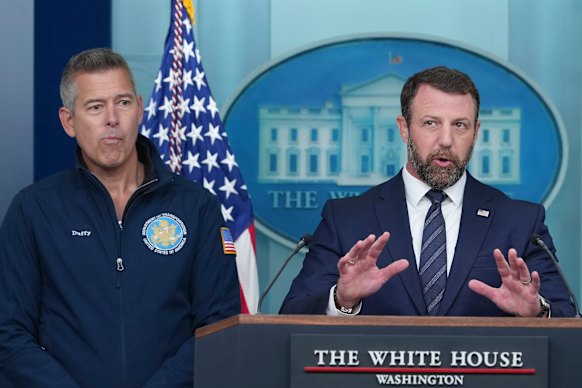
Sadly, in Trumpian times, the public has lost trust in any narrative emanating from the White House briefing room. Trump only has himself to blame for that. But when Homeland Security Secretary Markwayne Mullin and US Transportation Secretary Sean Duffy begin their press conference with, “This is what the leadership of President Trump looks like by the organisation and team he’s put together”, it politicises a process that is, for all intents and purposes, purely an aviation event.
Little wonder that people become suspicious.
Accused of not doing enough to upgrade the system during his time in charge, the previous transportation secretary under Democrat President Joe Biden, Pete Buttigieg said, “this should not be about politics” and that “when we had an outage, I didn’t stand there complaining about the Trump administration … we got to work … I’m certain that that’s what career officials and the career day-to-day employees at FAA and USDOT [US Department of Transport] are doing.”
Buttigieg called for transparency and said that he did not know why back-up systems did not operate, but the very “dedicated public servants” of the FAA will be working hard on the problem and we should wait for the officials to tell us what happened. Good advice for us all.
Some are speculating that very little money was spent on the system by Biden. Others say that Elon Musk and his DOGE cut all of the funds. Also in play is the theory that a new AI system called the Strategic Management of Airspace, Routes and Trajectories (SMART) had gone berserk. But political statements by presidential appointees blaming Congress for not providing enough money to keep things running do not make sense when the Congress is, or at least was until the midterms, controlled by the Republicans.
The state of US politics and suspicion of AI systems means the public is loath to believe that such a critical failure can be explained in simple terms. But I believe we should take all theories other than a systems upgrade gone wrong with a pinch of salt, and rely on the National Transportation Safety Board to eventually tell us what really occurred. Yes, eventually. I know no one likes to wait any more, but wait we must if we want to learn lessons rather than entrench mistakes.
Geoff Fairless is a retired air traffic controller, a CASA aviation safety inspector and aviation safety and risk management specialist.
Get a weekly wrap of views that will challenge, champion and inform your own. Sign up for our Opinion newsletter.
 Geoff Fairless is a retired air traffic controller, a CASA aviation safety inspector and aviation safety and risk management specialist.
From our partners
Disclaimer : This story is auto aggregated by a computer programme and has not been created or edited by DOWNTHENEWS. Publisher: www.smh.com.au