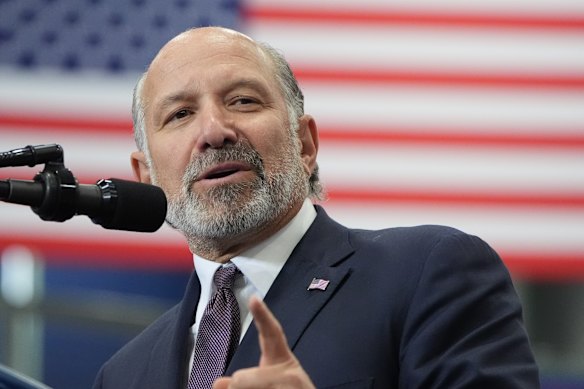

Washington: US Commerce Secretary Howard Lutnick is facing escalating pressure over his role in the Nvidia scandal that toppled chief executive Jensen Huang, with Democrats and Republicans demanding answers over the billionaire’s decisions about so-called chip smuggling.
Lutnick, who was already considered vulnerable in a potential post-midterm election reshuffle, faces questions about his apparent failure to blacklist Singaporean firm Megaspeed, which was formerly run by Alice Huang, the suspected Chinese spy with whom Jensen Huang (no relation) was having an affair.
More broadly, Lutnick and other officials – including President Donald Trump – are under pressure over the administration’s decision to allow Nvidia to sell some chips – the older H200s – to China as long as the US government could take a cut.
In a letter to Lutnick last week, Democrats in Congress called it an “unconstitutional export tax” and said the scheme could compromise national security. They requested that the commerce secretary preserve all records related to that and other decisions.
Lutnick has agreed to testify before the Republican-chaired Senate Banking Committee, as has Jensen Huang. Republican senator Jim Banks, who sits on the committee, was deeply sceptical of Lutnick’s actions when he appeared on Sunday-morning television.
“Secretary Lutnick had the power to close loopholes and put Megaspeed on the entity list and he did not do that,” Banks told Fox News.
“Why not? … Why did he not close that loophole? Why did he allow chip diversion and chip smuggling to continue to occur? I want to hear from Jensen Huang but I want to hear from Secretary Lutnick even more.”
Treasury Secretary Scott Bessent, who reportedly confronted Lutnick over the matter at the White House last week, has also zeroed in on the Commerce Department and its secretary.
Bessent told CNBC that Treasury, the Defence Department, State Department and US Trade Representative had all pushed for Megaspeed to be blacklisted for months “but Commerce has the pen”.
The Commerce Department did not immediately respond to a request for comment on Sunday (US time).
Bessent and Lutnick are both expected to travel on Air Force One with Trump to the Philippines and China on Monday (US time) as the president leads a delegation to the ASEAN and APEC summits, as well as a trilateral meeting in Shenzhen with China’s President Xi Jinping and Russian President Vladimir Putin.
US news outlet Semafor first reported that Lutnick would attend the trip, quoting an unnamed US official who said the Nvidia scandal “should not really have any bearing” on the visit.
Lutnick was already under pressure before the Nvidia scandal. He testified before Congress over his links to Jeffrey Epstein, admitting to interactions with the disgraced paedophile financier after the date on which he previously claimed to have severed all contact.
Speculation has been rife in Washington for months about Lutnick’s future. Reuters reported on Thursday that White House officials were discussing whether he should be pushed out. The White House did not respond to a request for comment.
Some perceive Lutnick’s influence with the president as relatively low. One Washington diplomat said: “If you wanted to form a relationship with someone in the Trump administration … you’d be crazy to pick him.”
Lutnick is the billionaire former president and chief executive of financial services firm Cantor Fitzgerald. On Sunday, The New York Times reported that the company – now run by Lutnick’s sons Brandon and Kyle – “had business dealings with several data centre companies in South-East Asia that cater to Chinese clients”, which could be affected by the regulations Lutnick is managing.
Chris McGuire, senior fellow at the Council on Foreign Relations and specialist on China and emerging tech, wrote in the Times that Lutnick should resign. His failure to enforce export controls “has enabled one of the largest transfers of controlled technology to a US adversary in history”, McGuire wrote.
While Lutnick has become the face of the Trump administration’s apparent laxness on Nvidia and chip sales, it was Trump who sanctioned the deal to sell mid-level chips to China and spoke about how Chinese President Xi Jinping “responded positively”.
On Sunday, Bessent said that Trump’s line in the sand was clear: older H200 chips could be sold to China but nothing above that. He shifted focus to a potential “culture of noncompliance at Nvidia” – until now a darling of the AI industry and the US sharemarket.
There must be a probe of whether Nvidia had such a culture and how far up the chain it went, Bessent told Fox News. “Was it a low-level fail, was it in the middle or was it up in the C-suite?”
Bessent said it was obvious that certain entities Nvidia was selling chips to were shell companies funnelling high-level chips to China.
It meant that the company’s next chief executive had to be an external appointment, he said. “They need a dramatic shake-up.”
Get a note directly from our foreign correspondents on what’s making headlines around the world. Sign up for our weekly What in the World newsletter.
 Michael Koziol is the North America correspondent for The Age and Sydney Morning Herald. He is a former Sydney editor, Sun-Herald deputy editor and a federal political reporter in Canberra.Connect via X or email.
From our partners
Disclaimer : This story is auto aggregated by a computer programme and has not been created or edited by DOWNTHENEWS. Publisher: www.smh.com.au