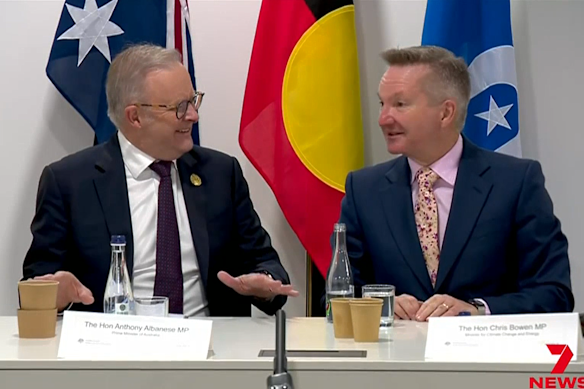

Anthony Albanese’s own radiation safety experts have rejected his claims that carrying a mobile phone close to the heart can interfere with its rhythm, declaring there is no scientific evidence to support the prime minister’s unsolicited health advice to cabinet colleague Chris Bowen.
The Australian Radiation Protection and Nuclear Safety Agency (ARPANSA), which advises the federal government on the health effects of electromagnetic radiation, has also dismissed concerns that keeping phones in trouser pockets could damage sperm or fertility.
The unusually blunt scientific clarification follows an embarrassing hot-mic exchange between Albanese and Bowen at the COP31 climate summit in Turkey, where the pair discussed the potential dangers of mobile phone radiation before joking about the relative importance of their hearts and genitals.
“There is no substantiated evidence that RF EME exposure at levels below the safety limits will have any impact on health including on heart function, sperm quality or fertility,” an ARPANSA spokesperson told this masthead.
“Precautionary measures to reduce EME exposure are not required, and there are no known safety concerns with carrying a mobile phone close to your body.”
The intervention directly contradicts Albanese’s warning to Bowen during a private conversation inadvertently captured by television cameras as the pair prepared for a renewable energy investment roundtable in Antalya on Friday.
After placing his phone in his jacket pocket, Albanese asked Bowen whether he was right-handed and where he usually carried his device.
“Generally yeah,” Bowen replied, pointing to his jacket pocket. “It should be away from your heart,” Albanese warned. “It can interfere with your rhythm.”
“A little bit radioactive?” Bowen asked. “Yeah. It makes absolute sense,” Albanese replied.
But Bowen was more concerned about another part of his anatomy.
“Speaking personally, I’m more conscious of putting it in my pants pocket,” he said.
“Because of your dick?” Albanese interjected.
“Because of my dick,” Bowen replied, laughing. “Arguably more important than the heart.”
The exchange, first broadcast by Seven News, prompted criticism from the Coalition, which accused the pair of engaging in inappropriate locker-room talk at an international summit.
Chief Medical Officer Michael Kidd declined to comment on Albanese’s health advice, instead directing questions to ARPANSA.
Albanese subsequently apologised, telling reporters in Manila on Sunday that the conversation had been intended as light-hearted banter between friends.
“I, of course, regret that and I apologise,” he said, while stressing that nobody had been hurt or harmed.
ARPANSA said its radiofrequency safety standard sets exposure limits many times below the levels at which known adverse health effects occur.
The agency, which continually reviews international scientific research on electromagnetic energy and health, said Australians did not need to take additional precautions when carrying their phones.
The episode has echoes of another Labor prime minister whose fascination with the possible dangers of modern technology extended well beyond conventional medical advice.
Paul Keating became so concerned about mobile phone radiation that his staff began wearing hands-free headsets during the 1996 election campaign, joking that the devices would stop them “frying your brain”.
As this masthead reported in 1997, virtually the entire prime ministerial office had adopted the headsets by the end of the campaign’s first week, although nobody could remember whether Keating or his chief political adviser, Don Russell, had first raised the alarm.
Keating’s suspicions went considerably further, according to former economic adviser John Edwards’ 1996 biography, Keating: The Inside Story. Edwards wrote that the former prime minister was deeply sceptical of conventional medicine, regularly consulted a Canberra herbalist and drank a daily glass of Chinese herbal medicine.
He even installed a trampoline in the backyard of his rented Canberra home, believing the brief moment of weightlessness at the top of each jump could destroy cancer cells.
Edwards described Keating as “inclined to fanciful cures for ailments”, while revealing he used an earpiece and small microphone to keep his mobile phone away from his head.
The prime minister’s office was contacted for comment.
Cut through the noise of federal politics with news, views and expert analysis. Subscribers can sign up to our weekly Inside Politics newsletter.
 Rob Harris is the national correspondent for The Sydney Morning Herald and The Age based in Canberra. He is a former Europe correspondent.Connect via email.
From our partners
Disclaimer : This story is auto aggregated by a computer programme and has not been created or edited by DOWNTHENEWS. Publisher: www.smh.com.au