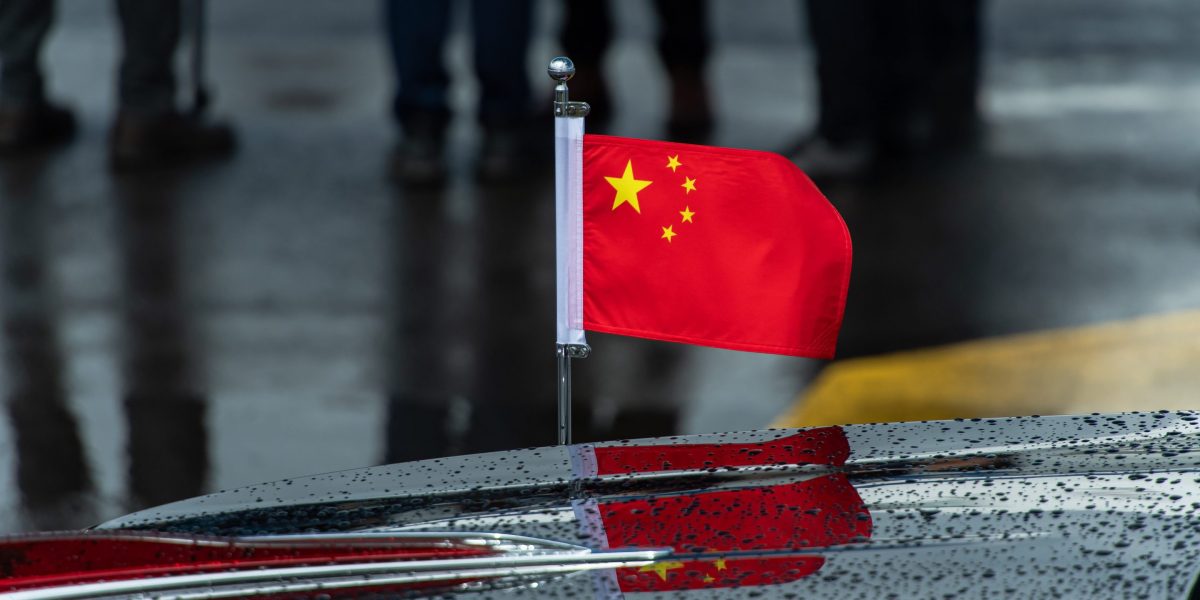
There was a time when China worried about competing with European carmakers. In the years leading up to China joining the World Trade Organization in 2001, the warning that circulated in the auto industry was lang lai le: “the wolf is coming.”
The wolf was technically already inside the gates—China had worked with foreign carmakers like General Motors and Volkswagen in joint ventures since the 1980s—but joining the WTO meant giving up 100% tariffs and import quotas that shielded China’s domestic car industry from competitors abroad.
But despite having to lower its trade barriers, China is now the dominant carmaker, producing over 7 million cars in the first quarter of 2026, according to the International Organization of Motor Vehicle Manufacturers. That’s almost twice the production of every EU country and the U.K. combined (3.7 million) and more than the 2.6 million made in the U.S.
EVs helped put China on top, to the point where the EU and U.S. imposed tariffs on Chinese-made models because Chinese government backing of the EV industry led to surplus production that’s flooding overseas markets with cheap exports. Meanwhile, weak domestic demand has forced Chinese carmakers to rely on sales abroad.
Germany, whose vaunted auto industry faces an existential threat, may mandate joint ventures with China, just like China did with Volkswagen decades earlier to protect its automakers.
“There’s been a complete reversal,” Eric Thun, professor of Chinese business studies at Oxford, told Fortune.
How China did it
As Beijing and local governments scrambled to meet economic growth targets, China built up its auto industry so much that it now has the capacity to produce an estimated two-thirds of the world’s car demand.
But when former General Motors Asia Pacific president Michael Dunne first visited China in 1986, then as a graduate student learning Mandarin, he told Fortune there “was no auto industry” yet. Just two old models ruled the streets: a boxy Soviet sedan called the GAZ-24 Volga and the Volkswagen Santana.
That same year, Beijing designated auto manufacturing as a pillar in its seventh Five Year Plan. It started inviting foreign carmakers into the country, allowing them to sell in China provided they manufacture the cars in the country and partner with a Chinese firm that owned at least half the venture.
By the late 1990s, these joint ventures accounted for more than 80% of China’s domestic vehicle production, according to a 2000 Congressional Research Service Report. The idea was that China would pick up the knowledge and learn to make its own cars.
That didn’t end up happening. Dunne, who spent 36 years in China advising automakers as the CEO of Dunne Insights, said the strategy partly succeeded in turning China into a major manufacturing hub, but it didn’t produce Chinese carmakers capable of challenging the likes of Volkswagen and General Motors, which continued to dominate with innovations in gasoline-powered vehicles.
Still, those joint ventures helped lay the groundwork for China’s eventual breakthrough. According to Oxford’s Thun, China required foreign automakers to source a percentage of their parts locally, which meant Volkswagen, for instance, sent teams of engineers to teach Chinese suppliers to meet their manufacturing standards.
“It was through these processes that they really created very deep industrial capabilities,” Thun said.
China joining the WTO in 2001 also inadvertently helped by creating domestic competition. Fengming Lu, assistant professor at the Coral Bell School of Asia Pacific Affairs at the Australian National University, told Fortune Beijing relaxed restrictions on new automakers that year, with the logic that it would help them prepare for cheaper imported cars.
Lu said this led to then battery maker BYD acquiring an automaker license in 2003 “because they saw more opportunities in an increasingly competitive but fast-growing auto market,” and benefitted two of China’s now-largest automotive groups, Chery and Geely.
Beijing also pushed domestic manufacturers to become less dependent on Western technology after joining the WTO, and even said it would provide tax support for research and development.
Changing the game with EVs
This institutional support was important since Chinese carmakers were at a technical disadvantage with their European and Japanese counterparts, who had spent decades perfecting internal combustion engines.
But EVs offered a way around that problem. Because China had an established battery and electronics industry, EVs gave Chinese companies a chance to compete on different turf.
“It was really the switch to electric vehicles which changed the nature of the game for Chinese producers,” Thun said.
China began supporting EVs in 2009, launching a program to deploy electric buses and taxis in cities across the country.
Jonas Nahm, a former member of the White House Council of Economic Advisers and a professor at Johns Hopkins School of Advanced International Studies, recalled speaking with Chinese taxi drivers around 2012 who hated their electric cars because the batteries had limited range, which would force them to switch to gas cars mid-shift.
But he said these early experiments helped China make better EVs that edged out the competition later on.
“These procurement policies essentially forced a lot of learning and gave them sort of space for experimentation, and so over time they just got a lot better at the battery piece, which is so essential for building a competitive car,” Nahm told Fortune.
In 2015, Premier Li Keqiang announced the Made in China 2025 strategic initiative, a turning point where the country made clear it wanted to be an EV leader. Beijing also backed the EV industry with subsidies and preferential financing, which helped manufacturers expand quickly.
But that led to excess supply—made worse by China’s prolonged real estate slump that weakened domestic demand—leaving exports to pick up some of the slack, according to the IMF.
The Tesla effect
But government policies weren’t initially enough to win over Chinese consumers to EVs, so Beijing turned to an American company that made them cool: Tesla.
In 2018, China began lifting restrictions on foreign ownership of EV manufacturers, which let Tesla build a factory in Shanghai without a Chinese joint-venture partner. Tesla broke ground on the factory in 2019 and started delivering locally-made cars by the end of that year.
Dunne said Chinese officials saw in Tesla a “really modern, good-looking electric car that has advanced technology and software” and thought it would change Chinese people’s negative perceptions of EVs.
It seemingly worked. Tesla’s Shanghai plant shipped 50,000 cars, and the company controlled 21% of the Chinese EV market in the first half of 2020.
“It was like a miracle happened overnight,” Dunne said. “The Chinese customers just fell in love with Tesla, and then started to change their minds about electrics, and we saw demand for EVs just skyrocket.”
Nahm said Beijing’s decision to let Tesla operate independently was also a deliberate way to introduce fierce outside EV competition to the country. Tesla sourced 95% of its parts locally and raised standards across the industry.
“Tesla was kind of a disruptor in that way,” Nahm argued, adding that its arrival “really spurred a lot of investment and technology advances among the domestic auto manufacturers.”
But that competition fueled a race-to-the-bottom price war referred to as neijuan, or “involution,” where Chinese carmakers are overproducing cars and selling at a loss domestically. They made 16 million EVs last year, outstripping domestic demand by 20%, according to the International Energy Agency’s 2026 Global EV Outlook report.
The release valve became EV exports, which doubled to 2.5 million last year as BYD, XPeng, and Xiaomi grabbed market share in Latin America and Europe. BYD even outsold Tesla for the first time this year. But this sparked backlash over unfair trade practices. In 2024, then President Joe Biden cited overcapacity and subsidies when his administration raised tariffs on Chinese EVs to 100%.
The effect is also evident in the European carmakers that came to China to set up joint ventures and are now struggling. For instance, China once supplied half or more of Volkswagen’s profits, but Volkswagen’s deliveries to China were down 36.6% in the second quarter of this year.
“The global automakers were caught flat-footed thinking they were going to be the darlings of Chinese consumers forever,” Dunne said.
Disclaimer : This story is auto aggregated by a computer programme and has not been created or edited by DOWNTHENEWS. Publisher: fortune.com