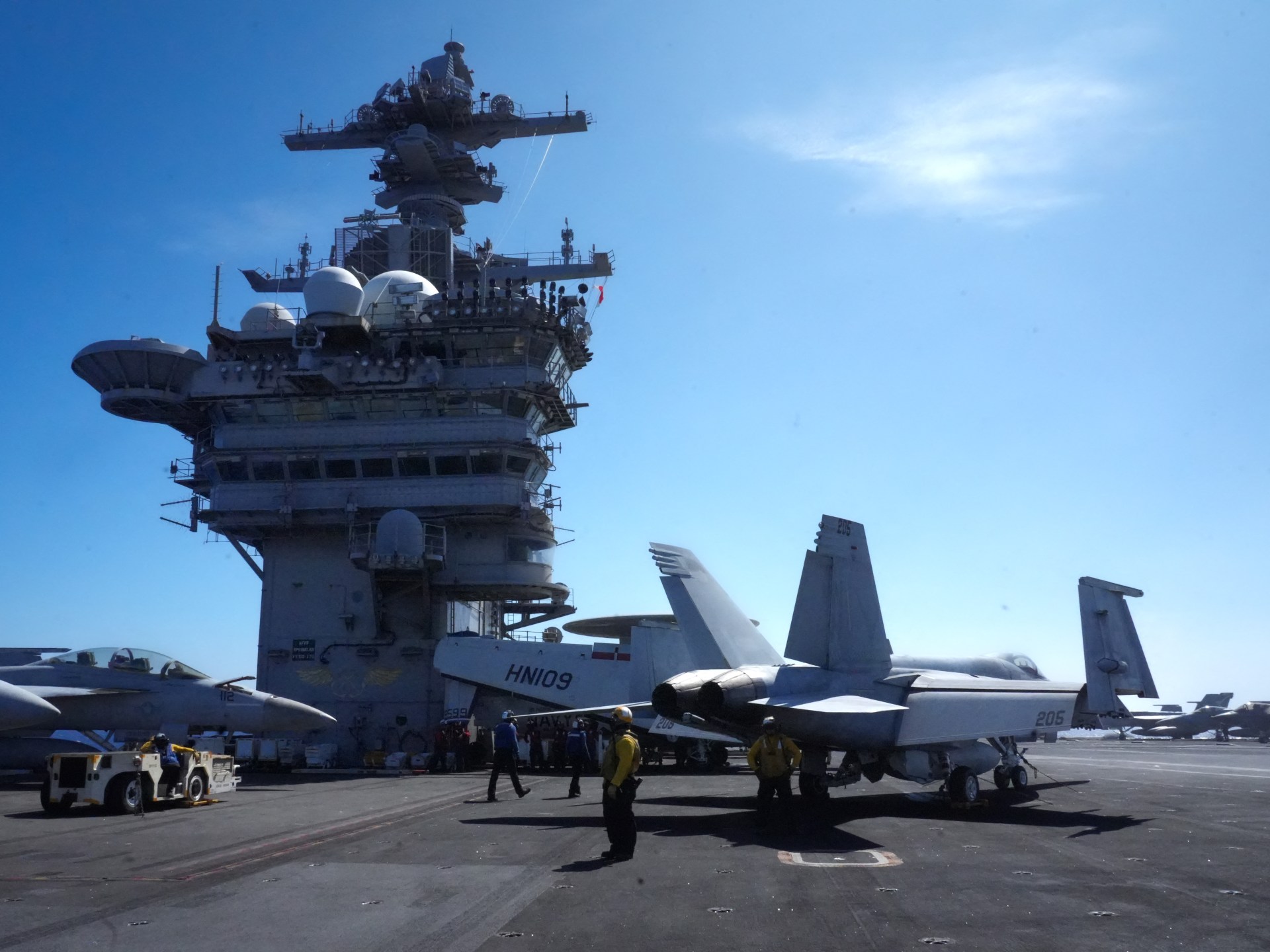
The United States has deployed a third aircraft carrier to the Middle East as diplomatic efforts to permanently stop the US-Israel war on Iran and reopen the Strait of Hormuz remain stalled.
On Monday, a US official told Al Jazeera that the USS Theodore Roosevelt had arrived in the Middle East. The aircraft carrier joins two others operating in the US Central Command (CENTCOM) area of responsibility.
Recommended Stories
list of 3 itemsend of list
The United States and Iran entered into a two-week ceasefire in April and later announced a broader memorandum of understanding in June, which collapsed in early July.
Since then, mediators from Pakistan and Qatar have been trying to prevent a return to the full-scale exchange of attacks between the US and Iran that also badly affected the broader Gulf region in March.
Last week, US President Donald Trump stated that further military strikes against Iran are “quite unlikely” and said the military component of the war was “effectively over” following discussions with Qatar’s Prime Minister Sheikh Mohammed bin Abdulrahman bin Jassim Al Thani. But he noted the US military remains “locked and loaded” if conditions change.
Does the deployment of another aircraft carrier to the region mean the US-Israel war on Iran is going to resume?
Here’s what we know:
What is the USS Theodore Roosevelt?
Named after the 26th US president, Theodore Roosevelt, the vessel is a nuclear-powered aircraft carrier.
Commissioned by the US Navy in 1986, the ship carries more than 5,000 personnel and a full air wing of more than 60 aircraft, including F-18s, the twin-engine, supersonic, all-weather multirole fighter planes.
Advertisement
According to the US Navy, the warship is tasked with “conducting carrier air warfare operations and assisting in the planning, control, coordination and integration of air wing squadrons in support of carrier air warfare”.
Besides combat operations, the carrier also replenishes ships at sea and rescues people, including refugees, at sea.
The USS Theodore Roosevelt has performed combat and humanitarian missions since its commissioning. During the 1990-91 Gulf War, it was deployed to the Mediterranean and Red Sea for combat operations. In 2003, it also supported US strikes during the Iraq War.
It has also been deployed in the Asia Pacific region during 2020-21 for military exercises with India, Japan, Australia, South Korea and Malaysia.
In October, a US official told Al Jazeera that the USS Theodore Roosevelt left its San Diego base in September, bound for the Middle East. According to another official, it arrived in the Middle East on November 15.
But the Pentagon and CENTCOM, which oversees military operations in the Middle East, have not formally confirmed the carrier’s arrival in the region.
What is the state of US deployment in the region?
The arrival of USS Theodore Roosevelt to the Middle East brings the total number of US aircraft carrier strike groups operating in the region to three. The USS George Washington and USS George HW Bush are the other two aircraft carriers currently deployed in the region.
Last month, a US official told Al Jazeera that the Makin Island Marine Expeditionary Force, carrying more than 2,000 Marines, have also followed the USS Theodore Roosevelt to the Middle East. The Wall Street Journal reported that the strike group and naval deployments could involve an additional 9,000 to 10,000 US troops in total, including sailors and Marines assigned to the carrier strike group and other ships. These deployments are however yet to be confirmed by the US military.
The US has had stationed troops and military assets at bases in the Middle East for decades. Of these, eight are permanent bases, located in Bahrain, Egypt, Iraq, Jordan, Kuwait, Qatar, Saudi Arabia and the United Arab Emirates. As of mid-2025, there were 40,000 to 50,000 US soldiers stationed around the Middle East, comprising personnel stationed in both large, permanent bases and smaller forward sites across the region.
According to open source intelligence analysts and military flight-tracking data, the US has deployed more than 120 aircraft to the region since early February, before the war on Iran began. This is the biggest surge in US airpower in the Middle East since the 2003 Iraq War.
Advertisement
Reported deployments include E-3 Sentry Airborne Warning and Control System (AWACS) aircraft, F-35 stealth strike fighters and F-22 air superiority jets alongside F-15 and F-16 fighter aircraft. In March, the Pentagon also ordered additional US forces to the Gulf.
The reinforcements consisted of three distinct formations.
The first was the Tripoli Amphibious Ready Group, centred around the America-class assault ship USS Tripoli and the 31st Marine Expeditionary Unit (MEU).
The second was the Boxer Amphibious Ready Group, built around the Wasp-class assault ship USS Boxer and the 11th MEU, based in Southern California in the US.
Together, these two Marine groups have added 4,500 Marines and sailors in the region.
The third was a contingent of about 2,000 soldiers from the 82nd Airborne Division’s Immediate Response Force, based at Fort Bragg, North Carolina. The airborne infantry division is focused on parachute assaults.
In total, nearly 7,000 additional soldiers have already been deployed to the Middle East since the war on Iran began.
How has Iran responded?
Kazem Gharibabadi, Iran’s deputy foreign minister for legal and international affairs, has said the country “will not wait for the US to attack first” and suggested “the US may be seeking to buy time by abusing diplomacy, in order to prepare the ground for another attack”.
Speaking to state TV in a video released by Iran’s Fars news agency, Gharibabadi warned that “Iran is not Cuba that you can blockade, nor is it Venezuela that you can force to surrender”.
He said US forces “have had no success with either an air blockade or a land blockade” in Iran so far, while the IRGC is currently producing missiles with “new ranges”.
Iran’s Foreign Minister Abbas Araghchi has called for stronger regional energy cooperation warning US attacks threaten stability across the Middle East.
“Given the increasing impact of US and Israeli aggression on the region’s energy security, strengthening energy cooperation has become an urgent and strategic necessity,” Araghchi said at a meeting of foreign ministers of the Economic Cooperation Organization in Pakistan’s capital Islamabad on Monday.
“Our region needs not only an independent security framework but also a regional, reliable and sustainable energy mechanism to safeguard energy flows, ensure stable energy supplies, reduce vulnerabilities from external factors, and increase our collective resilience to geopolitical shocks and disruptions,” the IRNA news agency quoted him as saying.
What has the US government said on resuming the war?
The Trump administration has appeared increasingly divided on how to proceed with Iran, since the Republican party suffered heavy losses in this month’s US midterm elections.
Secretary of State Marco Rubio has said that Washington’s economic pressure campaign against Iran was proving effective, so a resumption of large-scale military operations was likely unnecessary.
“The economic pressure on Iran is going to get even worse,” he added.
Advertisement
But Trump has given mixed messages about his plans for the war.
Last week, after a meeting in the Oval Office with Qatar’s prime minister, Trump stated on Truth Social and in a surprise briefing that there was “positive momentum” toward ending the conflict and that a resumption of strikes was “quite unlikely,” declaring the US-Israel war on Iran militarily “effectively over”.
Still, Trump insisted that the US economic pressure campaign against Iran would stay in place, including a naval blockade in the Strait of Hormuz and a more recent task force aimed at cutting off Iran’s trade by land and through the Caspian Sea.
Meanwhile, Iran’s conditions to end the war include an end to the US naval blockade of Iran’s ports, the lifting of economic sanctions, the release of Iranian frozen funds, ending fighting on all fronts, and an explicit announcement of an end to the war.
Iranian officials have in recent days underlined that Tehran will not accept the current status quo of “no war, no peace”.
Trump, on his part, has indicated that he is running out of patience with Iran as diplomacy stutters. Last week, Trumpsaid he had told his country’s lead negotiator, Vice President JD Vance, that, “We don’t need a deal with Iran.”
“Those days have long since passed. We’ve got their money, Hundreds of Billions of Dollars, and we’ve got their Strait!” he wrote on his Truth Social platform.
So can diplomacy work or is the region on edge?
It remains unclear where things stand in the region with both Iran and the US suggesting they’re prepared to attack first if tensions escalate.
Diplomatic efforts to stop attacks and reopen the Strait of Hormuz also remain stalled.
Last week in an interview with Al Jazeera, Iran’s parliamentary speaker and chief negotiator, Mohammad Bagher Ghalibaf, highlighted that Tehran wanted to move beyond a state of “no war, no peace”.
Ghalibaf said that Iran has conveyed seven conditions for a deal through a Qatari mediator and was awaiting an official US response. The conditions he outlined included lifting the US naval blockade and sanctions, releasing frozen Iranian funds, ending hostilities on all fronts and formally declaring the war over.
Trump’s administration, meanwhile, has tightened sanctions and maintained the blockade on Iranian ports.
The main issues in the US-Iran war now are those of sequencing and leverage, according to Rashid al-Mohanadi, vice president at the Center for International Policy Research. “Who does what, when, and how for a potential end of the conflict,” al-Mohanadi told Al Jazeera in an interview on Sunday.
The analyst added that it is clear that the whole region does not want to go back to full-scale war, which is obvious as “the whole region is leading on the mediation”.
But, he warned, the principal protagonists in the war appear to have divergent perceptions over their leverage.
“The Iranians perceive they have more leverage. The Americans perceive they have more,” he said. “When you have a situation like that, reaching a diplomatic end is quite difficult.”
Disclaimer : This story is auto aggregated by a computer programme and has not been created or edited by DOWNTHENEWS. Publisher: aljazeera.com