Nature’s bounty is full of surprises. Not every fruit is round and juicy. From fruits resembling snake-like skins to berries that make lemons taste sweet, exotic fruits from all parts of the world are flooding Indian markets. No wonder a basketful of exotic fruits has become the latest healthy gifting mantra. For starters, the price ranges between Rs 3,000 and Rs 30,000 for a hamper of exotic fruits.
Exotic & Ap-peel-ing
Across India and the world, several lesser-known fruits have interesting stories to tell. Some are everyday delicacies in their native regions, while others remain culinary curiosities, known only to local communities, farmers and adventurous food enthusiasts.
Some fruits look like they’re straight out of a fantasy world. Others surprise with their distinct flavours and properties. One fruit resembles a hand with elongated fingers, another wears a scaly exterior like a snake, while a tiny red berry can make a sour lemon taste like candy. Nature’s fruit basket is far more unusual than we imagine.
Quite A Handful
The Buddha’s hand, a citrus fruit found in northeastern India and parts of Asia, resembles a hand with elongated fingers. Unlike other citrus fruits, it has little to no pulp or juice. Its intensely fragrant rind is used in desserts, preserves and traditional preparations. In some Asian cultures, it is also considered a symbol of happiness and good fortune.
Another unusual variety is snake fruit, or salak, native to Indonesia. Covered in reddish-brown scales, it has crisp, pale flesh with a sweet-sour flavour. Despite its intimidating appearance, it is a popular snack in Southeast Asia. “Fruit diversity is a reflection of how plants adapt to their surroundings. Their unusual shapes, colours and textures are not merely curiosities but often serve specific biological purposes,” explains Fatima Qureshi, a botanist.
India has its own share of unusual fruits. Ice apple, popularly known as tadgola or nungu, is a summer favourite with translucent, jelly-like flesh. Obtained from the palmyra palm, it is particularly popular in coastal regions and is enjoyed for its refreshing texture. Elephant apple, found in parts of Northeast India, has a hard exterior and sour pulp, commonly used in Assamese curries, dals and chutneys.
Taste Of Novelty
Some fruits are unusual not just in appearance but also in what they do. Miracle fruit, a small red berry native to West Africa, contains a protein called miraculin that temporarily changes how the tongue perceives sourness. After eating it, even a lemon can taste remarkably sweet. This unusual property has made the fruit particularly interesting to food researchers and curious consumers.
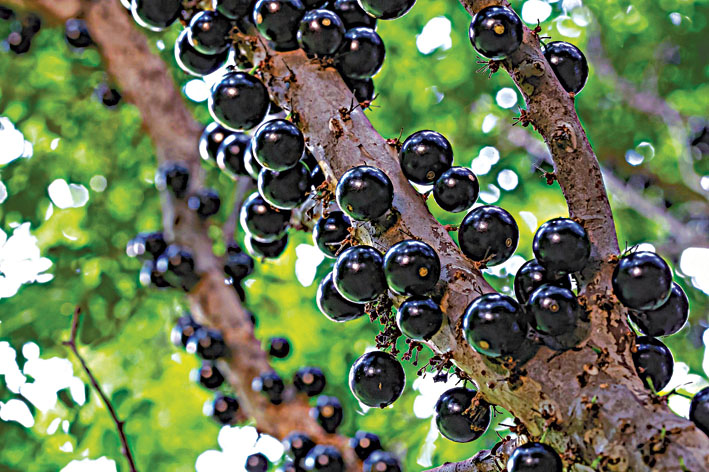
Further away, Brazil’s jabuticaba grows directly on the trunk and branches of its tree, creating the appearance of a tree covered in dark purple berries. Its soft, sweet flesh is used in juices, jams and wines. The kiwano, also known as the horned melon, has a spiky orange exterior and bright green, jelly-like flesh dotted with edible seeds. Its flavour is often described as a combination of cucumber, banana and lime. These unusual varieties demonstrate how differently fruits can evolve depending on their surroundings. Their colours, textures, flavours and growing patterns are not merely visual curiosities but also reflect the diversity of plant life. “Most of these fruits are sold directly from luxury auctions at the APMC and then shipped to the homes of rich people in Mumbai, Pune, Delhi, Hyderabad and Bengaluru,” says Jagdish Rathod, a fruit retailer from BKC, Mumbai.
Missing From Markets
Despite their uniqueness, many of these fruits remain absent from mainstream markets. Limited growing regions, short harvesting seasons, delicate skins and transportation challenges make large-scale
distribution difficult. Con-sumer unfamiliarity also plays a role, as shoppers often prefer fruits they recognise and know how to consume.
“People are curious when they see an unfamiliar fruit, but they also want to know how it tastes, how to eat it and whether it is worth trying,” says a mid-level manager from the Orchard Atlas gift box, Delhi-NCR.
Fresh & Unfamiliar
For farmers, cultivating unfamiliar varieties without assured demand can also be commercially risky. Limited awareness and the absence of organised supply chains further restrict their reach. However, greater interest in indigenous produce, biodiversity and alternative food experiences could create opportunities for these lesser-known varieties.
Preserving unusual fruits is also about safeguarding traditional food knowledge and agricultural diversity. “Many of these so-called exotic fruits like ambade in Goa and bimbli have been part of regional diets for generations. Even today, people use them in salads and fish curries,” says GS Shelke, a horticulturist.
A fruit need not be perfectly round, brightly coloured or familiar to deserve attention. Sometimes, the most fascinating discoveries are hidden beneath scaly skins, unusual shapes and unexpected flavours. Nature, after all, has a way of reminding us that there is always something new to taste.
Exotic Fruit Hampers
Miyazaki Mango (Eggs of Sunshine) Originally from Japan, these deep-red/purple mangoes are sold for Rs 2.5 lakh – Rs 3 lakh/kg in luxury auctions.
Duke Cherries: Premium
Duke cherries from J&K or imported US cherries cost Rs 2,000 to Rs 8,000/kg.
Black Grapes: These elongated black grapes from Himachal Pradesh cost Rs 2,000 to Rs 5,000/kg.
Dragon Fruit: The imported variety costs Rs 800 to
Rs 2,000/kg (each fruit weighs around 300-400g).
Buddha’s Hand: A rare to find citron fruit from North East India and China fetches around Rs 250 to Rs 1,500 per piece.
Jabuticaba (Brazilian tree grape): The exotic home-garden fruit is sold for Rs 1,500 to Rs 2,500/kg.
Fruit diversity is a reflection of how plants adapt to their surroundings. Their unusual shapes, colours and textures are not merely curiosities but often serve specific biological purposes.”
— Fatima Qureshi, Botanist
Many of these so-called exotic fruits like ambade in Goa and bimbli have been part of regional diets for generations. Even today, people use them in salads and fish curries.”
— GS Shelke, Horticulturist
Disclaimer : This story is auto aggregated by a computer programme and has not been created or edited by DOWNTHENEWS. Publisher: deccanchronicle.com