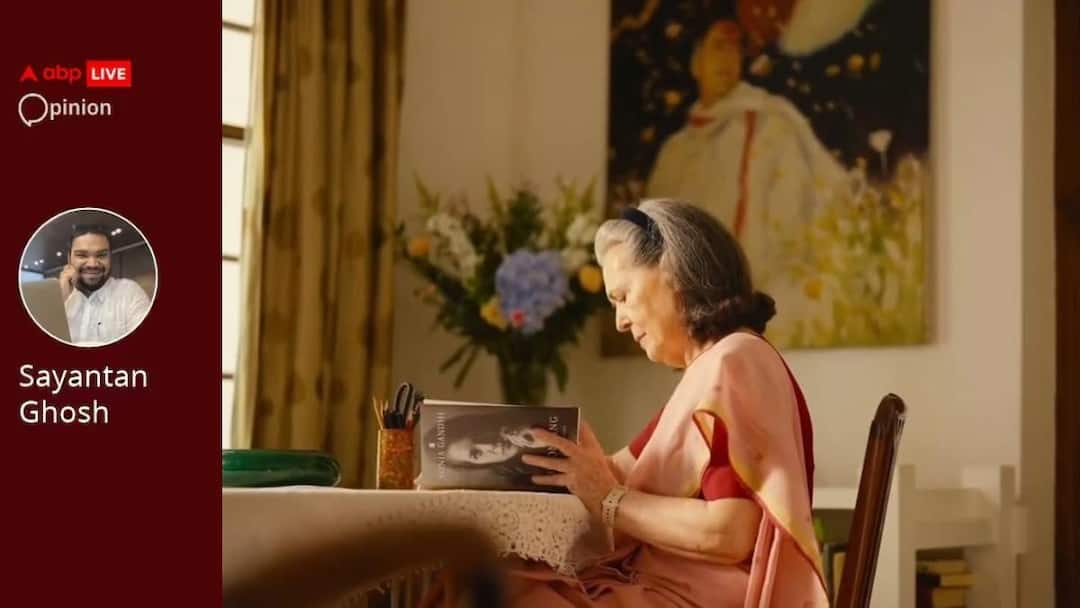
- Sonia Gandhi’s memoir unveils her outsider to insider journey.
- It details personal struggles, family losses, and political entry.
- Memoir discusses party leadership, key decisions, complex relationships.
The most anticipated political book of this moment has arrived: Sonia Gandhi’s memoir, Belonging: A Journey of Love. Released just days ago, it has stirred the country in the way few books do. People are reading it, dissecting it, arguing over it. For decades Sonia Gandhi has remained a figure of intense public scrutiny yet extreme private reserve; mountains of analysis have been written about her, while she herself has spoken almost nothing. The contours of her life and her politics have therefore remained largely unknown, filtered through others’ accounts, rumours, and political agendas.
With the memoir now in readers’ hands, a predictable pattern has set in. Almost everyone is reading it through the lens of their own politics. Supporters find validation; opponents treat the pages as a postmortem. The Bharatiya Janata Party has already subjected the book to close, adversarial scrutiny, extracting passages that, in its view, condemn the Gandhi family, the Congress, and the politics the party has practised. That reaction was hardly unexpected. A memoir by someone who has stood at the centre of India’s public life for so long was always going to be contested on political ground.
Yet to treat the book as purely political is to misread it. The sections that deal with her active years in politics occupy roughly a hundred to a hundred and fifty pages. The larger part of the volume is the story of a woman who was neither born nor raised in India. It begins in a small town in Italy, moves through a chance meeting with Rajiv Gandhi—the son of the then prime minister—and follows the slow, intimate evolution of their relationship. It is a love story, yes, but more than that it is the journey of an outsider who gradually became one of the deepest insiders in Indian politics. It is also, unmistakably, a book of attachment to the country she made her own.
What the memoir offers is therefore her own record of what she saw, what she felt, and what she came to believe. On the political episodes already well known to the public, she does not claim to present something radically new; readers of different ideological persuasions will find, as they always have, confirmation of what they already thought or will soon decide. The greater value lies in the parts of the story that had remained largely untold.
The Private Life
What stays with a reader long after the political arguments have faded is the quiet, almost hesitant way Sonia Gandhi opens the doors she once kept firmly shut. The book begins not with power or party, but with a young woman in Cambridge who looks across a room and feels something she cannot yet name. She sees a boy who does not quite belong to the familiar countries around her, and she senses, without knowing why, that her life is about to change. No one outside the family had ever been told how that first recognition grew into a decision, or how a girl of her time and place gathered the courage to leave everything she knew for a marriage that still had no fixed date.
When she finally arrived in Delhi, only three people came to the airport to meet her: Rajiv, his brother Sanjay, and, less expectedly, Amitabh Bachchan. Before the wedding, she stayed with Harivansh Rai Bachchan and his wife, learning the city and the rhythms of a household that was both warm and entirely new. The small, ordinary details are what make these pages feel alive: the first time she tried to wear a sari, the safety pins that held it in place, the nervousness of getting it wrong. At the same time, her family in a small Italian town suddenly found themselves under a glare they had never asked for. Photographers waited outside. Requests for a family picture kept coming until they finally agreed to one local magazine. The sense of being overwhelmed is described without drama, yet it is unmistakable.
Loss runs through these private chapters with a particular intimacy. She writes of Indira Gandhi as the person who accepted her as she was, who listened even when she herself was short-tempered. After Indira’s death, the conversations with Rajiv about why she did not want him to enter politics become raw. She speaks of the loneliness that settles on a woman in public life, and of the question that follows every fresh grief: whether there is ever enough time to weep, to feel sorry, to simply sit with sadness before the next demand arrives. The loss of their first child, born too soon and gone within hours, is told with painful clarity. Even a family that had known prime ministers could not decide where or how to bury the child in privacy.
She also writes of Sanjay and Maneka Gandhi, of the pressure she believes they placed on Indira that helped lead to the Emergency, and of her own refusal to accept it. Later come the years of cancer and other ailments, and the constant, quiet anxiety for Rahul and Priyanka and their children. One evening, as the Bharat Jodo Yatra neared its end in Kashmir, she spent hours calling everyone she could reach because she feared the security around her son was inadequate. The programme was delayed by a day. These are not the stories that settle political scores. They are the ones that show a person trying to hold her own life together while history keeps interrupting it. For any reader willing to set analysis aside for a while, that is where the book most clearly belongs.
Her Politics
In the final stretches of the memoir the narrative turns, with a quiet intensity, to the years that followed Rajiv Gandhi’s assassination. The Congress, once the natural centre of gravity in Indian politics, stood diminished and divided. For Sonia Gandhi the party had long ceased to be merely an organisation; it had become an extension of the family she had joined and of the India she had made her own. She writes of an inner urgency that was not ambition but a sense of duty, a resolve to hold the party together when it seemed on the verge of collapse. That distinction, between the pursuit of power and the acceptance of responsibility, runs through these chapters.
She speaks candidly of her complicated equations with two former prime ministers who shaped the Congress in different eras. Her relationship with P.V. Narasimha Rao is described as distant and at times strained, marked by differing styles and priorities. With Manmohan Singh she is more protective. She defends the role she played during the UPA years, arguing that her interventions were meant to steady a coalition government rather than to undermine the prime minister. At the same time she explains, with evident conviction, why she chose him in 2004: a man of integrity, free of personal ambition for the highest office, and possessed of a deep understanding of both governance and the country’s economic challenges. She records that her faith in him endured until the end of that decade in power.
The decision itself not to become prime minister is recounted in personal detail. She recalls the conversations with Rahul and Priyanka, their clear preference that she step aside, and her own weighing of the family’s place against the demands of the chair. Once the choice was made, she presents it as final. No pressure, she suggests, could have altered it. The episode is framed less as a political calculation than as a moment in which personal bonds took precedence.
Across these pages she also sketches her equations with leaders outside the Congress, among them Mamata Banerjee, Mayawati, Sharad Pawar and A.K. Antony. The portraits are measured, acknowledging both cooperation and friction. On the larger ideological plane she is unambiguous about her differences with the Bharatiya Janata Party and the Rashtriya Swayamsevak Sangh. Yet she draws a clear contrast with Atal Bihari Vajpayee, recalling a relationship that remained respectful and even admiring despite sharp political opposition. With Narendra Modi the tone shifts. She is critical of what she sees as an RSS-shaped vision of India, of a politics centred on hierarchy and control, while granting the scale of his rise and his distance from the older Delhi establishment. Personal contact, she notes, has been minimal; eye contact rarer still, though she records that he reached out when she was unwell.
The same chapters turn, finally, to Rahul Gandhi. She sees in him a politician who has matured beyond the expectations once placed upon him, one shaped by the long Bharat Jodo Yatra and by a deliberate effort to rebuild the Congress on new terms. She notes his insistence that the family step away from the party presidency and his support for Mallikarjun Kharge in that role. In her telling, these are not merely organisational choices but part of a larger attempt to reimagine the party’s future. The later pages thus leave the reader with a portrait of a political life continued under the weight of loss, duty, and an enduring belief in the possibilities still open to the Congress.
Belonging, with its silences
A memoir is not a court affidavit. Sonia Gandhi owes readers no confession, and it is naïve to expect her to accept responsibility for every failure of a party or government she led. But once she chooses to write political history, readers are entitled to notice where memory becomes defence.
The book is most guarded precisely where scrutiny is most needed. On the Emergency, Gandhi describes Sanjay’s influence and recounts family arguments that leave Indira appearing pressured and politically cornered. That may illuminate the household; it does not answer the larger question of responsibility for a government that suspended civil liberties. The account risks making the constitutional crisis a family dispute.
The same instinct appears in her treatment of the 1984 anti-Sikh violence. She acknowledges administrative failure and that some officials may have looked away or fuelled violence, yet insists Rajiv could not have authorised attacks. The grief is real; so is the unresolved question of political accountability. On Operation Blue Star, the memoir offers intimate details of the family’s fear after the army entered the Golden Temple, but that personal lens leaves the decision and its consequences largely outside the frame.
Nor does rejecting the charge that she was a “back-seat driver” settle the debate about her influence during Manmohan Singh’s governments. Her account of a division of labour—Singh governing, she leading the party—is a defence, not the final word. The National Advisory Council’s role remains open to political interpretation.
These are the book’s weakest pages: predictable, defensive, and less revealing than the personal chapters. Its treatment of Sanjay and Maneka also feels shaped by family loyalties. Yet Belonging remains intriguing, intimidating in its sweep, fascinating and controversial. Its authority is weakened by avoidable factual errors: it dates the India Against Corruption movement to 2012 rather than 2011, among other mistakes. The errors call for firmer fact-checking and editing.
Sayantan Ghosh, a columnist and Doctoral Research Scholar in Media & Politics, is a contributing author for ABP Live English.
[Disclaimer: The opinions, beliefs, and views expressed by the various authors and forum participants on this website are personal and do not reflect the opinions, beliefs, and views of ABP News Network Pvt Ltd.]
Disclaimer : This story is auto aggregated by a computer programme and has not been created or edited by DOWNTHENEWS. Publisher: abplive.com