TEHRAN — A Bahraini court on Monday sentenced 64 people, most of them Shia scholars, to life in prison, among them Sheikh Isa Qassim, the country’s senior religious authority. Five others got 15 years.
The High Criminal Court ended the largest trial of religious figures the kingdom has held. Of 69 defendants, 60 were clerics, and nine were affiliates such as religious reciters.
13 clerics were tried in absentia, Sheikh Qassim among them. He has lived in Qom since 2018, two years after the monarchy stripped him of his citizenship.
Some defendants were also fined 100,000 dinars, about $265,000, and judges ordered more than 8 million dinars confiscated, money the state says will go to charity.
To justify the crackdown, the regime’s prosecutors smeared the scholars as an Iranian-backed “terrorist network,” with public security chief Tariq Al Hassan framing the purge as a battle against “an ideology that demands obedience to Iran’s leadership above Bahrain’s sovereign authority.”
Defense lawyers and families argue the Al Khalifa monarchy is recycling tired security pretexts to criminalize Shia religious practice.
20 rights groups, including Human Rights Watch and Amnesty International, warned days before the verdict of torture reports, coerced confessions and closed hearings. When such claims are brushed aside, said Sayed Ahmed Alwadaei of the Bahrain Institute for Rights and Democracy, the judiciary becomes “an instrument of persecution.”
The arrests began May 9 with night raids on clerics’ homes. Human Rights Watch counts at least 37 seized that day and more than 700 people arrested since, children among them.
Hearings opened in July. The verdict, due November 8, slipped to November 22 while families and activists were kept out of court, then was pulled forward to Monday.
The U.S.-Israeli war on Iran shapes every aspect of the crackdown. Home to the U.S. Fifth Fleet and a signatory to the 2020 Abraham Accords normalizing ties with Israel, U.S. military assets in the country has come under Iranian missile and drone strikes, and ruling officials have been shaken by displays of public support for the attacks among large segments of the population.
In an interview with Reuters, a relative of one defendant stated that authorities are directly targeting Shias and “anyone who criticizes the Americans or the Israelis for the war they have launched.”
The regime’s forces have also restricted Ashura mourning processions and torn down religious banners across Shia neighborhoods.
Manama is repeating a well-worn pattern of state repression. Following the Saudi-backed military crackdown on the 2011 uprising and the forced dissolution of Al-Wefaq, the regime targeted Sheikh Qassim in 2017 on trumped-up illegal fundraising charges, imposing a suspended sentence alongside the same 100,000-dinar penalty.
A leaked 2006 document, the Bandar Report, described a plan to naturalize Sunni foreigners and dilute the Shia majority.
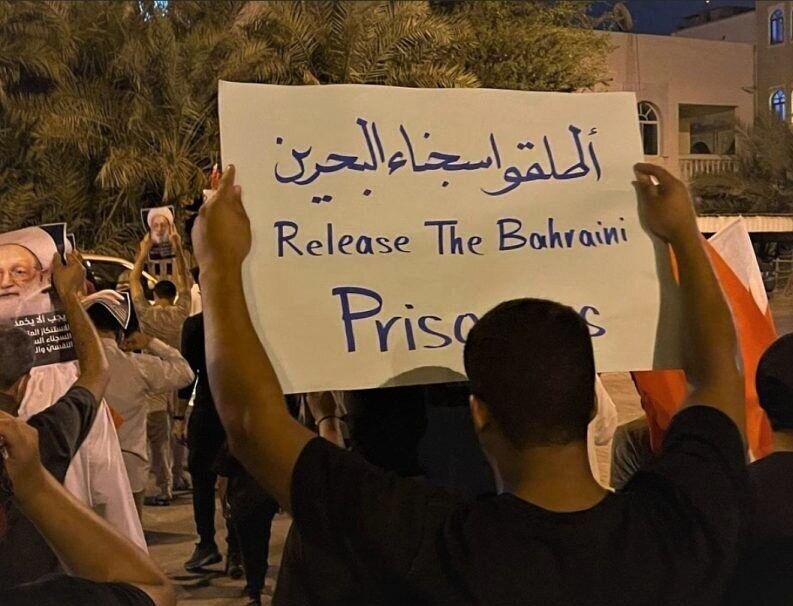
Protests have spread, with at least 25 arrests reported last week. The February 14 Coalition called the sentences an attack on the existence of Shias, and Al-Wefaq declared them null and void. Sheikh Qassim has warned that Shia institutions face an existential threat.
Disclaimer : This story is auto aggregated by a computer programme and has not been created or edited by DOWNTHENEWS. Publisher: tehrantimes.com