Victoria’s planning minister has approved 264 development proposals submitted directly to her office through Labor’s fast-track planning laws and rejected only one – a proposed sand quarry extension just outside her own electorate.
Critics say the development facilitation program – ramped up three years ago to approve more housing, but also used to assess data centres, quarries and big batteries – has become a virtual free pass for developers and shut the community out of the planning process.
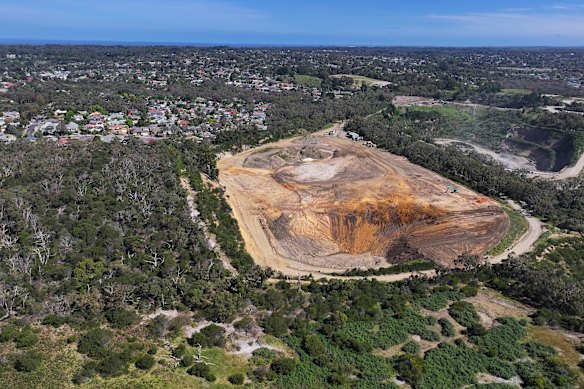
The proposed sand quarry expansion in Langwarrin, in Melbourne’s south-east, was refused a permit by Planning Minister Sonya Kilkenny on October 7, four weeks before the Carroll government entered caretaker mode. It was Kilkenny’s first refusal of a proposal submitted to her via the fast-track program since it was expanded in September 2023.
If approved, the quarry project would have extended to the boundary of Kilkenny’s electorate of Carrum, which she has held since Labor took the seat from the Coalition in 2014.
Her refusal was made after the sand quarry expansion proposal was granted a work plan approval by state authority Resources Victoria in 2022 but then refused a permit by Frankston City Council in 2023.
Quarry owner Heidelberg Materials initially appealed the council’s decision in the Victorian Civil and Administrative Tribunal, but abandoned that appeal and instead applied directly to the planning minister late last year, via the development facilitation program.
Labor boosted its fast-track planning program as a key aspect of its policy to deliver 800,000 new homes within a decade. The program enables eligible proposals to apply directly to the planning minister, bypassing local councils, and removes third-party avenues to object or appeal.
An analysis of decisions made by Kilkenny since the program’s expansion just over three years ago, provided to The Age by the Western Port Green Wedge Protection Group, reveals she has approved 264 proposals and refused one.
Heidelberg Materials has also been given 60 days to appeal the minister’s decision through VCAT, a right that is explicitly denied to councils or community members.
A Labor spokesperson said the development facilitation program was helping young people find a home and that every fast-track proposal went through an extensive pre-application process, meaning many are ruled out before formally entering the pathway.
“Every DFP [Development Facilitation Program] proposal is considered rigorously on its merits, including any impacts to traffic, overshadowing and amenity. For many applications, this process has resulted in increased setbacks, reduced heights and more landscaping,” the spokesperson said.
David Cole, a member of the Western Port Green Wedge Protection Group, which was part of a local campaign against the quarry expansion, said the fact the company still has an avenue of appeal illustrated how heavily the fast-track program was biased in favour of development.
“I don’t think that’s particularly well known, and I don’t think it’s a very reasonable thing either,” Cole said.
Kilkenny refused the quarry proposal on seven grounds, including unacceptable impacts on biodiversity and habitat connectivity; being inconsistent with the Frankston green wedge; loss of native vegetation; and encroachment upon nearby homes.
Langwarrin resident Elizabeth Cester had fought the quarry expansion since the day she received a letter in her mailbox notifying her of the proposal in 2023.

She was shocked to learn that a woodland in her neighbourhood could be cleared for sand mining.
“As locals, we’ve seen and value the variety of beautiful wildlife that use the area. That’s part of why we love living in our suburb, because we get native animals in our backyard,” she said.
Cester joined a community group opposed to the project, and was initially relieved to see Frankston City Council reject the proposal, only to learn that Heidelberg Materials had taken its expansion plan directly to the minister early this year.
For six months, the group waited for a decision, while Cester wrote to Kilkenny, to the department’s planning assessment team, and to Paul Mercurio, her MP in the neighbouring seat of Hastings.
“We just hoped for the best, right? We just thought the minister can make whatever decision they want, and we’ve got to live with it.”
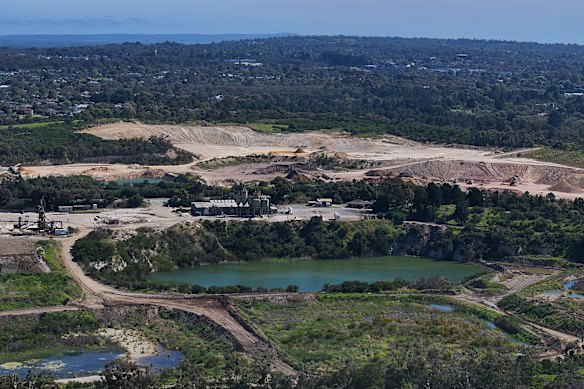
Cester said she was delighted when Kilkenny refused the application, but that relief turned to uncertainty when campaigners learnt that the company could appeal for a review of the decision.
Cester said community campaigners who fought the quarry proposal were shocked to learn this, given the planning department’s online guidance states “decisions made by the minister for planning under the provisions cannot be appealed” to VCAT.
“We believe the public deserves a clear explanation of how these provisions operate, whether communities have equivalent review rights, and how residents can participate if a review proceeds,” she said.
Heidelberg Materials told The Age it “does not intend to challenge the permit refusal”.
The development facilitation program has faced heavy recent criticism from local governments who argue the fast-track pathway is not producing good planning outcomes.
Whittlesea council, in Melbourne’s outer north, called an unscheduled meeting this month at which most councillors voted to call for the program’s abolition in its current form.
Boroondara, in the inner east, also voted to call for an immediate pause to the scheme in August. It argues the government has approved housing projects that ignore council height controls, and shifted almost $800,000 in assessment costs onto the council, which still has to assess each fast-tracked project, while application fees go to the state.
Whittlesea councillors called for the scheme’s abolition in a sign of their fury at being cut out of the decision-making process for two major proposals: a data centre in South Morang, and the master plan for Mernda’s future town centre.
Developer Dorman Capital submitted its town centre master plan directly to the minister in September, after “nearly two years of back and forth with council officers’ approved development plan dating back decades without any consideration to how their vision would be economically viable today,” managing director Nicholas Dorman said.
But councillors at the meeting derided the master plan as a housing under-development with “big box retail” and a “glorified drive-through”.
“There are many councils that are absolutely appalled by the [government] changes that were brought in that bypass council, bypass community, bypass appeal rights,” Whittlesea Mayor Lawrie Cox said.
“We’re not always perfect, but we do have a process that people can object, can take appeal rights, and go through the processes. Simply just taking it off the table and putting it on the minister’s office for a signature is wrong; it should never be supported that way.”
The development facilitation program’s expansion in 2023 was framed as a response to an urgent need to tackle Victoria’s housing shortage, but was in fact “a regulatory instrument for the government to consolidate its power”, said Crystal Legacy, an associate professor of urban planning at the University of Melbourne.
“They created this exception that we are in a housing crisis and we need to deliver supply much quicker, so let’s use this instrument to bypass council, and third-party appeal rights and local community engagement, to do this really important thing,” Legacy said.
But there is no evidence the state government does a better job of making sound planning decisions than the constituents it has disempowered through its planning changes, Legacy said.
“Considering that this current government is being heavily scrutinised around transparency and accountability of decisions related to infrastructure and governance, the development facilitation program itself requires further scrutiny,” she said.
A Coalition spokesperson said it opposed “Labor’s centralisation of planning powers under the development facilitation program in its current form”, but did not say how it would change the scheme.
Start the day with a summary of the day’s most important and interesting stories, analysis and insights. Sign up for our Morning Edition newsletter.
Disclaimer : This story is auto aggregated by a computer programme and has not been created or edited by DOWNTHENEWS. Publisher: www.smh.com.au