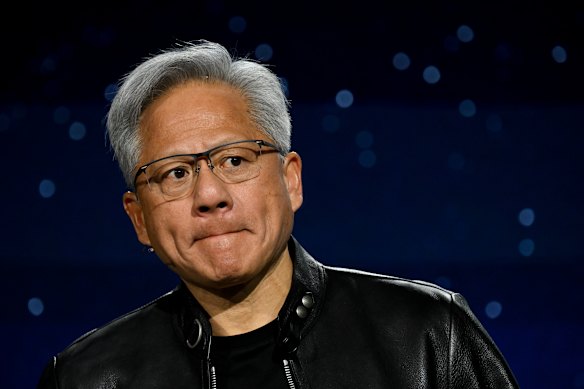
A petition calling for Jensen Huang’s reinstatement as Nvidia chief executive has already surpassed 187,000 signatures. Donald Trump “wouldn’t mind” if he regained the role.
Huang himself is said to be pondering whether he should reconsider his decision to resign in response to the revelations of his affairs with an alleged Chinese spy and, reportedly, Nvidia executives — although the AI giant’s board seems committed to its search for his replacement, and US Treasury Secretary Scott Bessent is urging for a complete outsider to replace him.
The petition’s website – “Stand with Jensen” – is being overwhelmed by a torrent of signatures of support from senior Nvidia employees, current and former staff, Silicon Valley leaders and Nvidia shareholders.
Elon Musk and Trump are encouraging them from the sidelines, with Musk saying Nvidia would lose critical deals without Huang and that it would be “an honour” to hire him.
The AI sector is fearful that without Huang, whose deals have a handshake quality to them, Nvidia might not be able to maintain its role in supplying chips and vendor financing – and providing guarantees to financiers – to a large part of the AI ecosystem.
Trump said on Monday he would be open to Huang’s reinstatement.
‘I would not mind [seeing Jensen Huang reinstated]… I think he learned a big lesson.’
Donald Trump
“I would not mind; I wouldn’t mind that,” he said. “I think he learned a big lesson – I guess maybe one lesson is more important than another.”
The US president also questioned whether Alice Huang (no relation), the woman at the centre of the controversy, was actually a Chinese spy.
“I don’t know that she was a spy. Usually what happens with that is that any woman coming to the country that’s a beautiful woman that comes from China, they say she’s a spy. I don’t know that she was a spy at all.”
US intelligence agencies, according to the New York Times, does suspect Alice Huang of being a spy. Secretary of State Marco Rubio wrote to Trump warning him of those suspicions, although Trump says he hadn’t heard that.
What doesn’t appear to have occurred to Trump or the thousands of people signing the petition to bring Jensen back, is that the question of whether Alice Huang was or wasn’t a spy isn’t the central issue for either the Nvidia board or the US government.
For the board, there’s the more conventional issue of a CEO having an affair with, it’s alleged, the senior executive of a major customer – Megaspeed, where Alice Huang was the CEO at the time of the relationship, acquired many billions of dollars worth of Nvidia’s most advanced chips – and reportedly at least one company subordinate without informing directors. That alone would provide a reason for dumping him.
For the government, the far more critical question is whether MegaSpeed was able, with Nvidia’s help, to circumvent export controls designed to prevent Chinese access to its most advanced chips.
In a sense, it has already answered the question after the horse has bolted by slamming that particular stable door shut.
On Monday, the Trump administration announced that it would introduce a new rule that would require overseas data centres to obtain a government licence before supplying any significant amount of computing power to companies with headquarters in a group of countries including China and Russia, with data centres required to determine whether customers are linked to those countries.
The US will also demand a licence for exports of advanced chips to companies headquartered in Indonesia, Malaysia and Singapore.
Megaspeed was based in Singapore. It imported vast quantities of Nvidia chips – far too large a volume for Singapore’s use – with suspicions that they were either smuggled into China or deployed in data centres in South-East Asian countries to train Chinese artificial intelligence models.
There’s a sense of déjà vu in what the administration has done.
One of the last things the Biden administration did, in January last year, was to promulgate a rule establishing a tiered global system to regulate exports of advanced chips.
Tier one was America’s close allies, including Australia, where there was unrestricted access. Tier two covered most other countries – including Singapore, Malaysia and Indonesia -where licensing requirements, caps on computing power and security frameworks were imposed. Tier three were countries under US embargoes like China, Russia and Iran.
One of the first things Trump did when he took office last year – after lobbying by Silicon Valley companies, including Nvidia – was to rescind that rule on the basis that it placed too much of an administration burden on US companies and allies.
‘Was it a low-level fail? Was it in the middle, or was it up in the C-suite? Who knew?’
US Treasury Secretary Scott Bessent
Without those rules for dealing with exports of advanced chips the US, which has adopted a laissez-faire approach to AI, has been reliant on its “entity list” – a list of organisations and individuals deemed to pose a risk to US interests – to manage exports of sensitive technologies. Companies need a special licence to deal with those entities on the list.
The fallout from Huang’s affairs has put a spotlight on US Commerce Secretary Howard Lutnick, who is under pressure for his rejections of calls from other government departments, well before the scandal surfaced publicly, to place Megaspeed on the entity list, which would have prevented Nvidia from dealing with it.
Despite urgings from Treasury and other departments, Lutnick refused to put Megaspeed on the list, ostensibly because it would, according to Trump in defence of one of his more committed loyalists, risk a “blow-up” with China.
That suggests at least some in the Trump administration were aware, or at least suspected, that Megaspeed might be providing a backdoor entry for Nvidia chips into China – although, given that it was Trump providing the excuse, he may have made it up after the fact to try to help one of his most loyal cabinet members.
It is US Treasury Secretary Scott Bessent, who has put the controversy and the issue of Huang’s fate into the right perspective.
He argues that Nvidia has to find a new external CEO, that the company needs a “dramatic shake-up” and that there needs to be an investigation into whether the company complied with US export restrictions. (Only Nvidia’s second-best H200 chips are supposed to be accessible to China).
It is important that there be an examination of whether Nvidia “had a culture of compliance around the US export restrictions” and whether its senior executives knew that the rules were being bent, he said.
“Was it a low-level fail? Was it in the middle, or was it up in the C-suite?,” Bessent asked.
“Who knew?,” he went on. “These shell companies [used to acquire Nvidia chips that were then on-sold to data centres in South-East Asia or smuggled into China] were obvious, they were being investigated, and did Nvidia use them as a workaround to sell chips to China?”
“Were they pressing these seemingly illicit sales to goose their revenues and their earnings?”
It is improbable that no one at Nvidia knew or suspected that the billions of dollars of sales to Megaspeed – a company that Alice Huang helped established as recently as 2023, with the apparent financial backing of Chinese tech giant Alibaba – were destined, directly or indirectly, for China.
Jensen Huang, given his relationship with Alice Huang, should certainly have known if there was anything questionable about Megaspeed’s dealings in his chips.
Who knew what and when will be tested by the Nvidia board’s internal inquiries, the administration’s separate investigation and in a Congressional hearing, before which both Jensen Huang and Lutnick have already been called.
As Bessent alluded to, the most important issue is not really whether Alice Huang was a spy – US intelligence agencies can sort that out.
The key question is if, and how, very large volumes of Nvidia’s most advanced chips – chips regarded as central to America’s AI lead over China – might have dodged US restrictions, and who might have facilitated the flow of those chips.
If Huang was at the centre of a scheme to sell Nvidia chips to China, or he suspected or was aware that China was the end-destination of Megaspeed’s chip purchase, he will have a lot more to worry about than whether he gets his old job back.
The Market Recap newsletter is a wrap of the day’s trading. Get it each weekday afternoon.
From our partners
Disclaimer : This story is auto aggregated by a computer programme and has not been created or edited by DOWNTHENEWS. Publisher: www.smh.com.au