- CPCB directed to conduct surprise inspections and access data.
The Supreme Court has warned that states, Union territories (UTs) and districts could face financial penalties if the water quality of the Yamuna deteriorates while flowing through their respective jurisdictions. The court said authorities responsible for worsening pollution must be held accountable, observing that despite substantial expenditure on cleaning the river, its pollution levels have continued to rise.
In an order dated November 4, a bench of Justices Manoj Misra and Manmohan directed the Central Pollution Control Board (CPCB) to monitor water quality at points where the Yamuna and its major drains enter and exit states, Union territories and districts.
The bench was hearing a plea concerning the cleaning of the river when it pointed out that industrial pollutants and untreated sewage must be addressed at their source, rather than relying solely on the construction of additional sewage treatment plants (STPs).
States, UTs, Districts To Face Fines If Yamuna Water Quality Deteriorates
The top court said the authorities concerned would be held responsible if the water quality deteriorated on any parameter while passing through or exiting a particular state, Union territory or district.
“If the water quality deteriorates on any parameter while flowing through, or exiting a state/Union territory or a district therein, that state/Union territory or district… shall be held accountable and penalised. The said compensation/ fine shall be deposited with the registry of this court,” the bench said.
The court asked the CPCB to propose a formula for determining the compensation or fine to be imposed in such cases.
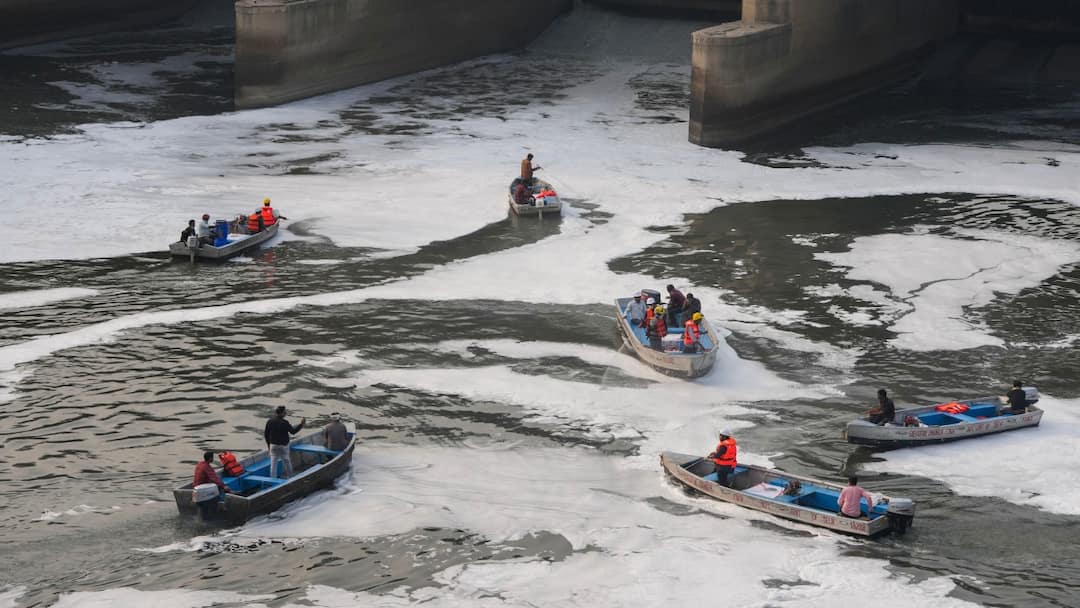
It also directed the pollution control body to examine and submit detailed reports on incidents of pollution in the Yamuna, including fish deaths, white foam floating on the river’s surface, eutrophication or algal blooms, and increases in Biochemical Oxygen Demand (BOD), Chemical Oxygen Demand (COD) and Total Suspended Solids (TSS) levels.
The reports must identify the causes behind such incidents or spikes in pollution levels and specify the remedial measures required, the bench said.
ALSO READ: CISF Deployment At Airports To Decline As Private Security Agencies Take Over Non-Core Duties
‘Huge Sums Spent, But Yamuna Pollution Has Only Increased’: SC
Expressing concern over the river’s deteriorating condition, the Supreme Court observed that the poor state of the Yamuna reflected wider failures in civic administration across towns, cities and villages along its banks.
The bench noted that 520 drains discharge wastewater into the river and said the continued deterioration of water quality, despite substantial spending on its cleaning, highlighted the shortcomings in existing efforts.
The court said industrial pollution and untreated sewage must be curtailed, if not completely eliminated, at the source. Where this cannot be achieved, sewage must first be tapped and subsequently treated.
However, it pointed out that the absence of an effective sewage network and the mixing of stormwater drains with sewage channels posed significant challenges to tapping wastewater.
Illegal Colonies, Slum Clusters Also Contributing To Pollution
The apex court observed that establishing sewage connections in several illegal and unauthorised colonies would be particularly difficult, as many had come up on encroached land without a planned grid layout or adequate space for laying sewage infrastructure.
It further said that sewage from unauthorised colonies and ‘jhuggi-jhopdi’ clusters located along drains and on the riverbed would continue to flow into the Yamuna unless these settlements were removed and their occupants rehabilitated.
ALSO READ: Man Shot Dead In Firing Near Delhi Minister Kapil Mishra’s Office In Khajuri Khas
CPCB Asked To Conduct Surprise Inspections, Monitor Treatment Facilities
The Supreme Court also directed central and state authorities, including ministries and government agencies, to provide all necessary administrative, logistical, technical, operational and infrastructural support to the CPCB, its officials and expert institutions engaged by it.
It ordered public and private entities, concessionaires, operators and agencies managing wastewater, solid waste and effluent treatment infrastructure to provide CPCB officials and designated third-party agencies with immediate and unrestricted access to their premises, installations and records.
The access must be available at all hours to facilitate unannounced inspections, surprise sample collection, volumetric audits, sensor verifications and technical assessments, the bench said.
The court further directed the concerned departments, authorities, concessionaires and plant operators to provide complete technical cooperation and unrestricted access to data, ensuring integration with the CPCB’s centralised monitoring system within the timelines set by the court.
The matter has been listed for further hearing on January 13.
(With agency inputs)
Disclaimer : This story is auto aggregated by a computer programme and has not been created or edited by DOWNTHENEWS. Publisher: abplive.com