Staff writers
Updated ,first published
The Australian sharemarket had its biggest drop since the start of October, with miners and energy stocks leading the decline as metals prices slumped and Nvidia led another sell-off in technology stocks on Wall Street.
The S&P/ASX 200 finished down 161.50 points, or 1.8 per cent, at 8883.20, with all 11 sectors in the red bar defensive utilities. The local bourse lost 0.4 per cent on Monday. The Australian dollar was trading at US67.39¢.
The newly created AFR Real Economy index – which tracks 500 companies that mirror the ABS’ composition of the actual economy in contrast to the ASX200, where miners and banks make up more than 55 per cent – was down 1.7 per cent. The AFR Global 50, tracking Australia’s top 50 companies with majority revenue from offshore, slumped 2.5 per cent.
On the ASX 200, mining stocks were the session’s biggest losers, with mining giants BHP and Rio Tinto down 5 per cent and 2.1 per cent, respectively. The copper and iron ore giants are viewed as local proxies for the AI trade, with copper the backbone of AI networks and data centres. Prices for the red metal have hit the lowest in more than four months as a selloff in technology shares and weaker Chinese economic data darkened the demand outlook and sapped appetite for risk.
At the same time, iron ore futures slumped to the lowest in four years as traders turned increasingly bearish on the demand outlook for weak Chinese steel production, low mill profitability, high iron ore port inventories and expectations of strong supply until the end of the year. Iron ore pure play Fortescue Metals lost 5.6 per cent. Gold miner Evolution Mining fell 1.9 per cent, silver miner South32 dropped 3.6 per cent and Lynas Rare Earths plunged 8.2 per cent.
Energy stocks also struggled. Oil and gas giants Woodside and Santos were down 1.6 per cent and 1.7 per cent respectively. Oil fell on signs that supplies were outpacing demand and as US Vice President JD Vance signalled the US wants to avoid a prolonged war in Iran. Coal producers – sought after when oil prices are high for their alternative fossil fuel – slumped, with Yancoal down 5.1 per cent and Whitehaven plunging 7 per cent.
Brent dropped below $US92 a barrel after shedding more than 3 per cent on Monday, while West Texas Intermediate was near $US85. Vance told Fox News the US wouldn’t allow the war to become an extended commitment, ruling out even a two-year involvement. “We’re not going to stay there forever,” he said.
Goldman Sachs has flagged an expected oil glut next year after the International Energy Agency said last week that global oil supply topped demand for the first time since the war began, predicting an overhang of about 2 million barrels a day this quarter.
The Big Four banks all declined, CBA down 0.4 per cent, Westpac down 1.4 per cent, National Australia Bank down 2.8 per cent and ANZ Bank down 0.8 per cent.
Technology stocks tracked their US peers’ losses, with AI data centre operator NextDC down 5.3 per cent and cloud and data centre connections provider Megaport down 6.6 per cent. Drone components maker Codan plunged 8 per cent.
Technology One rallied 8.9 per cent after saying its full-year profit before tax rose 20 per cent to $217.6 million, allowing it to boost its final dividend by 63 per cent. Its shine rubbed off on fellow software maker Xero, which gained 2.4 per cent, and helped pare WiseTech’s losses to 0.2 per cent.
The day’s standout performer was Mayne Pharma, which soared 87.2 per cent after saying it has agreed to be bought by Hungarian multinational pharmaceutical company Gedeon Richter at a deal valuing the company at about $604 million, close to double its market value before the bid.
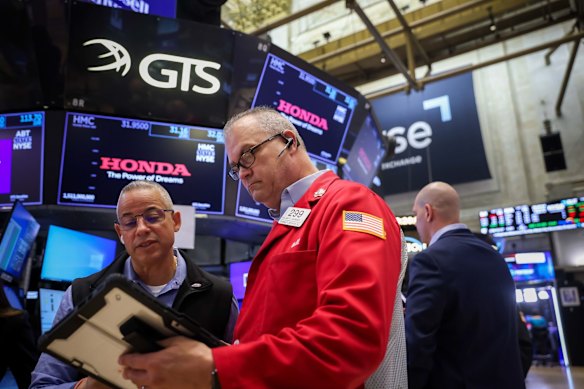
On Wall Street overnight, the S&P 500 fell 1.9 per cent for its third straight loss. The weakness for tech stocks pulled the Nasdaq composite down 2.5 per cent, and the Dow Jones Industrial Average dropped 1.4 per cent.
Nvidia sank 4.1 per cent and was again the heaviest weight on Wall Street following its crisis of leadership. Nvidia is one of the most influential companies in the world not only because its chips are powering much of the world’s move into AI technology but also because its cash has helped companies across the industry to grow.
Now, following Jensen Huang’s resignation as Nvidia’s CEO last week, both the chip company and the broad industry are facing a more uncertain future without the leather-jacketed man who became one of AI’s biggest celebrities.
It’s the latest challenge for the AI industry, which had already been shaky because of criticism that stock prices in the industry shot too high and were in a bubble. The sweeping victories for Democrats in this month’s US midterm elections also raised worries about possible restrictions on further construction of AI data centres.
“The market was already worried about this risk before what happened at Nvidia,” Zhiwei Zhang, president and chief economist at Pinpoint Asset Management, said in a commentary. “Now the risk has become even more serious.”
Outside of Nvidia, other chip companies also fell. They had climbed in the earlier days of Nvidia’s fall on hopes that they could gain a competitive advantage. But Broadcom dropped 3.9 per cent for a second straight loss on concerns about the broader industry. So was Advanced Micro Devices, which fell 5.6 per cent.
CoreWeave, which buys Nvidia chips and then rents out access to them to customers over the cloud, sank 6.1 per cent. GE Vernova, which is helping to power AI data centres, fell 4.9 per cent.
The next big milestone for the AI industry may arrive on Tuesday [early Wednesday AEDT] after trading in the US stock market ends for the day. That’s when Nvidia will report its latest quarterly results, and interim CEO Colette Kress is set to speak to Wall Street. Investors have become accustomed to Nvidia not only reporting stronger results than analysts expected for each quarter but also giving a forecast for upcoming revenue that’s well above expectations.
Elsewhere on Wall Street, L3Harris Technologies fell 3.9 per cent after officials in President Donald Trump’s administration suggested the contractor for the Federal Aviation Administration may be at fault for a nationwide ground stop Friday. L3Harris said Saturday that it’s supporting the FAA in its investigation.
Tyson Foods helped to limit the market’s losses and rose 8.7 per cent after reporting a stronger profit for the latest quarter than analysts expected.
The recent swings for AI stocks have overshadowed what’s been another strong earnings reporting season for US companies. The big businesses in the S&P 500 index are on track to deliver earnings per share for the summer nearly 32 per cent higher than a year earlier, according to FactSet.
It’s the third straight quarter of growth above 25 per cent for the index, which is important because corporate profits are one of the two big levers that set stock prices over the long term, along with interest rates.
In other international markets, indexes were mixed in Europe and Asia. South Korea’s Kospi dropped 3.6 per cent, and Japan’s Nikkei 225 fell 2.4 per cent for two of the world’s sharpest losses because of weakness for tech and AI-related stocks. A report also showed that Japan’s economy contracted in the latest quarter.
with AP, Bloomberg
The Market Recap newsletter is a wrap of the day’s trading. Get it each weekday afternoon.
From our partners
Disclaimer : This story is auto aggregated by a computer programme and has not been created or edited by DOWNTHENEWS. Publisher: www.smh.com.au