On 12 September 2007, an earthquake struck off the coast of southern Sumatra, Indonesia. Thousands of kilometres away, scientists monitoring India’s coastline had a question to answer: could the earthquake generate a tsunami, and if so, would its waves reach Chennai?
For a city whose Marina Beach had witnessed the devastation of the 2004 Indian Ocean tsunami, the question was more than scientific. It was a test of whether India could detect a threat at sea and warn people before it reached the shore.
The answer would come weeks before the country’s new tsunami warning system was officially inaugurated.
The disaster that changed India’s approach
On 26 December 2004, a magnitude 9.1 earthquake off Sumatra triggered a tsunami that swept across the Indian Ocean. The waves killed more than 10,000 people in India and devastated coastal communities across the region.
India had no dedicated tsunami warning system at the time. The disaster exposed a critical gap in the country’s ability to detect undersea earthquakes, assess tsunami risks, and communicate warnings to vulnerable populations.
The government responded by establishing an interim warning centre at the Indian National Centre for Ocean Information Services (INCOIS) in Hyderabad in early 2005.
The full Indian Tsunami Early Warning System was developed under the Ministry of Earth Sciences, with contributions from scientific and technical agencies. Its purpose was straightforward: detect earthquakes capable of generating tsunamis, assess the likelihood of dangerous waves and issue timely advisories to coastal authorities.
Reading the ocean before the waves arrived
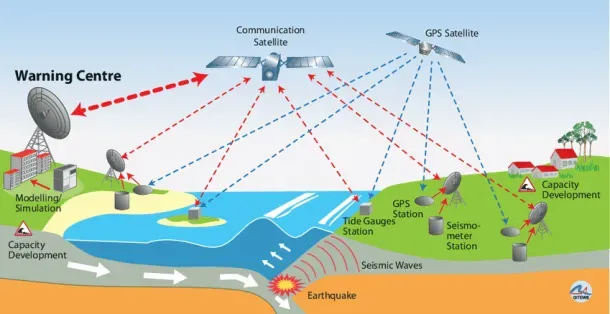
The new system relied on several layers of observation rather than a single instrument.
Seismic stations monitored earthquakes and helped scientists determine their magnitude, location, and depth. Deep-ocean bottom pressure recorders (BPRs) detected changes in water pressure that could indicate a passing tsunami. Tide gauges along the coast monitored changes in sea level.
The instruments fed information to the warning centre, where scientists analysed the data and used computer models to estimate the potential impact on coastal locations.

The system also incorporated simulated tsunami scenarios, allowing scientists to assess possible wave travel times and coastal inundation.
This combination mattered because not every powerful earthquake generates a tsunami, and not every tsunami poses the same threat to every coastline. Scientists needed to establish whether a wave had formed, where it was travelling, and how much time coastal communities might have to respond.
By September 2007, the system was nearing completion. Its instruments and analytical capabilities were about to face a real-world test.
The September alert and what it proved
The earthquake off southern Sumatra on 12 September 2007 provided that opportunity.
India’s warning system generated tsunami advisories after the earthquake, with the government later recording that the system had issued timely and accurate bulletins. The Ministry of Home Affairs’ annual report for 2007-08 specifically identified the event as an effective demonstration of the system’s capabilities.
The alert indicated that a small tsunami, with waves estimated at around 20 centimetres, was heading towards Chennai. Waves measuring approximately 18 centimetres were subsequently recorded along the city’s coast.
The difference between the estimated and observed wave heights was small, offering an early indication that the system’s monitoring and modelling capabilities could provide useful information about a tsunami’s arrival.

However, the event was not a repeat of the 2004 catastrophe. The September 2007 tsunami was much smaller, and the alert did not involve the mass evacuations associated with a major destructive tsunami.
Its importance lay in demonstrating that scientists could detect a potential threat, analyse it, and communicate information to authorities before the waves reached the coast.
On 15 October 2007, the National Tsunami Early Warning System was officially inaugurated at INCOIS in Hyderabad.
The system had taken approximately two-and-a-half years to establish. It was designed to operate round the clock, combining seismic monitoring, ocean sensors, computer modelling and communication networks to provide warnings across the Indian Ocean region.
The September alert had offered a preview of what the system could do. Its subsequent operation would help India strengthen its ability to respond to future tsunami threats.
The lesson was clear: a warning system is not simply a collection of instruments. It is a chain connecting scientific observation to public safety, and every link must work before the ocean reaches the shore.
Sources
‘Tsunami 10th anniversary, what’s changed‘: by Anil Sasi for The Indian Express, Published on 11 September 2014
‘Tsunami Early Warning System‘: by the Ministry of Home Affairs, Government of India, Published in 2008
‘Protection from Tsunami‘: by the Press Information Bureau, Government of India, Published on 26 December 2016
‘Indian Tsunami Early Warning System‘: by the Indian National Centre for Ocean Information Services, Government of India
‘Kapil Sibal Inaugurates Tsunami Early Warning System‘: by the Press Information Bureau, Government of India, Published on 15 October 2007
Disclaimer : This story is auto aggregated by a computer programme and has not been created or edited by DOWNTHENEWS. Publisher: thebetterindia.com