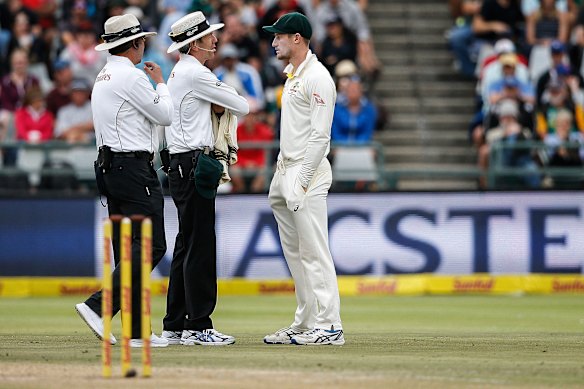

When Cameron Bancroft made his first Sheffield Shield century in a year against South Australia at Adelaide Oval two weeks ago, the celebration was meaningful.
After cutting a boundary, he sank to his knees with what looked like relief. And not just relief – it was noticeable that a weight appeared to be lifted from his shoulders.
The weight had not just been about making hundreds. Australia’s return to South Africa for a first Test series since 2018 had sat very heavily on Bancroft’s shoulders, given that there was always a chance his name would be dragged back into it as the player who used sandpaper on the ball.
But ahead of that innings, Bancroft had told those close to him he was informed that Usman Khawaja intended to come forward with his recollections of the Sandpapergate episode, a version of events that showed in detail why there was a case for collective responsibility from the team.
Following a bruising couple of weeks for Australian cricket, Bancroft now has the opportunity to open up with an account that can be more complete than anything yet aired.
Though David Warner and Steve Smith both served longer bans, no player was affected more greatly by the scandal than Bancroft. While it is true he briefly returned to the Test team in 2019, the majority of the past eight years have seen him unable to make the kind of mark on the game that would have helped balance what remains a hugely problematic period in the team in 2017-18.
Where Smith and Warner were able to return to the Test side for long stints, adding considerably to their records and pay packets, Bancroft has never been able to do anything that would shake the most indelible images of him – a cricketer shoving sandpaper down his underpants in a moment of panic in Cape Town. He is to Sandpapergate what Trevor Chappell was to underarm.
Bancroft has spoken extensively about how hard he tried to fit into the team. It’s worth noting that he was selected in place of a young Matt Renshaw, who had not fit into the team back then as a 20-year-old.
The coach at the time, Darren Lehmann, liked to refer to Bancroft as “a good kid”, almost as though he was an agreeable character who would do what the team asked of him. In South Africa, that was taken to extremes.
Khawaja’s account shows that in Port Elizabeth, after Warner expressed hesitation about using sandpaper due to the amount of public scrutiny he was under from broadcasters, Bancroft put his hand up.
At least once during the series, he received a team shout out and a round of applause for what he was doing for the team in “managing” the ball.
It is possible that not everyone in the team knew exactly what he was doing with the ball. But there’s little doubt that Bancroft’s job was well known.
Khawaja also recounts that a member of the coaching staff entered their segmented part of the Newlands dressing room on the fateful day the scandal was exposed, encouraging Bancroft to do more of what he was doing. Once again, the compulsion to fit in would have been overwhelming.
So Bancroft raised the degree of risk, from a brief bit of ball management on the boundary at the start of a session, to trying to continue doing so in the middle of the ground, by the pitch, under the full glare of the SuperSport cameras. The rest followed painfully.
In December 2018, when his ban was about to expire, Bancroft sat down for a Fox Cricket interview with Adam Gilchrist. That interview was expected to be the moment at which Bancroft spoke expansively about what had happened in South Africa, who did what, and when. But instead, the desire to fit back in took precedence, and he spoke in generalities about his journey of self-realisation.
“The decision was based around my values at the time,” he told Gilchrist. “I valued fitting in. With fitting in, you hope that earns you respect.
“If I’d actually said no, and went to bed that night … I would’ve gone to bed and felt like I would’ve let everybody down. I would’ve felt like I let the team down.”
Three years later, when interviewed by The Guardian’s sports writer Donald McRae, Bancroft was pushed harder on collective knowledge and responsibility. This led to his admission that it was “self-explanatory” that the bowlers would have known they were operating with a tampered ball. Bancroft’s words pushed Khawaja to the edge of making his own public admissions about the matter.
The bowlers, both in 2021 and again now through Pat Cummins and Mitchell Starc, have maintained that they did not know. The specifics of those denials, and also multiple lapses in recall, have been the subject of much debate since Khawaja spoke about the affair ahead of his book release.
Bancroft is aware of what Cummins has said, in addition to the very different recollections of Khawaja, Warner and the tour squad member Chadd Sayers. He must have collected his thoughts to consider how closely, or otherwise, they chime with those accounts.
The memories of Bancroft may be the key to ending an exhausting couple of weeks of claim and counter-claim. He has sat with those thoughts in his head for a long time, including specific conversations with numerous figures both before and after the fateful moment he was captured on the big screen at Newlands.
Bancroft’s version of events would doubtless be painful for some, but that must be balanced against the weight of experience that had caused his shoulders to regularly sag over the past eight years.
As the old saying goes, the truth hurts, but silence kills. Bancroft clearly felt a little less suffocated when he reached three figures in Adelaide. It is up to him how much more he wants to chase that feeling of openness.
News, results and expert analysis from the weekend of sport sent every Friday. Sign up for our Sport newsletter.
 Daniel Brettig is The Age’s chief cricket writer and the author of several books on cricket.Connect via X.
From our partners
Disclaimer : This story is auto aggregated by a computer programme and has not been created or edited by DOWNTHENEWS. Publisher: www.smh.com.au