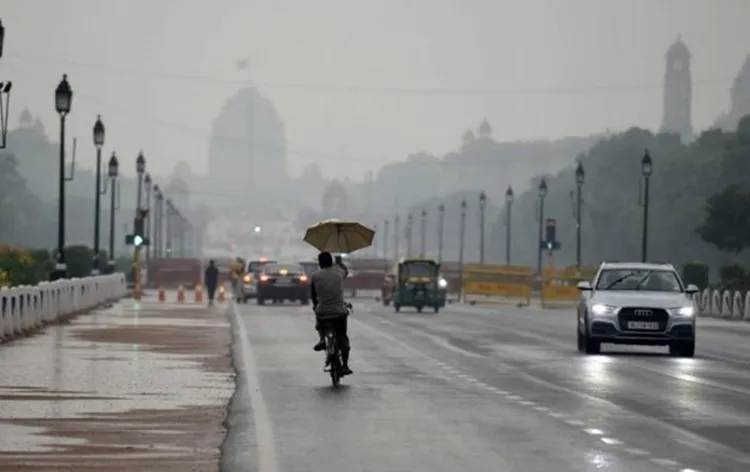
If you stepped outside in Gurugram on Sunday, November 15, the change in the air may have felt noticeable. After days of hazy skies and pollution-heavy mornings, light showers brought a brief spell of relief. The rain, accompanied by stronger surface winds, appeared to clear some of the suspended dust and improve visibility across parts of Delhi-NCR.
The change was reflected in the numbers, too. According to the Central Pollution Control Board (CPCB), Gurugram’s average Air Quality Index (AQI) dropped from 340 on Saturday, November 14, to 283 on Sunday, moving from the ‘very poor’ to the ‘poor’ category. This came after six consecutive days of very poor air quality.
For residents who had been waking up to hazy skies, the showers offered a welcome break. But there is a catch: cleaner-looking skies do not necessarily mean clean air.
So, does rain really wash pollution away? And if it does, why does the relief often disappear within a day or two?
How rain acts as nature’s air purifier
There is some science behind that fresh-after-rain feeling. When raindrops fall through the atmosphere, they collide with suspended dust, smoke and other airborne particles, collecting some of them and carrying them down to the ground.
Scientists call this process wet deposition, commonly referred to as atmospheric washout.
Think of it as nature’s way of rinsing the air. As droplets travel downwards, they capture pollutants through processes such as interception and impaction. These particles then settle on roads, rooftops, trees and other surfaces along with the rainwater.
However, rain does not remove every pollutant equally well.
Larger particles, such as PM10 (particulate matter measuring up to 10 micrometres), are generally easier for raindrops to capture. Fine particles, particularly PM2.5 (measuring 2.5 micrometres or smaller), are much harder to remove efficiently.
This distinction matters because PM2.5 can penetrate deep into the lungs and is a major concern during Delhi-NCR’s winter pollution episodes.
The intensity and duration of rainfall also matter. A sustained spell of rain generally has more opportunity to wash particles out of the atmosphere than a brief drizzle. A few passing showers may clear some dust without making a significant difference to the finer pollution particles.
Why the wind matters as much as the rain
In Gurugram, the November 15 improvement was not simply a result of rainfall. Stronger surface winds played an important role, too.
Rain helps remove pollutants from the atmosphere, while wind helps disperse them. When winds move at higher speeds, they can carry polluted air away and bring in relatively cleaner air from surrounding areas.
This is particularly important during winter, when Delhi-NCR experiences conditions that allow pollution to accumulate close to the ground.
The Commission for Air Quality Management (CAQM) explains that low wind speeds, a shallow atmospheric mixing layer, and stagnant weather conditions restrict the dispersal of pollutants. In simple terms, there is less vertical and horizontal movement to spread pollution out.

When stronger winds arrive, they can break this stagnation, allowing pollutants to disperse. This means that a combination of rainfall and favourable wind conditions can produce a more noticeable improvement than either weather event alone.
Why does the pollution return after the rain?
If rain can wash away airborne particles, why does the AQI climb again so quickly?
The answer lies in the fact that rainfall removes some of the pollution already present in the air, but it does not switch off the sources producing it.
Vehicles continue to release exhaust, construction activity generates dust, industries emit pollutants, and biomass burning contributes to particulate matter. Once the rain stops and the atmosphere becomes stagnant again, these emissions can accumulate.
Winter conditions make this worse. Lower temperatures and reduced atmospheric mixing can trap pollutants near the surface, allowing concentrations to rise again.
There is another complication: high humidity can cause certain airborne particles to absorb moisture and grow in size. This can affect how they scatter light, making the atmosphere look hazier even when the underlying pollutant concentrations have not changed in the same way.
A clearer sky is not always cleaner air
The next time it rains after a particularly polluted spell, it is worth remembering that a blue patch of sky is not an air-quality certificate.
The AQI is calculated using measured concentrations of pollutants such as PM2.5, PM10, nitrogen dioxide, sulphur dioxide and ozone. Visibility, on the other hand, is influenced by several factors, including humidity, fog and suspended particles.

The rain may have made stepping outside a little more pleasant that Sunday, but Gurugram’s AQI was a reminder that the relief would not last on its own. Once the showers stopped, the familiar sources of pollution were still there: vehicles on the roads, dust from construction sites and emissions from surrounding areas.
And that is perhaps the most important distinction: rain can give us a temporary break from polluted air, but cleaner air is something we have to work towards long after the clouds have passed.
Sources:
‘Gurugram’s AQI improves to ‘poor’ after six consecutive days of ‘very poor’ air’ by Vidhi Bhutra for Hindustan Times, Published on 16 November 2026.
‘What Rain Really Does to Air Quality: Myths vs Facts’ by Equinox Labs, Published on 29 September 2026.
‘Does Rain Improve Air Quality? What You Should Know’ by IAQ Answers, Published on 28 September 2026.
Disclaimer : This story is auto aggregated by a computer programme and has not been created or edited by DOWNTHENEWS. Publisher: thebetterindia.com