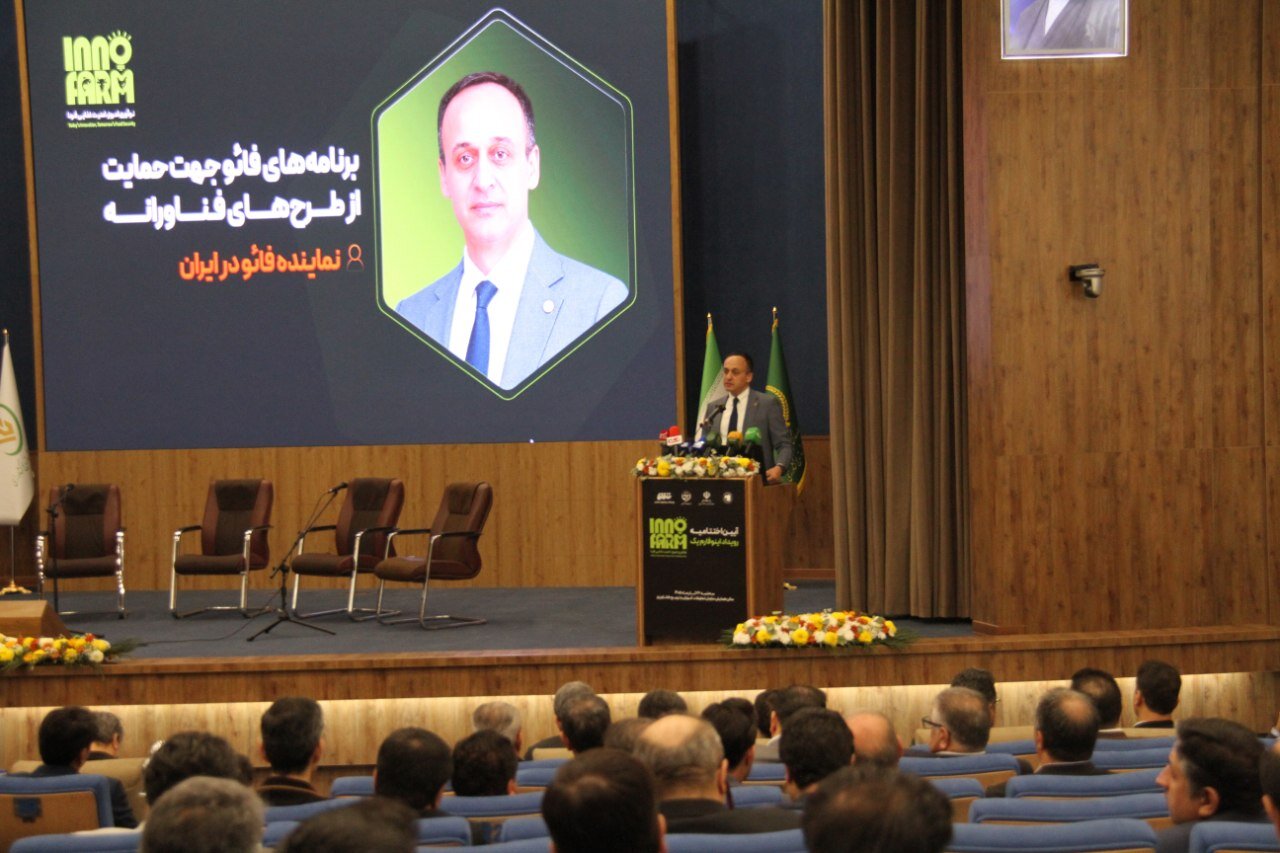
TEHRAN – The Food and Agriculture Organization of the United Nations (FAO) held the InnoFarm event in Tehran on Tuesday to expand its support for technology-driven initiatives in agricultural education, development and management, bringing together stakeholders from the government, research and innovation sectors to promote the application of new technologies in agriculture.
The event was organized with the participation of the Ministry of Agriculture, the Agricultural Research, Education and Extension Organization (AREEO), and the Vice Presidency for Science, Technology and Knowledge-Based Economy.
Addressing the event, Mr. Farrukh Toirov, FAO Representative in the Islamic Republic of Iran, said innovation was a key driver of agrifood transformation worldwide, as food production systems face growing demands to provide nutritious food while addressing water scarcity, climate risks and rising production costs.
Meeting these challenges requires innovations that producers can access, trust and put into practice, he noted, adding that FAO places innovation at the center of its efforts to achieve better production, better nutrition, a better environment and a better life, leaving no one behind.
He explained that FAO’s Strategic Framework identifies technology, innovation and data, alongside enabling conditions such as governance, human capital and institutions, as four accelerators of progress toward these goals.
Referring to the organization’s activities in Iran, Toirov highlighted initiatives in digital agriculture and precision resource management, including support for apple producers in the Lake Urmia Basin. These initiatives have explored the use of smart irrigation systems and digital advisory applications that provide farmers with alerts and guidance on irrigation, soil conditions and fertilizer management.
He also pointed to the promotion of Farmer Field Schools and practical knowledge-sharing approaches under the same initiative, saying these platforms help bring scientific knowledge directly to farming communities and support the transition toward more sustainable agricultural practices.
Turning to InnoFarm’s role, the FAO representative said one of the most challenging aspects of agricultural innovation was translating promising ideas into practical applications. Researchers need opportunities to test their solutions against real production challenges, entrepreneurs require technical and business support, and investors need credible evidence before committing resources, he explained.
In this regard, he said InnoFarm’s efforts to connect these groups could help bridge the gap between research and practical application and introduce useful innovations into livestock, poultry and aquaculture production. Its combination of scientific assessment, mentoring, business preparation and investor engagement reflects an approach that can help promising technologies move closer to market adoption.
Toirov also referred to FAO’s SDG Agrifood Accelerator Programme, implemented with technical support from the Social Enterprise Ecosystem and Development (SEED), as an example of the organization’s efforts to support agrifood enterprises. The programme provides small and medium-sized businesses with tailored mentoring in investment strategies, marketing and financial planning, while helping them evaluate their social and environmental contributions.
Among the businesses supported by the programme were enterprises involved in indigenous grain processing in Ghana and precision rice farming in Thailand. Their experiences demonstrate how tailored support can address the needs of different technologies and markets while maintaining a focus on sustainable development, he said.
He stressed that support for selected innovators should continue beyond award ceremonies, enabling them to test business assumptions, demonstrate the results of their solutions and build lasting relationships with customers and investors.
The FAO representative also highlighted the World Food Forum’s Startup Innovation Awards as another model for supporting young agrifood entrepreneurs by connecting them with mentoring opportunities, platforms to present their solutions and greater international visibility.
Young entrepreneurs have valuable ideas, he said, but access to expertise, testing facilities and professional networks often plays a decisive role in determining whether these ideas can be translated into practical solutions.
Toirov further introduced FAO’s Agrifood Systems Technologies and Innovations Outlook (ATIO) and its associated Knowledge Base as resources for tracking emerging technologies, understanding their applications and assessing the conditions that influence their adoption.
He said these resources could help initiatives such as InnoFarm compare available solutions, identify gaps in evidence and evaluate the suitability of innovations for specific agricultural production systems.
He also pointed to opportunities for sharing well-documented Iranian experiences through international knowledge networks, emphasizing that evidence on the performance, affordability and adoption of technologies would make such exchanges particularly valuable.
Disclaimer : This story is auto aggregated by a computer programme and has not been created or edited by DOWNTHENEWS. Publisher: tehrantimes.com