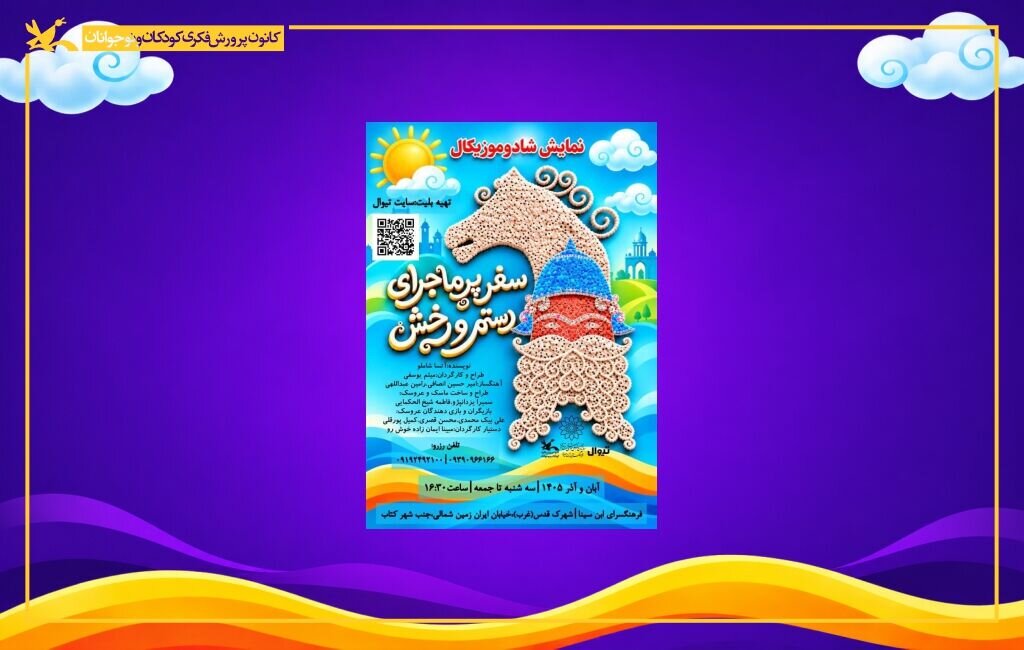
TEHRAN- “The Adventures of Rostam and Rakhsh,” a theatrical production by the Institute for Intellectual Development of Children and Young Adults (IIDCYA), based on the story of the Seven Labors of Rostam from Ferdowsi’s epic masterpiece Shahnameh, will be staged at Ibn Sina Cultural Center in Tehran.
The play is written by Atesa Shamlou, designed by Samira Yazdanpajou and Fatemeh Sheikholhokamai, and directed by Meysam Yousefi. The production is being presented as part of the institute’s rotating theater program.
The play was previously produced under the title “Haft Khan” (The Seven Labors) as part of the “Book, Theater, School” project. It has already been performed in schools, at IIDCYA centers and through the institute’s mobile theater program, which takes theatrical productions to children in different communities.
Ali Beyk-Mohammadi, Mohsen Qasri and Komeil Pourqoli make up the cast, while Amirhossein Ensafi and Ramin Abdollahi are responsible for the music.
The story begins when Zal informs his son Rostam that King Kay Kavus and his army have been captured by the White Div, a powerful demon dwelling in Mazandaran. To rescue the king and his soldiers and break the demon’s spell, Rostam sets out on a perilous journey from Sistan to Mazandaran, accompanied by his loyal horse, Rakhsh. Along the way, he must overcome a series of formidable challenges known in Persian literature as the Haft Khan, or Seven Labors of Rostam.
Rostam is one of the most celebrated heroes in Persian literature and the central warrior figure in many of the legendary episodes of the Shahnameh, or Book of Kings, composed by the Persian poet Abolqasem Ferdowsi in the late 10th and early 11th centuries. Born to Zal and Rudabeh, Rostam is associated with Sistan and serves as the principal defender of the Iranian kingdom against its enemies. Renowned for his extraordinary strength, courage and military skills, he embodies the ideals of heroism, loyalty and devotion to his homeland. His adventures form a substantial part of Ferdowsi’s epic, which recounts the mythical and historical past of Iran through stories of kings, warriors, conflicts and moral trials.
Rakhsh, Rostam’s legendary horse, is far more than a means of transportation. A remarkable and intelligent animal, he is the hero’s inseparable companion and plays an active role in several of his adventures. Known for his strength, speed, courage and loyalty, Rakhsh shares Rostam’s dangers and contributes to his victories. In the account of the Seven Labors, the horse is particularly important, demonstrating his own courage and alertness when confronting dangers. The relationship between Rostam and Rakhsh represents a bond of mutual trust and companionship, making the horse one of the most memorable animal characters in Persian epic literature.
The Seven Labors recount Rostam’s journey through a series of dangerous encounters and supernatural challenges. These include battles with fierce animals, demons and other mysterious forces. Each trial tests a different aspect of the hero’s abilities, requiring not only physical strength but also courage, intelligence, patience and determination. The final confrontation with the White Div is particularly significant, as Rostam must defeat the demon to save Kay Kavus and his companions. The story has remained one of the best-known sections of the Shahnameh and has inspired numerous artistic interpretations, including illustrations, paintings, theatrical performances and adaptations for younger audiences.
Drawing inspiration from ancient Iranian literary sources, the new theatrical production combines humor and music with a psychological approach to themes such as raising awareness and avoiding false self-confidence. Through Rostam’s adventures, the play seeks to introduce young audiences to a major part of Iran’s literary heritage while encouraging reflection on personal qualities and the importance of making informed decisions.
The Shahnameh, one of the most influential works of Persian literature, consists of approximately 50,000 couplets and preserves a vast collection of Iranian myths, legends and historical narratives. Ferdowsi’s epic has played a major role in maintaining the Persian language and transmitting cultural traditions across generations. The story of Rostam and his Seven Labors remains among its most enduring narratives, offering younger readers and audiences an introduction to the values, imagination and heroic traditions of classical Persian storytelling.
“The Adventures of Rostam and Rakhsh” will run from November 17 to December 18, at Ibn Sina Cultural Center, located on North Iran Zamin Street, Shahrak Qods.
SAB/
Disclaimer : This story is auto aggregated by a computer programme and has not been created or edited by DOWNTHENEWS. Publisher: tehrantimes.com