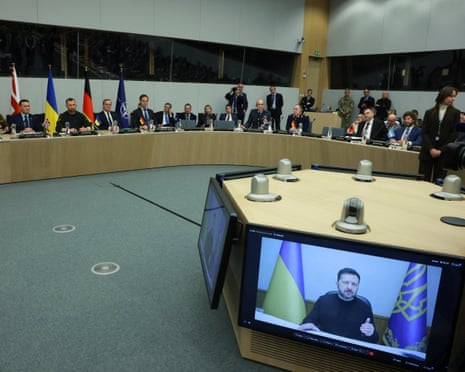
Ukraine’s president Volodymyr Zelenskyy has urged allies to send deliveries of air defence missiles to Kyiv without delay, as he addressed ministers during the Ukraine Defence Support Group in Brussels.
“Russia keeps attacking us with jet-powered Shaheed drones, cruise missiles, and, most dangerously, ballistic missiles, and we need to defend against all of this,” he said.
“The world has enough [of air defence missiles] and America has them, some European countries have them, and some of our other partners around the world have them, too. These interceptors should not be sitting in warehouses. They should be in air defence batteries, protecting our cities, towns and villages from Russian strikes and saving lives, of course.”
“We all understand that there are long waiting lists for new interceptors, but we need them here and now,” he added.
Zelenskyy warned that “every successful Russian strike makes Russia more aggressive, more demanding, and less willing to compromise.”
And, on that note, we will be closing the blog for today.
-
Ukraine’s president Volodymyr Zelenskyy has urged allies to send deliveries of air defence missiles to Kyiv without delay, as he dialled into a meeting of Ukraine’s key allies at a high-level meeting in Brussels (17:07).
-
The renewed request came hours after Ukraine critically damaged the Kerch Bridge linking occupied Crimea with Russia, in what Zelenskyy hailed as an “unprecedented” military operation which drew comments from allies (10:32, 14:55, 15:01, 17:34).
-
Several European partners, including Denmark, Germany, Sweden and the UK, declared their plans to further support Ukraine amid growing concerns about a particularly difficult winter ahead (9:55, 9:58, 16:01, 17:11).
-
On Thursday, top EU leaders are going to meet in Berlin for latest talks on Ukraine within the so-called Coalition of the Willing, with Finland’s influential Alexander Stubb saying the meeting will be “very important” to help influence the structure of any peace talks with Russia (13:03).
In other news,
-
46 people were injured, including four seriously, after two commuter trains collided near the main railway station in Prague (10:09).
-
Candidates for Serbia’s Student List, the grassroots movement of political outsiders that pulled off a spectacular victory in last month’s elections over the party of the populist leader Aleksandar Vučić, have been sworn in as MPs as they begin the process of forming a government. (13:46).
-
Former US president Joe Biden’s memoir, Promise Me, America, got published today, with some of his unfiltered views on Ukraine’s Zelenskyy, Ukraine, France’s Emmanuel Macron and Brexit (13:41).
-
After 65 days without a government, the Swedish outgoing prime minister and Moderates leader Ulf Kristersson has asked for more time before parliament votes on whether they want him as prime minister (15:50, 16:29).
If you have any tips, comments or suggestions, email me at jakub.krupa@theguardian.com.
I am also on Bluesky at @jakubkrupa.bsky.social and on X at @jakubkrupa.
The section of the Crimean Bridge that appears to have collapsed in Tuesday’s attack was described by Russian engineers at the time of its construction as the most technically challenging part of the entire project.
Dmitry Kondakov, a senior executive at the company building the bridge, said in 2016 that shipping arches were “the most difficult thing we have to do”, noting that Russia had little experience constructing such complex structures.
Another senior official described the operation to install the arches as the “pinnacle of the entire construction project”, calling it the most technically demanding stage of building the bridge.
Their comments highlight the complexity of the rebuild operation planned by Russia (11:12).
The US undersecretary of defence Elbridge Colby has praised Europe for stepping up to take more responsibility for Ukraine’s defence, helping mount the Ukrainian forces mount “a resilient denial defence.”
Colby said Europe and the US “have made tremendous progress in making Nato 3.0 a reality,” while continuing to support Ukraine.
But he said more needs to be done, urging Europe “to focus its defence industrial-based efforts on military efficacy and battlefield utility, rather than ancillary domestic or industrial policy objectives” and continue its spending on Ukraine-related schemes.
Turning to Ukraine, he said:
“In October, for the second consecutive month, Ukraine gained more territory than Russia and Russian forces suffered their highest monthly casualty toll of the war.”
But in a rather curious part of his statement, Colby appeared to distance the US from some of the recent deep strikes in Russia.
He argued:
“It is our view that focusing on support, our support on the frontlines and on associated mid-range strikes is the most effective way to enable Ukraine’s defence, and thus to set the conditions for an end to the war. …
While the public conversation focuses on the spectacle of deep strikes designed to incur pain on the Russian population, our assessment is that such strikes have not been effective in driving an end to the war, nor do they contribute to blunting Russia’s advances on the frontline.
Moreover, such strikes as especially those that target civilian infrastructure, such as Wildberries, have actually probably hardened the Russian public’s resolve and the Kremlin’s own willingness to escalate. Moreover, it is important to note that the balance of advantage in deep strikes may well favour Moscow.”
He added:
“This is not to say that Ukraine should be forced to fight with its hands tied behind its back. Rather, that we should be clear about is that the focus of our support should be on enabling and advancing Ukraine’s ability to hold the line of battle and, where possible, make gains.
Strikes focused on the frontline and direct support to that battle area, of course, fall into this category, but consistent with this approach, strikes that target Russia’s war making machinery can also help contribute to slowing Russia’s advances on the frontlines.”
Colby also said the US administration “remain firmly committed to bringing this conflict to an end on terms that secure a durable peace,” even as it appears that Russia wants to continue the war.
Germany’s defence minister Boris Pistorius has warned that “the fifth war winter … threatens to be harder than the ones before,” as Russia “has further expanded its arsenal of attack drones and ballistic missiles.”
“With daily airstrikes, Russia is trying to take out Ukraine’s energy infrastructure and water supply. It is terrorising Ukraine from the air because it cannot achieve military success on the ground,” he said.
Pistorius warned that Russia “may intentionally try to cause humanitarian emergencies in Kyiv, Odesa and other large cities to break the Ukrainian people’s resistance.”
“If Russia were to succeed, the consequence would be dramatic, both for Ukraine and for Europe,” he said.
Earlier, UK’s Wes Streeting said the aim of the meeting is to discuss how to “put Ukraine in the best possible position for future negotiations.”
Ukraine’s president Volodymyr Zelenskyy has urged allies to send deliveries of air defence missiles to Kyiv without delay, as he addressed ministers during the Ukraine Defence Support Group in Brussels.
“Russia keeps attacking us with jet-powered Shaheed drones, cruise missiles, and, most dangerously, ballistic missiles, and we need to defend against all of this,” he said.
“The world has enough [of air defence missiles] and America has them, some European countries have them, and some of our other partners around the world have them, too. These interceptors should not be sitting in warehouses. They should be in air defence batteries, protecting our cities, towns and villages from Russian strikes and saving lives, of course.”
“We all understand that there are long waiting lists for new interceptors, but we need them here and now,” he added.
Zelenskyy warned that “every successful Russian strike makes Russia more aggressive, more demanding, and less willing to compromise.”
Nordic correspondent
The Speaker of the Riksdag, Andreas Norlén, has said granted Ulf Kristersson’s request for more time for coalition talks (15:50) but that he wants to have clarity for the Swedish public by Christmas.
He said he would give parties one more week before he calls in the party leaders to decide what will happen next, but that he is determined to get to the end of this process soon so that by Christmas, Sweden will either have a new government or can prepare to go back to the polls with a second election.
He said:
“My opinion is that this formation of government needs to come to an end in good time before Christmas. I want that when the Swedish people celebrate Christmas they will know that Sweden either has a new government or are preparing themselves for another election.”
Sticking to the Swedish theme for a moment, Sweden’s defence minister Pål Jonson is the latest leader to stop by the journalists upon his arrival at today’s Ukraine Defence Contact Group in Brussels.
In his comments, he said the meeting was “timely” as “the situation in Ukraine is very challenging due to the fact that Russia scaled up its production, both of ballistic missiles and also drones and glide bombs.”
Sweden will spend €4bn on helping Ukraine in 2027, Jonson said, noting cross-party backing across the parliament.
The minister also said that Sweden signed a letter of intent with Ukraine and the UK on the upcoming delivery of Gripen fighter jets for Ukraine.
Responding to questions from reporters, Jonson also said that the US undersecretary of defence Colby did not say “specific” information on the ongoing review of the US posture in Europe.
“We are expecting it to come by the end of the year,” he said, adding that “the message is clear that Europe is going to shouldering the lion’s share of conventional deterrence by 2028.”
Asked about the peace negotiations with Russia, the Swedish minister said he “has not seen any serious intent from the Russian side” on ending the war in Ukraine, stressing the need to keep supporting Kyiv in the meantime.
Jonson pointedly disagreed with Finland’s president, Alexander Stubb, who has repeatedly called for direct talks with Russia’s Vladimir Putin.
Asked if he sees any merit in that approach, he said:“Not quite, because we do not see any serious commitment from the Russian side to making any kind of compromise.”
“I know there’s all kinds of ideas drifting around that we should also have a discussion about the European security architecture. We do not welcome that.”
Nordic correspondent
In other news, after 65 days without a government, Moderates leader Ulf Kristersson has asked for more time before parliament votes on whether they want him as prime minister.
Two weeks after he was given the task to attempt to form a “middle” coalition government by the Speaker, he said on Tuesday afternoon that he had requested a few more days.
The Speaker will hold a press conference later this afternoon when he is expected to respond to the former prime minister’s request.
His announcement comes after the Centre party leader, Elisabeth Thand Ringqvist, asked Kristersson and the Social Democrats leader Magdalena Andersson to present a “total package” for her party to choose between after talks between the left-leaning parties failed to produce a result.
She has already said yes to Andersson’s proposal of a coalition between the Social Democrats, Green party and the Centre party with cooperation with the Left party. But the Left party has since continued to demand ministerial posts, which the Centre party has refused to accept.
Kristersson said:
“A majority government that cannot agree does not work, so nothing would get done. A few more days are needed before a vote takes place, so that the Centre party can have a complete basis for decision making which is needed to take a position.”
If the vote on Kristersson does not lead to a government, parties have just one more attempt before another election will be automatically called.
Kristersson said he does not want another election, but is “totally prepared” for one and already has a team of people preparing in case.
The Speaker is due to speak shortly.
Meanwhile, Ukraine’s Volodymyr Zelenskyy has said Kyiv is working on a prisoner of war exchange with Russia, “one of the most important agreements reached at the trilateral meeting in Abu Dhabi.”
He said Ukraine would submit its proposals to the US, and could “deliver results in the coming weeks.”
“The timeline for implementing this agreement depends on how quickly the Russian side acts and on the American team’s communication with them,” he said.
Acting on the success of the humanitarian operations in Oleshky, Ukraine will also propose 10 other areas in the occupied parts of Kherson and Zaporizhzhia regions where similar actions are needed, Zelenskyy said.
Arriving earlier, UK defence secretary Wes Streeting – who co-chairs the group – said the meeting comes “at a critical time for the war in Ukraine” in what he argued “has been a terrible year for Vladimir Putin.”
“Russian casualties are [at] intolerably high levels as a direct result of his illegal and unnecessary war. The economic costs on his economy and his own people have been catastrophic. And all of those lives and all of those, economic costs are coming with little to no gain. The frontline isn’t moving, and Ukraine continues to show extraordinary resilience, courage and ingenuity.”
Streeting said the meeting was focused on “mobilising the support for allies … to see Ukraine through what will inevitably be a challenging winter.”
“We’re all invested in the, attempt to negotiate a peace, and an end to this conflict that has to be on terms that are acceptable to Ukraine. There can be no decision about Ukraine without Ukraine.”
On the Kerch Bridge strike, he said:
“I think we’ve just seen another example of Ukrainian ingenuity and Ukraine’s absolute determination to defend itself against Russian aggression. We stand with Ukraine, as they do that.”
Just like Rutte, he said he expected “a number” of announcements from Ukraine’s allies to help Kyiv in the coming months today.
Over in Brussels, the Ukraine Defence Contact Group is about to meet for their latest talks on Ukraine, including the US undersecretary of defence, Elbridge A. Colby.
Nato’s secretary general Mark Rutte just arrived and chatted with reporters, telling them he is “relatively optimistic” ahead of the meeting, hoping for “some good announcements this afternoon.”
“A lot of people are working very hard to bring peace to Ukraine. But in the meantime, we have to make sure that they have what they need to get through winter, that they have what they need to be as strong as possible in the peace negotiations.”
On the Kerch Bridge, Rutte said that “it’s important that Ukraine defends itself.”
“And that means also hitting out at logistical nodes; it’s unavoidable that they do that. … We have to see, of course, what exactly happened but at least [from] the media footage, it seems that they were successful.”
Rutte declined to comment on the peace negotiations, saying merely that “the US is playing a crucial part here.”
“I think it’s good that Europe is now at a table – that was one of the outcomes of Abu Dhabi – I think the Europeans have organised themselves now quite well.”
Asked about the renewed Starshield restrictions affecting Ukraine, he said that “relevant parties are working very hard to make sure that as soon as possible, things are back to normal.”
“I know that anyone who can be helpful here is working on this.”
Disclaimer : This story is auto aggregated by a computer programme and has not been created or edited by DOWNTHENEWS. Publisher: theguardian.com