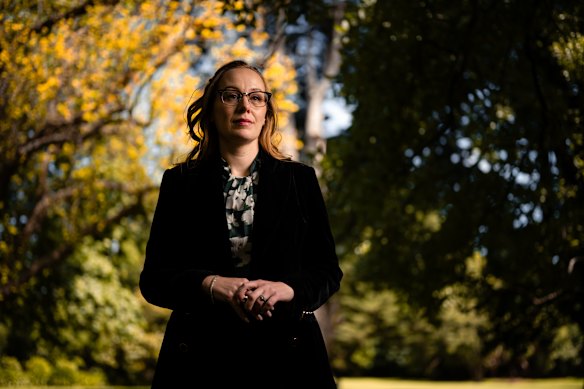

Sara Webb spent the day before her wedding in an emergency department in a state of extreme agitation, feverish and shaking uncontrollably, her heart beating abnormally fast.
She was having a terrifying reaction to a medication that had been rapidly injected directly into her bloodstream.
The emergency doctor instead diagnosed her with pre-wedding anxiety.
In April 2025, Webb spent her bachelorette party sick and feverish, drinking fluids and taking paracetamol to get through the festivities. Then came a night of unrelenting vomiting and diarrhoea.
“It was just horrendous,” the 29-year-old astrophysicist said.
Her fiance, Simon Goode, knew she needed to go to hospital.
Webb arrived at Bendigo Hospital’s emergency department, dehydrated and severely nauseated. She told the attentive nurses she was getting married the next day and managed a joke.
“I told them I didn’t want to Bridesmaids my way down the aisle,” Webb said, recalling the comedy film and its infamous explosive gastro scene.
Intravenous fluids and an oral anti-nausea medication helped, and Goode left to take care of 11th-hour wedding preparations.
But Webb was soon overcome by another wave of nausea before a second dose was due, so she was offered an alternative medication.
“I said ‘OK, whatever it takes’.”
Within 20 seconds of the drug being rapidly pushed through a catheter in her arm, Webb felt an overwhelming sense that something was very wrong.
“I had never understood the term ‘impending doom’, but at that moment I very quickly did,” Webb said. “My body felt like it was on fire, and I could feel my heart racing in my chest.”
The Apple watch on her wrist recorded her heart rate at 186 beats per minute. She was shaking uncontrollably and felt a sudden urge to urinate. But when she stood, she was overcome by lightheadedness.
A nurse rushed into her room and caught her under her arms.
“She said, ‘sweetheart, something is wrong. What’s wrong?’”
Webb had been given a large dose of metoclopramide (Maxolon), a commonly prescribed anti-nausea medication with a significant risk of side effects that aren’t routinely disclosed.
Roughly one in 100 people who take metoclopramide will develop temporary movement disorders, such as akathisia causing agitation, an uncontrollable urge to move and a profound sense of terror.
For an IV dose of metoclopramide – particularly one rapidly injected – the risk of akathisia is up to one in four people.
Tachycardia – an abnormally fast heart rate – is another known adverse reaction to a rapid dose of metoclopramide. For this reason, it should be injected slowly over at least three minutes.
The drug’s foundational trials primarily involved male participants and male lab animals. But metoclopramide is predominantly prescribed to females, many of them pregnant women with hyperemesis gravidarum.
Webb explained to the nurses that she had felt terrible immediately after the dose.
“[They] were trying to figure out what was happening,” Webb said. They connected her to an echocardiogram (ECG) and took blood samples.
Then, Webb recalled, a doctor arrived at her bedside and asked the nurses to clear the room, his manner condescending.
“He grabs both my hands and asks: ‘Are you nervous about getting married?’,” Webb said.
“I was so confused. I said: No, I’m not nervous at all. I’ve been with my partner for seven years.
“I’m sitting there, trembling, freezing cold, with the heart monitor going off, sweating bullets.”
Webb told the doctor she thought she was having a reaction to the medication.
“He said: ‘I don’t think you’re having a reaction. This is a very common medication … we need to figure out how to get you to calm down’,” Webb recalled.
“At this point, I was on the brink of tears.”
Webb pointed to her high heart rate reading on the Apple watch and the ECG monitor, but the doctor removed the watch from her wrist and turned the monitor away from her.
“He said it was reinforcing my anxiety,” Webb said. “I was thinking, oh my god, I have died, and this is purgatory.”
Webb had managed to text Goode, who raced back to the hospital, and the doctor left her side when he arrived.
“The rest was a bit of a blur,” she said.
Within a few hours, Webb’s symptoms subsided and she was discharged.
She felt terrible, but she did not “Bridesmaids down the aisle”.
‘A moral obligation to act’
Webb is among more than 2500 women who shared their experiences of medical misogyny with the Sydney Morning Herald and The Age as part of an ongoing investigation.
On Tuesday, the federal government released an audit of every university healthcare-practitioner training program, which found just 9.5 per cent of health and medical curricula contained any mention of sex and gender.
To fix the problem, the review’s authors at The George Institute of Global Health said sex and gender education must become a mandatory condition of course accreditation.
Assistant Minister for Women Rebecca White said there was a moral obligation to act on the audit’s findings, not just for women but for men and gender-diverse people.
“We know for such a long time that there’s a gender bias in the healthcare system, and it is a problem that is systemic,” White said, acknowledging recent monumental improvements across the healthcare system and many practitioners employing a sex and gender lens in daily practice.
Professor Bronwyn Graham, the audit’s lead investigator, said future healthcare practitioners were not being told that the course content – presented as sex and gender-neutral – was based on evidence developed using males.
“But they’re also not being taught about the history of sex and gender bias in the system,” said Graham, director of The George Institute’s Centre for Sex and Gender Equity in Health and Medicine.
“We hear time and time again that women’s symptoms are complicated, they’re vague, they’re confusing,” she said, “and so health professionals [respond]: we’ve seen you, we can’t work it out, so it must be anxiety.”
Diagnosis: pre-wedding panic attack
A few weeks after Webb’s wedding day, she received her hospital discharge summary.
“I looked at it and went: what the hell?” Webb said.
Documented in her formal medical records was the conclusion that her tachycardia was “likely due to her having a panic attack, which Sara herself acknowledges,” and that following IV treatment, “and some time to compose herself, she was much improved”.
There was no mention of metoclopramide.
She had never agreed with the assumption that she was having a panic attack – “quite the opposite”.
“I said to [my husband]: I think this is medical misogyny,” Webb said. “And that’s when I filed a complaint.”
Bendigo Hospital responded with a formal apology from the head of the emergency department and generated a new discharge summary. It erased “panic attack”, and acknowledged Webb had received “a dose of IV metoclopramide and almost immediately experienced tachycardia, shaking and was febrile”.
“I am someone who is empowered to have a voice, and it makes me very sad to think of all the people who aren’t, who may have been gaslit or misdiagnosed, and they may not have even known it was happening and it could have had life-changing consequences,” Webb said.
At several leading education institutions, work is under way to address sex and gender bias in healthcare. RMIT has begun a major overhaul to embed sex-specific education across its healthcare training.
University of Sydney medical students are taught to identify and respond to unconscious bias and stereotyping and, last week, second-year students were sent an article from this masthead’s Medical Misogyny investigation as recommended reading.
Graham said reforming how future practitioners are taught could not happen in a vacuum. “Education is teaching what the research is telling us, and there are still gaping holes, particularly for women and gender-diverse people’s health,” she said.
From this year, the Australian government’s Medical Research Future Fund will finance only research that considers sex and gender variations at every stage of the project. The audit’s authors want the Australian Research Council to follow suit.
Australia’s clinical practice guidelines also needed updating, Graham said.
One positive step forward was the publication of a new global definition of heart attack that is expected to help improve the diagnosis and timely treatment for women.
“There is an appetite for change, and we’ve got some very clear levers to make that change,” Graham said.
Start the day with a summary of the day’s most important and interesting stories, analysis and insights. Sign up for our Morning Edition newsletter.
From our partners
Disclaimer : This story is auto aggregated by a computer programme and has not been created or edited by DOWNTHENEWS. Publisher: www.smh.com.au