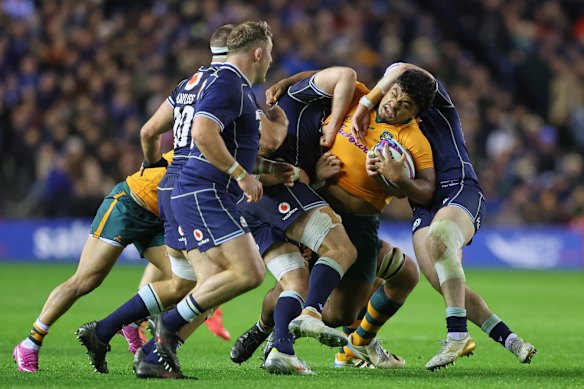

Wallabies forwards coach Tom Donnelly said the key to getting the side’s attack firing is more urgency and muscle when carrying the ball, as stats emerged showing the team’s power in the contact zone has nosedived in the past four Test defeats.
Donnelly’s comments came as he rejected talk of the squad being weary at the end of a long season. Returning No.10 Carter Gordon also said the team’s confidence had been reinstalled by a spirited performance at Murrayfield, despite the defeat to Scotland.
The Wallabies fixed their leaky defence against Scotland, going from an average of 46 points per game in the last three Tests, to conceding 15 in Edinburgh.
But the attack didn’t fire enough shots to win a dour, grinding contest. The Wallabies scored two tries, in the 12th and the 79th minute.
“We had a really good review this morning around our carry-clean detail, and some of our fundamentals of our game,” Donnelly said. “If we get that right, on the back of that, it allows us to play with quick ball and allows us to be able to use our attacking weapons.
“If we don’t quite get that right, the ball becomes slow and it becomes a lot harder. Defences over here get set pretty quick and early, and they’re pretty hard to break down if you’re not getting your carry-clean detail right.”
The Wallabies’ attack is based on getting good go-forward in the middle, and with a fast recycle, a compressed defensive line will allow a sweeping attack to exploit space. It worked pretty well in the first eight games of the year – with mostly competitive showings against Ireland and France, and an undefeated run of six matches against Italy, Japan, Argentina and South Africa.
But stats show the Wallabies’ ability to punch holes in the line has degraded in the last two months, which saw big losses to New Zealand, a record defeat against England and then the Scottish loss.
After getting across the gainline with 48 per cent of their carries between July and September, the last four games have seen the Wallabies only do it on 43 per cent of carries. Against Scotland, Australia only crossed the gainline with 38 per cent of carries, and had 93 post-contact metres.
The average post-contract metres fell from 136 metres to 117 per Test, in those two blocks, and so did percentage of dominant carries (down from 23 per cent to 20 per cent)
“Scotland defended really well. If we carry high, they’re really good at choke-tackling, holding you up, wrestling, creating slow ball. So we had to get our body height down and we didn’t get that right on a number of occasions, so we’ll get that right this weekend and hopefully our attack will be unlocked on the back of it,” Donnelly said.
“It’s the sort of name of the game that we’re trying to get quick ball and momentum and defences are trying to slow us down, and so if you don’t quite get it right or you’re a little bit off, there’s different ways you have to adjust, and kick strategy becomes a bit of it. So it’s definitely been a focus for us. Didn’t quite get it right on the weekend.”
The Wallabies’ struggle was doubled against New Zealand and England by the fact their opposition were crossing the gainline with over half of their carries, and being far higher in line break efficiency (when a line break turns into a try).
The Wallabies’ defence was far better against Scotland. But igniting attack will be the aim for Australia in Cardiff on Sunday morning, given their Welsh opponents turned in one of the all-time defensive efforts to beat New Zealand.
“Obviously playing off slow ball makes it quite tough and gives the defence time to set their line, so you’re always playing into a wall rather than into space. But I thought the few moments that we did have where we did have some space to play and do, we actually looked quite good,” Gordon said.
“We were able to start playing a bit more shape and the footy we kind of want to play. It was just a little — it was too little too late, unfortunately.”
Donnelly brushed off questions of players potentially being weary at the end of a long year, and the prospect of rotating in fresher players against Wales.
But in the search for more urgency at the breakdown and punch at the line, it’s highly likely some of the Wallabies forwards will change, with Tom Hooper a big chance of starting.
Gordon said the Wallabies’ belief levels are still high.
“The confidence is there. It’s just unlocking it, and Scotland really reinstalled that belief and that confidence,” he said.
 Iain Payten is a senior sports reporter for The Sydney Morning Herald.Connect via X or email.
From our partners
Disclaimer : This story is auto aggregated by a computer programme and has not been created or edited by DOWNTHENEWS. Publisher: www.smh.com.au