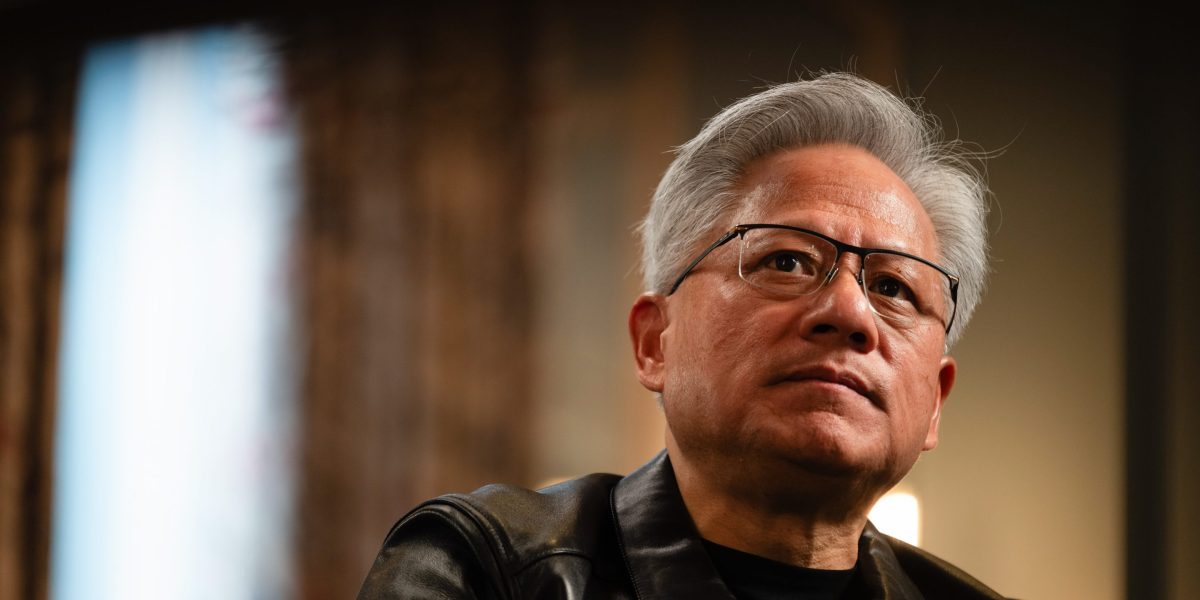
Nvidia’s board ended the talk of a Jensen Huang comeback on Tuesday. On the company’s first earnings call without its cofounder, chair Harvey Jones said the board “does not intend to reinstate Jensen as CEO.” He then ruled out any discussion of why Huang left.
“We will not be addressing or taking questions on today’s call regarding the circumstances of Jensen’s resignation and the ongoing investigation,” Jones said. None of the eight analysts who got on the line pressed the point. None asked about Singapore or Megaspeed or about a report earlier Tuesday that the Securities and Exchange Commission is investigating whether Nvidia misled investors. It was a bit tense.
That left the biggest open question about the world’s biggest chipmaker unasked: where some of its revenue really ends up. Nvidia beat Wall Street’s estimates by about $7 billion on $115.8 billion in quarterly revenue, as Fortune’s Alexei Oreskovic reported. Nvidia stock was up nearly 5% in after-hours trading to roughly $163.
The board’s line
Jones said Huang “voluntarily resigned” on Nov. 12 “after disclosure of personal behavior inconsistent with the company’s code of conduct, standards, and cultural norms.” The board accepted the resignation unanimously, he said. It has hired a search firm and will consider internal and external candidates.
Huang had said earlier Tuesday on X that he “would be honored” to return as CEO. “I own my mistakes completely, and I am committed to cooperating with the Board’s independent investigation,” he wrote.
Jones tied the search to the national security questions around the company. “Our new CEO will have to navigate those waters very carefully,” he said. On Tuesday the board also created a national security and export control oversight committee. Jones said it “will enhance our engagement with the U.S. government, including all relevant agencies.”
What didn’t get asked
The call had a one-question limit. Bank of America’s Vivek Arya came closest to the scandal, asking about talent retention and the leadership transition. Interim CEO Colette Kress said that among employees, “there are diverse opinions,” and that “from a business perspective, it’s business as usual.” Other analysts asked about margins, vendor financing and next year’s outlook.
The question they skipped is a downright national-security scandal. In the quarter that ended July 2025, Nvidia attributed $10.2 billion in sales, 22% of its revenue, to customers billed in Singapore, according to its 10-Q filing. “Customers use Singapore to centralize invoicing while our products are almost always shipped elsewhere,” the company wrote in that filing. It added that over 99% of its controlled data center compute revenue billed to Singapore was for orders from U.S.-based customers.
The next quarter, Nvidia began reporting revenue by the location of customers’ headquarters. It said that change “provides a better representation of the geographic profile of our revenue.” Singapore no longer appears as a line.
On Monday, the Commerce and Justice departments confirmed a criminal investigation into Megaspeed, a Singapore-based data center company suspected of helping shift Nvidia’s most powerful technology to China, according to AFP. Commerce began probing the company in 2024. The departments said Nvidia put Megaspeed on a “no sell” list in June 2025. Huang resigned after reports of extramarital affairs, including one with Alice Huang, a former Megaspeed executive whom U.S. authorities suspect of spying for Beijing. She is not related to him. Megaspeed has said it will work “constructively” with the government.
On Tuesday, the Wall Street Journal reported that the SEC is opening a civil probe into whether Nvidia’s disclosures misled investors.
What Nvidia did say about China
Kress gave one new China detail: sales of licensed Hopper data center chips to China were $2.4 billion in the quarter. “We are no longer shipping licensed Hopper data center products to China,” she said. The company’s forecast for next quarter assumes no data center compute revenue from China.
On new Commerce Department export rules released this week, which tighten access to advanced chips through other countries, Kress said Nvidia is “still going to spend some time studying those.” She also said “demand far exceeding supply” would keep performance strong. Nvidia raised its outlook for fiscal 2028 revenue growth to about 75%, from 70%.
Kress also put a number on customer concentration: frontier AI labs are expected to make up about 15% of Nvidia’s data center revenue this year.
Kress said Nvidia will file its 10-Q “in the coming weeks,” the first regional revenue breakdown since Huang’s exit. Huang and general counsel Tim Teter have agreed to transcribed interviews with three House committees, and Huang’s is expected before Thanksgiving. Kress ended the call with: “We’ve got this.”
Disclaimer : This story is auto aggregated by a computer programme and has not been created or edited by DOWNTHENEWS. Publisher: fortune.com