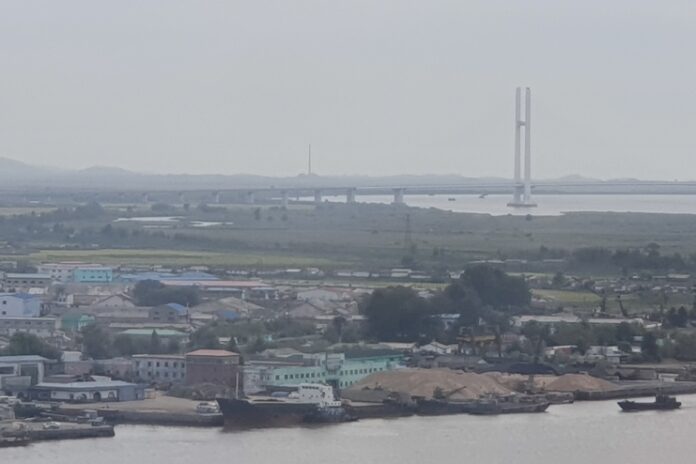
North Korea spent weeks promoting its light industry at a Pyongyang garment and footwear exhibition this fall. People in Sinuiju remain unimpressed in November 2026, however, because local factories fund such showpieces with Chinese contract manufacturing income. The goods on display never reach ordinary North Korean consumers.
Sinuiju residents have been dismissing regional factory construction and light industry exhibitions as propaganda detached from reality, according to a Daily NK source in North Pyongan province on Monday. The factories are going up under the Regional Development 20×10 Policy, which Kim Jong Un announced in January 2024. The policy calls for building modern factories in 20 cities and counties every year for a decade.
The criticism sharpened after the National Garment and Footwear Exhibition 2026 opened in Pyongyang on Oct. 21. State media covered the two-week event at the Three Revolution Exhibition House extensively. The reports stressed production results and quality improvements across the light industry sector. They gave particular weight to regional factories and praised sharp gains in quality and design. Regional products, the reports claimed, had become hard to tell apart from goods made in Pyongyang.
Sinuiju residents point out, however, that the products shown at the exhibition never reach stores or markets. They also note that factory workers earn no real income from making those products.
One garment factory in Sinuiju reportedly paid for its exhibition pieces with income from Chinese contract manufacturing orders. The money did not come from profits on sales of the factory’s own clothing. In contract manufacturing, North Korean factories sew garments from fabric that Chinese clients supply. They then send the finished goods back across the border to China. The sector has shown tentative signs of recovery in 2026 after collapsing during the COVID-19 border closure.
“A factory should make products, sell them to the people and buy materials with that money,” the source said. “In reality, factories earn money doing other work and then make products to put on display.”
Contract manufacturing orders keep factories and workers afloat
Factory workers themselves draw a clear line between showing a product and selling it. Entering an item in an exhibition is one thing, they say. Producing and selling it steadily at a profit is another matter entirely.
“We do not receive rations or wages for making those clothes,” one worker reportedly said. “The contract work brought in from China at least let us receive rations. The factory used that money to make the clothes for the exhibition.”
Contract manufacturing orders from China serve as a key source of income for these factories. The orders keep production lines running and support workers’ livelihoods, the source explained. Workers therefore care far more about how many orders have arrived and how long the work will last.
The gap between propaganda and reality extends well beyond Sinuiju and the garment industry. Many new regional factories sit idle for lack of raw materials and electricity. Trade officials have also been scrambling to find raw materials for light industry.
“Sinuiju has many garment and shoe factories, including those under the Unha Trading Bureau,” the source said. “People here know exactly what goes on inside those factories. Knowing the full story, they have no reason to welcome even the finest exhibition products.”
The Unha Trading Bureau oversees export garment factories that mainly fill clothing orders consigned from China.
“The authorities hold exhibitions every year and advertise the new products they have made,” he added. “People who hear that news still do not feel their own lives have changed. They are far happier to hear that a factory received one more contract order. News that one more factory has been built means much less to them.”
About This Translation
This article was originally written in Korean and translated with the help of generative AI tools. It was then edited by a native English-speaking editor. All AI-assisted translations are reviewed and refined by our newsroom.
Reporting from Inside North Korea
Daily NK operates networks of sources inside North Korea who document events in real-time and transmit information through secure channels. Unlike reporting based on state media, satellite imagery, or defector accounts from years past, our journalism comes directly from people currently living under the regime. We verify reports through multiple independent sources and cross-reference details before publication.
Our sources remain anonymous because contact with foreign media is treated as a capital offense in North Korea — discovery means imprisonment or execution. This network-based approach allows Daily NK to report on developments other outlets cannot access: market trends, policy implementation, public sentiment, and daily realities that never appear in official narratives.
Maintaining these secure communication channels and protecting source identities requires specialized protocols and constant vigilance. Daily NK serves as a bridge between North Koreans and the outside world, documenting what’s happening inside one of the world’s most closed societies.
Disclaimer : This story is auto aggregated by a computer programme and has not been created or edited by DOWNTHENEWS. Publisher: dailynk.com