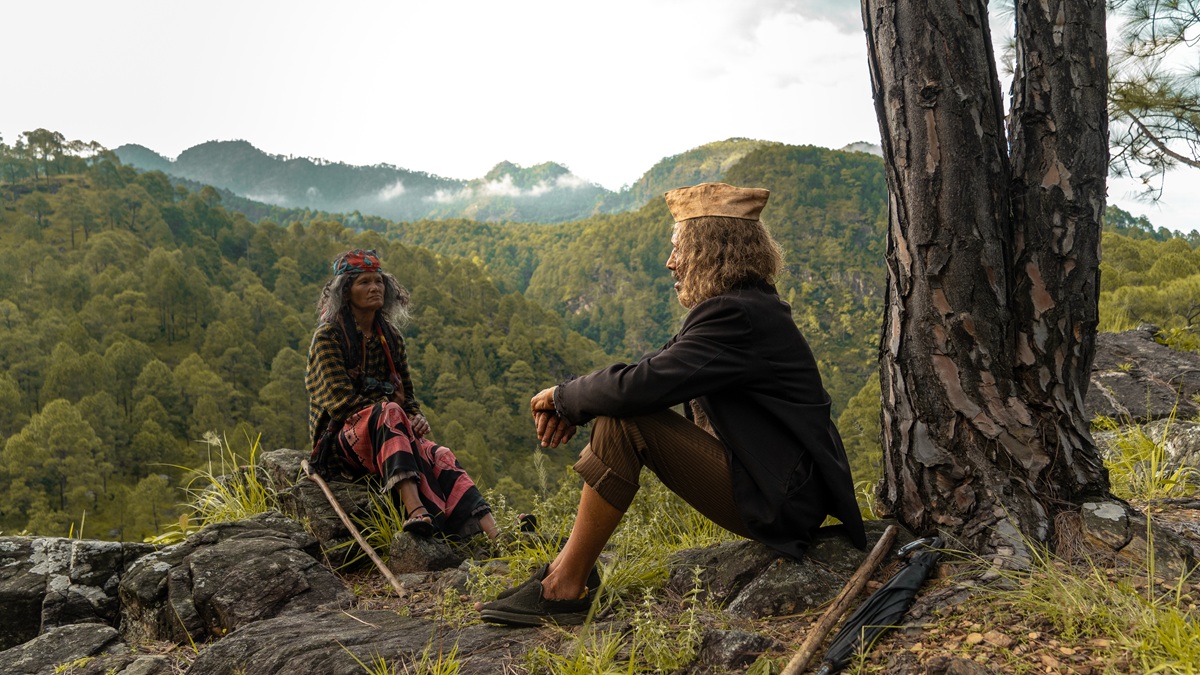
The idea for ‘Pyre’ came to filmmaker Vinod Kapri through a conversation that lasted barely an hour. In 2018, while in Munsiyari, Uttarakhand, he met an elderly couple, both around 80 years old. There was nothing particularly dramatic about the encounter, but something the couple said stayed with him long after they parted ways.
The husband was worried about who would look after his wife if he died first. His wife, meanwhile, had a different concern. If she died before him, who would cook for him? He did not know how to cook. They also had 30 to 40 goats, and when Kapri asked what they would do if they ran out of them, the husband had a rather matter-of-fact response. His wife had not been keeping well, and whenever he took her to the hospital, villagers helped him. He would give them a goat in return, not because they demanded it, but as a gesture of gratitude. When asked what would happen if the goats ran out, he simply said that they would die before that happened.
“That whole conversation stayed with me. I thought maybe this could be a fascinating story of love, loss and the loneliness of an elderly couple,” says Kapri, recalling the encounter that eventually became Pyre.
For him, the film was always intended to be a love story. The setting, the isolation of the Himalayan village and the larger questions around migration and the disappearance of village communities became part of its narrative, but the emotional centre remained the relationship between the two elderly protagonists, Bubu and Aama.
“Love doesn’t mean that you need to say ‘I love you’ every day. For me, love is just taking care of each other,” he says. What moved him about the couple he met was that even in their final years, their biggest concern was what would happen to the other if one of them were no longer around. “Even in your last days, you are thinking about your partner, about what is going to happen to him or her. That thought itself is something beyond love.”
In the film, Bubu and Aama have spent 28 years waiting for their son to return. It is a long wait, one that can easily be read as an expression of abandonment and despair. Yet Kapri sees something else in it. “If you are waiting for someone, it immediately translates into hope. This whole story, for me, is about hope. They are waiting, believing that their son will come back.”
He acknowledges that many viewers have described the film as deeply sad, but what interests him is that they have also found hope in its central idea. The possibility that a loved one might return, even after years of waiting, keeps the characters going. Kapri says he has always been fascinated by stories built around waiting, whether it is the Japanese film ‘Hachiko Monogatari’, about a dog that continues to wait for its deceased master, or relationships in which someone disappears and the other person continues to hold on.
“I have lost many good friends, many people who mattered to me, and I am still waiting for them to come back,” he says.
One of the ways Kapri wanted to keep the film from becoming overwhelmingly bleak was through the relationship between Bubu and Aama. Their arguments, teasing and everyday banter offer moments of warmth amid the loneliness surrounding them. He wanted audiences to become attached to the characters, to carry them in their memories long after leaving the theatre.
The response has been more intense than he anticipated. At a recent screening, a young woman approached him in tears. She told him she hated him for making such a beautiful film. When he asked why she was crying, she explained that the film had reminded her of how badly she had treated her grandfather and how she had failed to look after him when he was alive. She could no longer make amends with him, but she could change the way she treated her grandmother.
“That is the kind of impact this storytelling and this film is leaving on people’s hearts. It is overwhelming,” he says.
While the film is rooted in the Indian Himalayas, Kapri believes the questions it raises extend well beyond the mountains. Migration, for instance, is not simply a matter of people choosing to leave their villages. When basic facilities, education and employment are missing, staying back becomes increasingly difficult.
“If you don’t have schools, jobs, roads, electricity or even basic medical facilities, migration is bound to happen,” he says. He points out that even as India approaches the end of 2026, several villages remain without proper connectivity. Recalling a video he had watched of villagers in Andhra Pradesh or Telangana carrying an elderly woman on a makeshift stretcher for three to four hours to reach a road, he says the problem is not confined to Uttarakhand. It is a reality in different parts of the country.
For Kapri, the film’s most unsettling imagery comes from the two funeral pyres built outside the couple’s home. It is an image that grows out of a reality he knows well. In some Himalayan villages, when someone dies, families have to wait days for enough people to gather to carry the body to the nearest river for the last rites. Kapri had heard several such accounts and incorporated them into the film. But he took the thought further, imagining what would happen if there was nobody left in the village to help.
“I thought, what if there is no one in the village? What is this couple going to do?” he says. The idea of a man building a funeral pyre for his wife and then preparing one for himself was among the most difficult aspects of the storytelling. It was also deliberately unsettling.
“We could not provide them roads, medical facilities, food, education, power or electricity. And when they are going to die, we cannot even provide them a decent funeral,” he says.
In one scene, Bubu tells a fellow passenger that people like them are so cursed that they cannot even afford to reach a funeral ground. The next image of him building his own pyre takes that thought to its starkest conclusion. “I wanted to hit it hard, and it worked,” says Kapri.
But perhaps the most uncomfortable aspect of Pyre is that the loneliness it depicts is not exclusive to remote mountain villages. It can exist in cities, too, where elderly parents and their children may live in the same place but remain disconnected. Children may be working in other countries, or simply too caught up in their own routines to realise how much time has passed since they last checked on their parents.
Kapri sees this as part of a larger breakdown in family and social relationships. He believes people are becoming increasingly consumed by their individual lives, their phones and the constant stream of content they engage with.
“We are so consumed with mobiles and reels and whatever is happening around us. Even if you are sitting in a bar with four or five friends, everyone is on the phone,” he says. He also observes that people increasingly turn to technology to discuss their problems rather than confiding in friends or family.
For him, this is reflected in the smallest changes within households. He remembers an era when families waited for everyone to return home before sitting down for dinner. Today, family members often eat at different times, with little effort to share a meal or even ask how someone else’s day has been. “As a society, we are failing each other,” he says.
Interestingly, Kapri’s own connection with the South goes back to his childhood. Born in Secunderabad, he spent the first four years of his life there, as his father was in the Army. His mother would tell him that he spoke Telugu fluently as a child, so much so that she worried he was not picking up Hindi. Although he can understand Telugu today, he admits he cannot speak it. Hyderabad, however, continues to be a familiar destination, with regular visits for work.
For a filmmaker whose story begins with an elderly couple worrying about how the other would survive alone, Pyre ultimately asks a question that is difficult to dismiss once the film is over: when the people who have spent their lives caring for us grow old, will we be there for them?
For Kapri, the answer lies in recognising that love is not always expressed through grand gestures or declarations. Sometimes, it is simply knowing who will cook for the other, who will take them to the hospital, or who will be there when they need someone.
And sometimes, it is the act of waiting.
Set in a village in Kumaon, the award-winning film is a Himalayan love story exploring migration, ageing and family, featuring first-time performances by octogenarian and septuagenarian actors.
Disclaimer : This story is auto aggregated by a computer programme and has not been created or edited by DOWNTHENEWS. Publisher: deccanchronicle.com