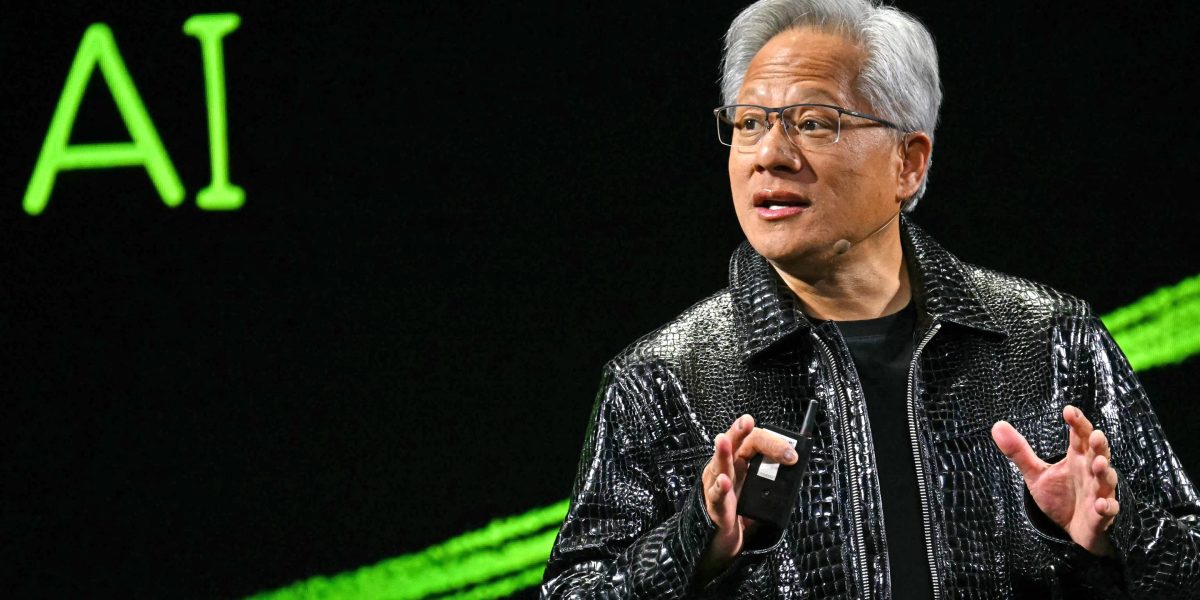
Nvidia’s solid third-quarter results will no doubt reassure Gulf investors that the U.S. chipmaking giant is on course to maintain a healthy growth trajectory despite the resignation of Jensen Huang.
Nvidia reported revenue of $116 billion for the three months to October, up 103% from a year ago, and above Wall Street estimates of $109 billion. It has beaten estimates in each of the last five quarters.
For the Gulf states, which are betting big on AI to help move their economies away from oil and rely on Nvidia’s advanced chips to achieve that, the company’s future success is critical.
Huang’s affair with a woman suspected of being a Chinese spy has heightened political pressure to tighten export controls amid long-running concerns in the U.S. that China’s access to advanced American AI chips could undermine national security.
It is also likely to sharpen scrutiny of Nvidia’s future dealings with the Gulf as part of a broader effort to prevent China from accessing banned American technology via intermediaries.
Such concerns have previously made securing Nvidia’s advanced chips an uphill battle for regional AI champions such as PIF-owned HUMAIN and Abu Dhabi-backed G42.
In July, the U.S. Department of Commerce loosened export restrictions on the UAE so that approved government agencies and entities—including its tech champion G42—can receive advanced computing hardware, including from Nvidia, under broader license exceptions. The rule change set no caps on how many chips or other sophisticated goods can be sold to those entities.
Democratic China hawks have frequently raised the alarm over the large-scale sales of AI chips to the Gulf region, arguing they could give China backdoor access to U.S. technology. Last May, Democratic senators demanded that AI chip deals with Saudi Arabia and the UAE contain adequate guardrails to prevent the leakage of sensitive technology to China.
Both Gulf countries maintain strong commercial ties to Chinese tech entities.
In September, Chinese tech giant Alibaba Cloud announced plans to ramp up its data center capacity and expand localized AI services across the UAE. Meanwhile, in Riyadh, Lenovo unveiled its first laptop made in Saudi Arabia at its sprawling 200,000-square-meter manufacturing facility, developed as part of a $2 billion partnership with Alat, a subsidiary of Saudi Arabia’s Public Investment Fund (PIF).
In its first policy response to the Nvidia scandal, on Monday the U.S. Commerce Department introduced an interim rule requiring overseas data centers to obtain a government license before supplying “significant volumes of computing power” to firms with headquarters in 22 embargoed countries, including China. The move aims to close a loophole that has allowed Chinese companies to lease Nvidia’s computing power from locations in other countries.
With Democrats holding majorities in both chambers of Congress from January next year, increased congressional scrutiny of Gulf AI deals is likely.
More broadly, the Gulf’s exposure to the volatility in AI stock prices has been further rattled by Jensen’s resignation amid a broader sell-off in AI tech stocks over the past few months, on the back of valuation and investment bubble concerns.
While not all Gulf funds disclose their individual investments, publicly available filings suggest that Gulf sovereign wealth funds, such as Mubadala, have relatively limited direct exposure to Nvidia shares compared to the scale of their investments in other tech firms.
According to the consultancy, Global SWF, Mubadala ranks among the top institutional backers of AI worldwide.
MGX, an AI and advanced tech investment firm backed by Mubadala, holds stakes and has participated in funding rounds for OpenAI, Anthropic, xAI, Databricks, GlobalFoundries, Isomorphic Labs, and SpaceX.
Saudi’s PIF-backed AI venture HUMAIN invested $3 billion in xAI’s $20 billion Series E round in February, shortly before it merged with SpaceX.
Global SWF estimates that Mubadala’s portfolio may have declined by $17.5 billion since the onset of the AI selloff at the end of June, largely driven by a more than 50% drop in chipmaker GlobalFoundries’ share price. PIF, meanwhile, is estimated to have suffered a $5.6 billion decline in the value of its AI-related holdings, largely attributable to its stake in SpaceX.
“Indirectly and strategically, Gulf wealth funds are exposed to the current market turbulence,” Sam Winter-Levy, a senior fellow in the Technology and International Affairs program at the Carnegie Endowment for International Peace, told me.
“MGX and other Gulf vehicles hold large stakes in AI labs, data center platforms, and other companies whose valuations depend on the AI boom—and Nvidia, of course, is central to that boom. The Gulf’s national AI strategies are built on Nvidia hardware. I think a prolonged loss of confidence in Nvidia would hit the Gulf relatively hard.”
In a research note published on Monday, London-headquartered Capital Economics warned that the ongoing shakeout in the AI sector is setting the stage for a larger downturn in the U.S. equity market over the next year.
With Nvidia considered a bellwether for the AI industry, its results should help to calm the markets and buoy investor sentiment ahead of Anthropic’s planned listing on Thursday.
Backed by MGX and the Qatar Investment Authority, the Claude developer’s listing is expected to value the business at $1.4 trillion. It has been reported that the shares could be six times oversubscribed.
You can read my piece here, which takes a closer look at what the potential fallout from the Nvidia crisis could mean for the Gulf’s AI ambitions, particularly in terms of its planned data center buildout.
Melissa Hancock
And as ever, thanks for reading, and do keep in touch with your thoughts and ideas.
melissa.hancock@fortune.com
Masdar’s Californian sunshine
Masdar expands its U.S. renewable energy footprint
Abu Dhabi-backed Masdar has completed its $950 million Lockhart Solar and Storage complex in California, marking another major step in the clean energy giant’s growing U.S. renewables push.
With 365-MW of solar generation and 173.7MW of battery storage, the project can produce electricity to meet the annual needs of about 350,000 homes and businesses.
Commercially, the project is backed by a hybrid of long-term power purchase agreements with California utilities and corporates.
The project was developed by Terra-Gen, which is owned jointly by Masdar and U.K.-headquartered global infrastructure manager, Igneo Infrastructure Partners.
Masdar operates a major part of its U.S. footprint through Terra-Gen, an independent U.S. renewables developer and operator, in which Masdar acquired a 50% stake in 2024 alongside Igneo.
Masdar has already invested around $3 billion in renewable energy projects across the U.S., with a portfolio reaching 6.3 GW across onshore wind, solar, and battery energy storage systems as of Sep. 2026.
It is targeting an expansion of its portfolio by as much as 25-GW by 2030, capitalising on rising power demand from data centers, industrial electrification, and expanding domestic manufacturing.
Globally, Masdar is also pressing ahead with its ambition to reach 100-GW of portfolio capacity by the end of the decade.
Its U.S. expansion comes despite the federal rollback of clean energy incentives under the Trump administration. Trump declared a national energy emergency on his first day in office last year, stating that inflation was driven by overspending and high energy costs. He officially launched the “drill, baby, drill” policy to extract domestic “liquid gold.”
According to a report released in July this year, the scaling back of incentives has led to the cancellation or delay of $83 billion in investment across hundreds of projects.
Global oil rebounds
Oil flows recover, geopolitical risks persist
A strong recovery in global oil supplies helped the market return to a surplus in October, the first time since the outbreak of the U.S.-Iran war.
Inventories climbed by 2.3 million barrels per day (bpd) to 105.4 million bpd last month, according to the International Energy Agency (IEA), as “Gulf exports recovered much faster than global oil demand.”
The higher export rates prompted the Paris-based agency to “significantly” raise its expectations for global oil supply for the remainder of 2026, with fourth-quarter estimates now 3.3 million bpd higher.
The IEA forecasts fourth-quarter supply will average 105 million bpd, exceeding projected demand by 1.7 million bpd.
The oil market is “straightening out” and “showing tentative signs of rebalancing,” it said.
It follows seven months of disruption to global oil flows, as the ongoing war choked off shipments through the Strait of Hormuz, a critical shipping route that normally carries around a fifth of the world’s oil and gas supplies.
However, Capital Economics sounded a note of caution about the future path to recovery given that the EIA data also shows that the stock of commercial oil inventories in the OECD plunged by 101 million barrels between February and October.
“Rebuilding depleted oil stock inventories–which is key to allowing oil prices to trend lower–will require oil flows sustaining sizeable surpluses into 2027,” it said in a research note published on Monday.
The research firm’s working assumption is that conditions in oil and natural gas markets largely normalize by the end of 2027 and that prices and spreads fall back further.
“But there is an obvious risk that things either fail to improve, or even get worse,” it added.
On Monday, Yemeni pro-government forces, backed by Saudi Arabia, said they were withdrawing from an area overlooking the strategically important Bab al-Mandab Strait, at the southern end of the Red Sea, to reinforce positions around Aden and neighbouring areas.
Their retreat follows weeks of intensified fighting with the Iran-backed Houthi movement.
Saudi Arabia has relied heavily on the Bab al-Mandab Strait as a critical oil export route in light of ongoing disrupted shipping through the Strait of Hormuz.
At least 10 ships were hit in the first 10 days of November, following a record 37 strikes in October—the highest monthly total since the conflict began, according to the Washington Institute for Near East Policy.
The Big Number
$529 billion
The amount that DIP Holding raised in its IPO on the Dubai Financial Market last week, the UAE’s first stock market listing of 2026. Shares began trading on Nov. 11 under the ticker symbol DIP and gained up to 7% during their market debut. Saudi Arabia’s Public Investment Fund and a unit of Blackstone were among foreign investors that participated in the offering, according to Bloomberg.
The 3 things we enjoyed reading this week
- My Fortune colleagues do a deep dive into the dramatic downfall of Jensen Huang, Nvidia’s longtime CEO, whose leadership helped turn the company into a $5.7 trillion powerhouse and the driving force behind the global AI boom. The ensuing upheaval has exposed potential vulnerabilities in the AI industry, particularly Nvidia’s complex financial relationships with the AI companies and data center businesses that depend on its chips, as well as mounting concerns about an AI investment bubble.
-
Dubai tycoon Hussain Sajwani expects his investments in three AI firms—OpenAI and SpaceX and Anthropic—to generate billions of dollars in returns. In recent years, Sajwani’s Dubai-based real estate firm, Damac Group, has broadened its investment portfolio to include technology and data centers. In 2025, Sajwani pledged to invest $20 billion in U.S. data centres, making the announcement while standing alongside Donald Trump at a press conference in Mar-a-Lago, Florida. He told Bloomberg last week that about $9 billion of that amount had since been deployed.
- Iran’s extensive network of dams and water-transfer projects may have been built, in part, to support underground missile facilities, according to experts who identified significant overlaps between water infrastructure and areas targeted by U.S. and Israeli airstrikes. Researchers have mapped at least 533 dams across the country, with some analysts suggesting they provide military installations with independent supplies of water.
Disclaimer : This story is auto aggregated by a computer programme and has not been created or edited by DOWNTHENEWS. Publisher: fortune.com