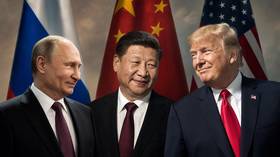
Commentators in Russia have assessed prospects for the trilateral summit, and whether it compares to the 1945 Yalta Conference
The leaders of the United States, Russia, and China – the top three nuclear powers – are set to meet today on the sidelines of the APEC summit in Shenzhen. Strategic cooperation and global security architecture will likely be on the agenda. Russian experts have been weighing in, and RT has compiled some top analysis on what results can be expected from the event.
Dmitry Suslov, deputy director of the Center for Comprehensive European and International Studies at the National Research University Higher School of Economics, CFDP member:
The upcoming trilateral summit in Shenzhen should not be compared with the Yalta or Potsdam conferences, or even with the Congress of Vienna of 1815. No concrete decisions will be taken at the meeting between Putin, Xi Jinping and Trump. All three sides have emphasized this, and until the very last moment there were disagreements between them over the agenda.
Trump, for example, wanted to discuss nuclear arms control. That has not been met with much enthusiasm either in China or in Russia. For their part, neither the Americans nor the Chinese want the Ukraine conflict to be discussed at this venue. In the end, it was decided the agenda would focus on the broad questions of war and peace among the world’s leading powers and on issues of strategic stability, again in a broad sense, without limiting or reducing specific weapons systems. Questions of space exploration, artificial intelligence, and the Iran conflict will also likely be addressed.
Still, this summit is exceptionally important, and its main outcome and contribution to the world order will be agreement among the world’s three leading powers on the need to maintain normal, manageable relations between them and to prevent war.
First, the summit will be a vivid illustration of the current global balance of power. It will underscore that the three leading powers in the world are indeed the United States, China, and Russia. They really do play the leading role in world politics and international security.
Second, the summit will emphasize that normal working relations must be maintained among these three leading powers, and that despite all the rivalry and contradictions between the US and China, and between the US and Russia, an open clash between them is unacceptable. A direct war among these three powers is the most terrible threat to international security that one can imagine.
Third, there is reason to believe that such meetings will continue in the future, and that we are witnessing the emergence of a new format of international interaction: a ‘Big Three’, though not in the ‘Yalta’ sense.
In this context, the decision to base the agenda not on nuclear arms control in the traditional sense, but rather on strategic stability as the prevention of direct war between Russia and the US, and between China and the US – whether nuclear or conventional – is absolutely correct.
The new world order will be multipolar and even polycentric – there is simply no alternative. Recently, the power not only of the largest countries but also of medium-sized states has increased significantly. Moreover, the emerging world order is characterized not only by the participation of several great powers, but also by several different civilizations. Previous examples of a multipolar world order at the global level existed within a single European civilization. The future order, however, will be poly-civilizational.
Because of both the participation of a large number of poles and its poly-civilizational character, the new multipolar world will be less stable, less manageable, and more pluralistic. An ordered multipolar system will only be possible when the West, represented by the US and the European countries, abandons its struggle to preserve the remnants of its hegemony. For now, the US recognizes the reality of multipolarity, but it does not welcome this reality, and it still hopes that it can retain global primacy, that it can turn history back. That is why rivalry underpins relations between the US and China, just as it underpins relations between Russia and the US.
Disclaimer : This story is auto aggregated by a computer programme and has not been created or edited by DOWNTHENEWS. Publisher: rt.com