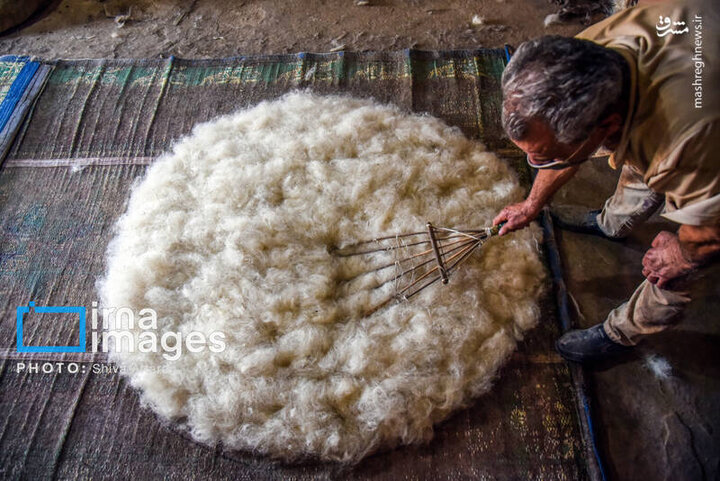
TEHRAN – Iran’s traditional felt-making craft, known as namad-mali, faces an uncertain future as declining consumer demand, changing lifestyles and the gradual loss of traditional skills threaten its continuity. Although the centuries-old practice has considerable potential for producing a wide range of contemporary goods, artisans say its survival depends on developing sustainable markets, supporting workshops and passing on their knowledge to younger generations.
The craft, which involves transforming natural wool into a dense fabric through the application of water, soap and repeated rubbing and pressure, is among the oldest forms of textile production. Unlike woven fabrics, felt is made by interlocking wool fibers without the use of weaving or knitting. The process relies on the natural properties of wool and the skill and experience of the craftsperson.
For generations, felt was used to make practical household items and clothing, particularly in communities where sheep farming provided an accessible source of raw material. Its insulating properties and durability made it suitable for different climates and everyday needs.
Today, however, the craft is struggling to maintain its place in daily life, even as growing interest in traditional knowledge and handmade products offers opportunities for its revival.
Esmaeil Nikookar, an experienced felt-making specialist based in Gilan province, northern Iran, believes that international recognition could help bring renewed attention to the craft, but says official recognition alone will not guarantee its survival.
“Reviving felt-making requires more than international registration. It needs wider markets for its products, the introduction of new applications and effective support for artisans,” he told the Ministry of Cultural Heritage, Tourism and Handicrafts’ news service.
His remarks come as felt-making is being prepared for consideration through a multinational nomination to a session of UNESCO’s Intergovernmental Committee for the Safeguarding of the Intangible Cultural Heritage. The proposed nomination offers an opportunity to highlight the craft’s cultural significance and the shared traditions of communities involved in its practice.
For artisans such as Nikookar, however, the real test will be whether greater recognition translates into stronger demand, viable livelihoods and renewed interest among younger generations.
A craft shaped by climate and local knowledge
Felt-making in Iran reflects the country’s geographical and climatic diversity, with traditional techniques adapted to local conditions and the intended uses of the finished products.
In northern Iran, where humidity and rainfall are relatively high, felt-makers traditionally produce denser and more tightly compressed pieces to improve their durability and resistance to moisture.
Nikookar said artisans in these areas devote considerable time and effort to pressing and compacting wool, drawing on experience accumulated over generations to produce felt suited to the local environment.
Traditional felt products were known for their strength and insulating qualities. When properly made, their tightly interlocked fibers created a dense structure that helped protect users against cold, heat and rain.
These characteristics reflect a practical understanding of natural materials rather than merely an artistic tradition. The ability to select suitable wool, regulate moisture and apply the right amount of pressure is central to producing a durable piece of felt.

Felt-making also illustrates how communities developed everyday technologies using materials readily available to them. Sheep’s wool, in particular, provided a versatile resource for making protective clothing and household items long before modern synthetic textiles became widespread.
Although the craft has deep historical roots, Nikookar believes its usefulness should not be confined to the past.
Beyond traditional mats: New possibilities for felt products
One of the main opportunities for the revival of felt-making lies in expanding its range of products and adapting traditional techniques to contemporary tastes.
While felt is commonly associated with floor coverings and other traditional household items, Nikookar says the material can be used to make a much broader range of goods, including footwear, socks, trousers, waistcoats, hats and women’s handbags.
Such products could help introduce felt to consumers who may have little interest in traditional items but are attracted to distinctive handmade accessories and clothing.
Wool’s natural insulating properties are another advantage. Its fibrous structure slows the transfer of heat, helping felt products retain warmth in cold conditions while also providing some insulation against external heat.
These properties could be emphasized in the development and marketing of contemporary felt goods, particularly those designed for outdoor use, clothing and home accessories.
However, turning these possibilities into commercial opportunities requires more than producing new designs. Artisans need access to appropriate markets, product development opportunities and a better understanding of changing consumer preferences.
Nikookar believes that a combination of traditional craftsmanship and modern design could give felt-making a new role in the handicraft market without sacrificing its distinctive production methods.
Declining demand threatens the craft’s continuity
Despite its potential, the most immediate challenge facing felt-making is the shrinking market for its products.
Nikookar considers declining public interest and reduced consumption among the main threats to the craft’s survival. When consumers stop purchasing handmade products, production gradually contracts, leaving artisans with fewer financial incentives to continue working.
His own experience illustrates how changing lifestyles can affect not only the market for traditional goods but also the skills associated with making them.
He continues to produce a type of traditional hat that his father once made. The hat was once associated with a particular social standing and was commonly worn by community elders, prominent individuals and wealthier members of society.

As clothing preferences and social customs changed, demand for the item declined. With fewer people using it, the specialized knowledge required to produce it also became increasingly vulnerable to neglect.
For Nikookar, this is a reminder that the disappearance of a traditional product can lead to the gradual loss of an entire body of practical knowledge.
Exhibitions, meanwhile, have offered some opportunities to introduce the craft to new audiences, although they have not necessarily resulted in sustained commercial demand.
He recalled receiving encouraging attention from visitors at handicrafts exhibitions, including one in Shahr-e Kord. Yet public interest did not always translate into purchases.
“The main issue is establishing a connection between artisans’ products and consumers’ actual needs,” he said.
This distinction is important for the future of traditional crafts. While exhibitions can raise awareness and provide opportunities for artisans to present their work, they cannot replace regular sales channels and a dependable customer base.
Developing a sustainable market, therefore, requires identifying products that people are willing to buy and use, rather than relying solely on the cultural appeal of traditional craftsmanship.
Preserving handmade techniques
Another concern for Nikookar is the preservation of traditional production methods as newer equipment and mechanized processes become more common in some workshops.
He said he carries out every stage of felt-making by hand, without using machinery. For him, this approach is an essential part of the craft’s traditional character and embodies skills and experience passed down through generations.
Although modern equipment can facilitate production in some settings, he believes traditional manual techniques should also be safeguarded and documented.
The distinction is not simply between handmade and machine-assisted products. Traditional methods preserve specific forms of knowledge, including the handling of wool, the application of water and pressure, and the judgment required to achieve the desired density and texture.
If these methods disappear, an important part of the craft’s intangible heritage could be lost, even if felt products continue to be manufactured using modern techniques.
AM
Disclaimer : This story is auto aggregated by a computer programme and has not been created or edited by DOWNTHENEWS. Publisher: tehrantimes.com