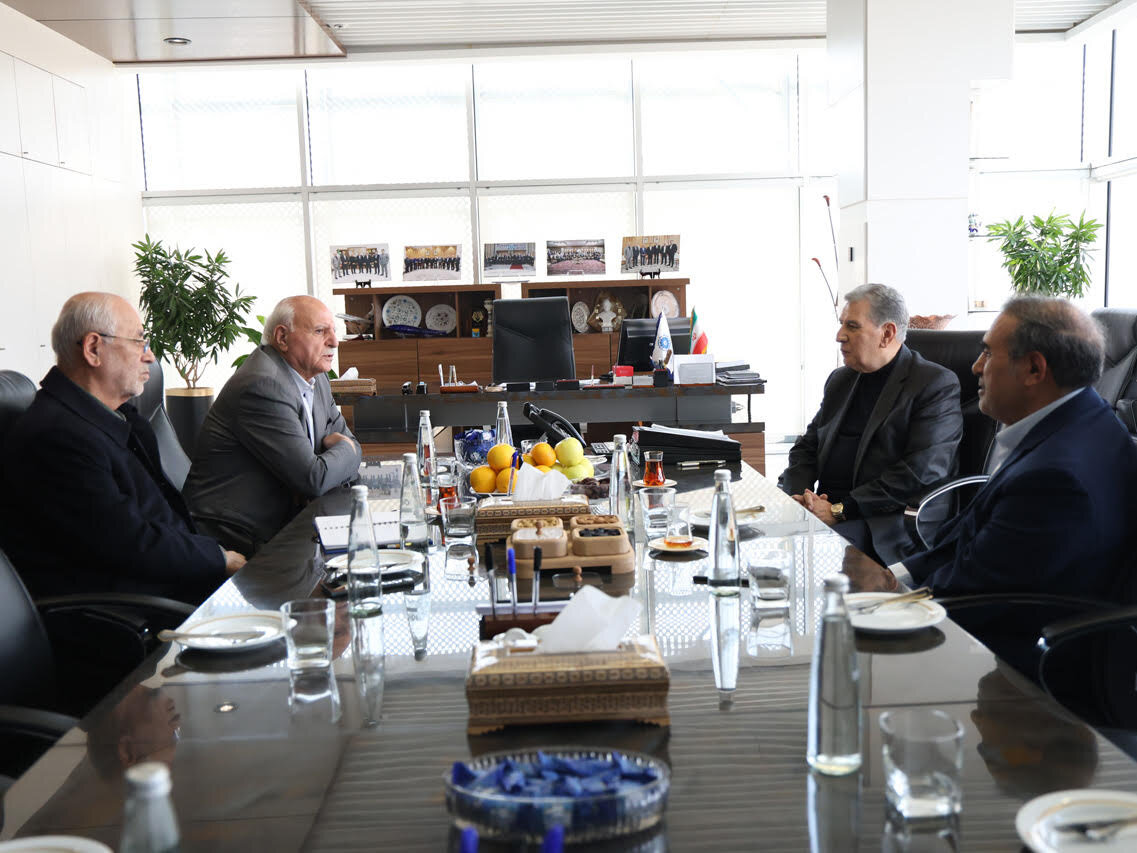
TEHRAN- The monthly meeting of the heads of the Iran Chamber of Commerce, Industries, Mines and Agriculture; the Iran Chamber of Guilds; and the Iran Chamber of Cooperatives was held, focusing on the private sector’s concentration on solutions to support the government in supplying essential goods.
Samad Hassanzadeh, Head of the Iran Chamber of Commerce, Industries, Mines and Agriculture; Ghasem Nodeh Farahani, Head of the Iran Chamber of Guilds; and Bahman Abdollahi, Head of the Iran Chamber of Cooperatives, in the joint meeting of the heads of the three chambers, emphasized the issue-oriented nature of private sector activities and the presentation of solutions that help simultaneously resolve the concerns of economic actors and the government.
Samad Hassanzadeh, Head of the Iran Chamber of Commerce, Industries, Mines and Agriculture, said at the monthly meeting of the heads of the three chambers held at the Iran Chamber: “In difficult economic conditions and given international complexities, the private sector has a greater duty than before to present solutions to the government for resolving economic problems, creating social calm, and improving people’s livelihoods.”
He considered the devising of multifaceted solutions that simultaneously help resolve several concerns to lie within the intellectual and operational capacity of the country’s private sector, and added: “At present, on the one hand, one of the problems of the country’s exporters concerns issues in the area of settling foreign exchange obligations, and on the other hand, enhancing resilience in people’s livelihoods and supplying essential goods and raw materials needed for production is a key concern for the government.”
The Head of the Iran Chamber added: “The solution we present to the respected government for simultaneously resolving two concerns—namely, simultaneously resolving exporters’ foreign exchange obligation settlement problems and supplying essential goods and the livelihood requirements of the people and the country’s production—is that exporters be given the mission to import the country’s needed essential goods in exchange for settling their foreign exchange obligations.”
Following the presentation of this proposal, the view of the heads of the three chambers—the Iran Chamber of Commerce, Industries, Mines and Agriculture; the Iran Chamber of Guilds; and the Iran Chamber of Cooperatives—was that exporters who export in the interest of the country’s production should import the essential goods needed by the country, and an incentive opportunity should be created for exports and imports.
At present, exporters are allowed to import only the raw materials, parts, and machinery they need; while the proposal of the heads of the three chambers was that, by removing this restriction, permission for imports should become general and the government should allow exporters, in exchange for settling their foreign exchange obligations, to import essential goods needed by the country up to the ceiling of their foreign exchange obligations.
Also, in continuation of this meeting, it was decided that, given that the prescription for treating the country’s economy in the current conditions is the maximum presence of the private sector, the request of the three chambers was that the government provide a mechanism for the private sector to play a greater role in economic management and for private sector participation in organizing the country’s economy to increase.
Another part of this meeting was devoted to economic diplomacy and the role of the private sector in this area, where the heads of the three chambers emphasized that the government should provide conditions so that the private sector can play a maximum role in international dealings and economic diplomacy and in utilizing economic exchanges with neighbors, aligned countries, BRICS members, Shanghai Cooperation Organization members, and Eurasian Economic Union members.
Samad Hassanzadeh, regarding the development of economic diplomacy, stated: “Although Iran’s enemies are seeking a naval blockade and blocking communication routes, in the international space we see that many countries announce their readiness to expand economic interaction with Iran.”
Hassanzadeh, referring to the visit of an Iran Chamber delegation to Kenya, spoke of Iran’s high capacities for entering the Kenyan and African markets and reported on the consideration of establishing a trade center and permanent exhibition of Iranian products in Nairobi in order to establish successful Iranian companies and cooperatives, given the demand of the Kenyan market.
Bahman Abdollahi, Head of the Iran Chamber of Cooperatives, also referring to recent meetings with the ambassadors of Uzbekistan and Kazakhstan in Tehran, emphasized the existence of opportunities for extraterritorial cultivation in Kazakhstan and said: “Kazakhstan is a hub for the production of agricultural inputs, and given the suitable water resources and the extent of agricultural land in this country, there is the possibility that, through extraterritorial cultivation in Kazakhstan, we can meet a significant part of the country’s needs in the area of inputs and essential goods.”
Abdollahi also, regarding opportunities for trade relations with Uzbekistan, reported on that country’s plan to build a new city in Uzbekistan as the country’s commercial capital and stated: “This plan has provided a suitable opportunity for exporting building materials and technical-engineering services from Iran to Uzbekistan, and we must plan to take advantage of this opportunity.”
Given that economic stability is a principle for decision-making in economic activities, at the end of this meeting it was decided that in future monthly meetings of the heads of the three chambers, market stability and the matter of market regulation would be examined as the agenda and necessary planning would be carried out in this area.
Ghasem Nodeh Farahani, Head of the Iran Chamber of Guilds, also at the end of this meeting, described the efforts of the three chambers to regulate the market and supply the people’s necessities as a great help to the government and said: “With the experiences we have gained in the recent imposed wars, the Iran Chamber of Guilds is ready for any conditions to supply the people’s necessities and maintain market stability.”
MA
Disclaimer : This story is auto aggregated by a computer programme and has not been created or edited by DOWNTHENEWS. Publisher: tehrantimes.com