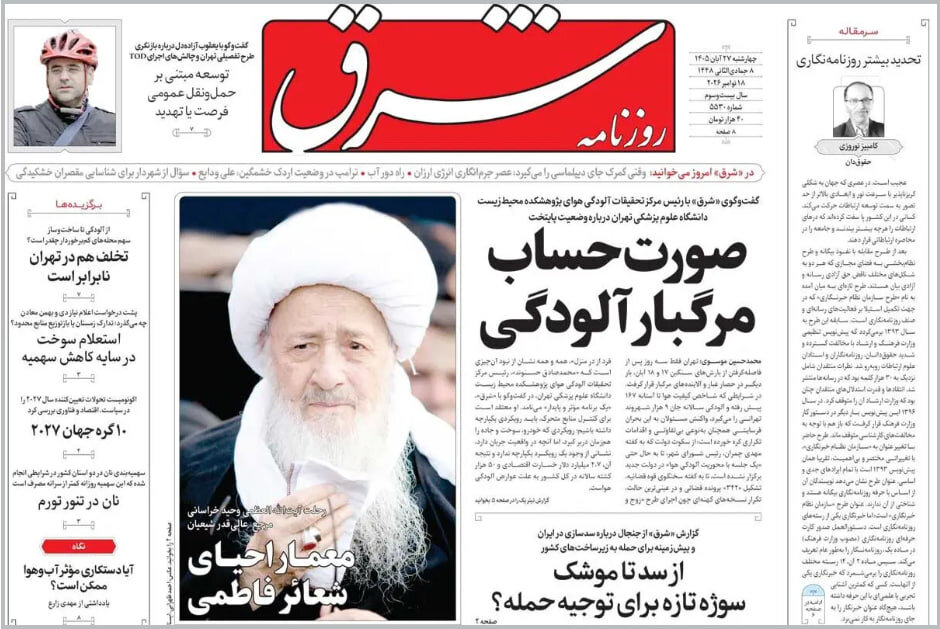
Shargh assessed the final two years of President Donald Trump’s term, arguing that congressional constraints on domestic policy may push him to focus on foreign affairs. In this context, Iran is expected to remain a central priority. According to the paper, Trump’s failure to achieve his objectives during the 40-day conflict likely demonstrated that regime change cannot be accomplished through remote air campaigns alone.
As a result, he is unlikely to repeat the same strategy. The newspaper nevertheless warns that another major confrontation remains possible if Benjamin Netanyahu’s political camp stays in power. If large-scale war is avoided, a more important question concerns how Iran would respond to tighter economic and transportation restrictions. Shargh argues that attempts to increase pressure through maritime measures and pressure on neighboring states could leave Tehran facing difficult choices. Should Iranian leaders conclude that such conditions are unsustainable, regional tensions could enter a new phase marked by greater uncertainty.
Iran: A serious challenge to the US scenario
The Iran newspaper focused on the ECO foreign ministers’ meeting in Islamabad. It argued that Washington is trying to increase pressure on Tehran through economic measures and restrictions on important transportation routes. However, the paper stressed that geography and regional economic realities cannot be reshaped by unilateral decisions. Routes that are strategically important to Iran are also essential to neighboring states for trade, transit, and access to markets. Although the Economic Cooperation Organization continues to face structural limitations, the meeting highlighted a shared interest in preserving economic connectivity. According to the article, neighboring countries benefit from open borders and transportation networks and therefore have incentives to maintain regional cooperation. The newspaper argued that while the US seeks to tighten pressure on Iran, countries in the region remain focused on keeping routes open, expanding trade, and preventing external pressures from disrupting long-standing economic ties. From this perspective, practical economic interests may limit attempts to isolate Iran from its neighbors.
Ham-Mihan: Hormuz Strait will not surrender
The newspaper Ham-Mihan examined the strategic importance of the Strait of Hormuz. It noted that the waterway is not simply a route for oil tankers but a vital link connecting the Persian Gulf to international waters. A significant share of regional energy exports passes through the strait, making it important for several Persian Gulf states. According to the paper, this dependence provides Iran with asymmetric leverage. Even without closing the strait, Tehran could increase shipping risks, insurance costs, transportation expenses, and uncertainty for investors, raising the economic price of efforts to isolate the country. The article argued that the main issue is not whether the strait remains open or closed, but who determines the rules governing security and deterrence in the region. Washington seeks freedom of navigation independent of Iranian influence, while Tehran maintains that lasting security cannot ignore Iran’s geopolitical position. The newspaper concluded that both sides appear to prefer limited pressure tactics over direct military confrontation.
Donya-e-Eqtesad: A transit coalition in Hormuz
Donya-e-Eqtesad discussed the recent trilateral meeting among Iran, Oman, and Uzbekistan in Muscat. The newspaper argued that the gathering should be viewed as more than a maritime security discussion. According to the article, Uzbekistan’s participation links security in the Strait of Hormuz with the North-South Transport Corridor and broader competition over Eurasian trade routes. Iran’s geographic position allows it to serve as a bridge connecting Central Asia to open seas through rail and road networks. The paper stressed that Uzbekistan’s importance extends beyond bilateral trade. The country can act as a strategic connector among China, Central Asia, Iran, and southern markets. As a result, the Muscat meeting could contribute to stronger transportation links and greater regional economic integration while supporting Iran’s broader economic diplomacy objectives.
Arman-e-Melli: Iran amid Trump-Putin-Xi negotiations
Arman-e-Melli examined the expected meeting of the presidents of the US, China, and Russia on the sidelines of the APEC summit. The paper described the gathering as an important diplomatic event and suggested that Iran would likely be a significant topic of discussion. Although the three countries have differences regarding regional conflicts and broader geopolitical issues, the Iranian nuclear file may provide limited common ground. According to the article, all three oppose Iran acquiring nuclear weapons and may emphasize continued engagement with the International Atomic Energy Agency. The newspaper argued that any understanding among the three powers would require complex political calculations. For Trump, the meeting could help demonstrate international influence and strengthen his diplomatic standing. However, Arman-e-Melli cautioned against expecting a rapid breakthrough. While the summit may shape future diplomatic discussions, it is unlikely to produce an immediate resolution to tensions between Iran and the US.
Disclaimer : This story is auto aggregated by a computer programme and has not been created or edited by DOWNTHENEWS. Publisher: tehrantimes.com