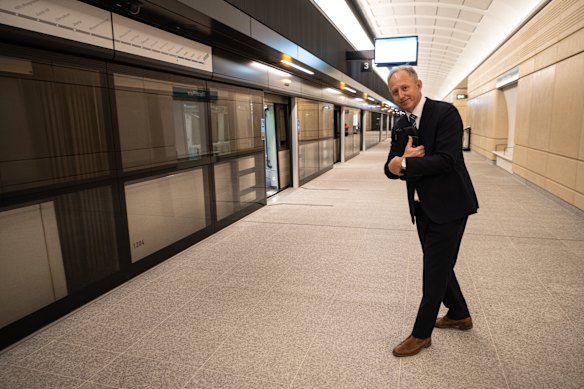

A former NSW Transport chief and architect of Sydney’s metro rail network will take on one of the country’s toughest jobs steering the delivery of the over-budget and long-delayed Snowy 2.0 pumped hydro scheme.
After a stint working on mega-projects in Saudi Arabia, Rodd Staples will assume the role as Snowy 2.0’s delivery chief in late January, replacing Dave Evans who has led the project since 2023.
In his new job, Staples will oversee the performance of Italian company Webuild and its subsidiaries, which are constructing Australia’s largest renewable energy project, as well as the entire 5500-strong workforce.
While the new hydro scheme in the Snowy Mountains has faced well-documented challenges, Staples said all mega-projects, including Sydney’s new metro rail lines, had their moments and needed to navigate unforeseen events.
“Every project of this scale has got unique elements so you can’t provide a cut-and-paste method to everything. For Snowy, the remoteness and the environmental sort of areas of the project are particularly obvious,” he said.
“What’s different for me on Snowy is that I’m stepping into a role where there’s already a large team established and a contractor in place. My message to the team, the principal contractor and to Australia is pretty simple – let’s get this done.”
The forecast cost of the federal government’s hydro project has blown out to as much as $25 billion – more than four times its post-feasibility estimate – and been delayed until late 2029. The latest price tag comprises an estimated cost of $22.2 billion and a contingency of almost $3 billion.
Former Liberal prime minister Malcolm Turnbull commissioned Snowy 2.0 in 2017, declaring a completion deadline of 2021. His initial price tag of $2 billion, announced before a feasibility study was complete, climbed to $6 billion when the report was completed, and later rose to $12 billion in 2023.
Staples, who will be based in Cooma, said he was confident of taking on the challenge of meeting the $22.2 billion budget, adding that one of the greatest variables was unknowns in construction design, which was 96 per cent complete for Snowy 2.0.
“That is one key ingredient of confidence for me stepping in,” he said.
“This is not one of those [projects] where it’s still in that really early planning, and it’s got 10 to 12 years. I like the idea that this has got a few years of hard push to get it done.”
Snowy Hydro chief executive Dennis Barnes said Staples’ accomplishments with Sydney Metro and the city’s light rail project spoke for themselves, adding they were defining pieces of infrastructure which had been delivered despite numerous technical and contractor challenges.
“Snowy 2.0’s complexity, uniqueness and scale is on another level. Rodd is up for the challenge,” he said.
For the past two years, Staples has been chief of transport for Saudi Arabia’s city-development of Qiddiya, which has involved oversight of high-speed train and metro projects. Under construction south-west of the capital Riyadh, Qiddiya will become home to scores of sporting and entertainment facilities including the world’s largest water park.
In an email to staff on Wednesday, Evans said he had decided it was time to step down after 10 years at Snowy 2.0, which had included roles as project director and more recently chief delivery officer.
“Together, we have tackled some of the hardest challenges in civil engineering. It’s now time for me to hand over the reins for this critical home stretch and take the opportunity to spend more time with my family,” he said.
Start the day with a summary of the day’s most important and interesting stories, analysis and insights. Sign up for our Morning Edition newsletter.
 Matt O’Sullivan is transport and infrastructure editor at The Sydney Morning Herald.Connect via X or email.
From our partners
Disclaimer : This story is auto aggregated by a computer programme and has not been created or edited by DOWNTHENEWS. Publisher: www.smh.com.au