TEHRAN- Theater groups from Russia, Turkey and Iraq will take part in the 19th Marivan International Street Theater Festival, which will bring together 40 groups and 270 participants, the organizers announced at a press conference in Tehran on Tuesday.
The international program will feature a performing group from Russia, a special guest from the country, a joint Iranian-Turkish production, and two performances from Iraq, according to Rouhollah Iraji, director of the festival’s international section.
The festival, one of Iran’s major events dedicated to street theater, will be held in the western Iranian city of Marivan, with performances planned in public spaces as well as unconventional venues, including schools, prisons and military barracks.
Festival secretary Fateh Badparva said the event would be held on a non-competitive basis this year, with the emphasis placed on artistic exchange and celebration rather than competition.
He described the Marivan festival as one of Iran’s most specialized events dedicated to street theater, adding that its objectives extend beyond artistic activities to include promoting the tourism potential of the western Kurdish city.
The festival traces its origins to 1993, when five editions of a regional stage theater event were held under the name of the Marivan Theater Festival. It subsequently developed into a nationwide event and gradually established an international presence.
Badparva said the organizers had initially been concerned that removing the competitive format might affect participation, but the response from theater groups had been encouraging.
Several social and environmental issues will receive particular attention in this edition. Water scarcity and the importance of responsible water consumption are among the main themes, while works addressing the tragedy at Shajareh Tayyebeh School in Minab, Hormozgan province, have also been considered in the selection process.
The tragedy at Shajareh Tayyebeh Elementary School occurred on February 28, when a missile strike hit the school during the US-Israeli military attacks on Iran. The attack killed dozens of children, mostly aged between seven and 12, along with teachers and school staff, making it one of the deadliest attacks on civilians during the conflict.
Badparva said the ongoing war and its consequences would be another subject addressed through the performances, emphasizing the role of theater in reflecting social concerns.
Atabak Naderi, director general of performing arts at the Ministry of Culture and Islamic Guidance, also highlighted the importance of using theatrical language to raise public awareness about water conservation. He said theater artists could help communicate the need for more responsible use of water resources through their performances.
The program will extend beyond conventional outdoor stages. Performances are planned at Shano Park, Lake Zarivar, schools, prisons, military barracks and other locations across the city. The unconventional venues are part of the festival’s experimental performance section, which seeks to explore different relationships between theater, public spaces and audiences.
The organizers are also expanding the festival’s academic dimension. Ali Abdolrahimzadeh, secretary of the research seminar, said 61 paper abstracts had been submitted, of which 46 were shortlisted and 39 papers were eventually selected by the selection panel. Fourteen papers will be presented in person, while six will be displayed in poster format.
Researchers from India and the Kurdistan Region of Iraq will also contribute to the seminars through online presentations. Speakers Majid Sarsangi and Mohammad-Hossein Nasserbakht will participate in discussions with researchers.
Abdolrahimzadeh said the long-term objective was to strengthen the connection between street theater and academic theater studies, potentially through the establishment of specialized university courses or a dedicated academic program.
The festival will also feature Kordestan Music Nights, organized in cooperation with the Music Office of the Ministry of Culture and Islamic Guidance’s deputy for artistic affairs. Calligraphy masters will take part in accompanying programs during the event.
According to executive secretary Avat Hesami, 40 theater groups comprising 270 participants will attend the festival. He noted that the challenging circumstances of the past two years had affected cultural and artistic activities in the country, but cooperation among artists and organizers had helped maintain the event.
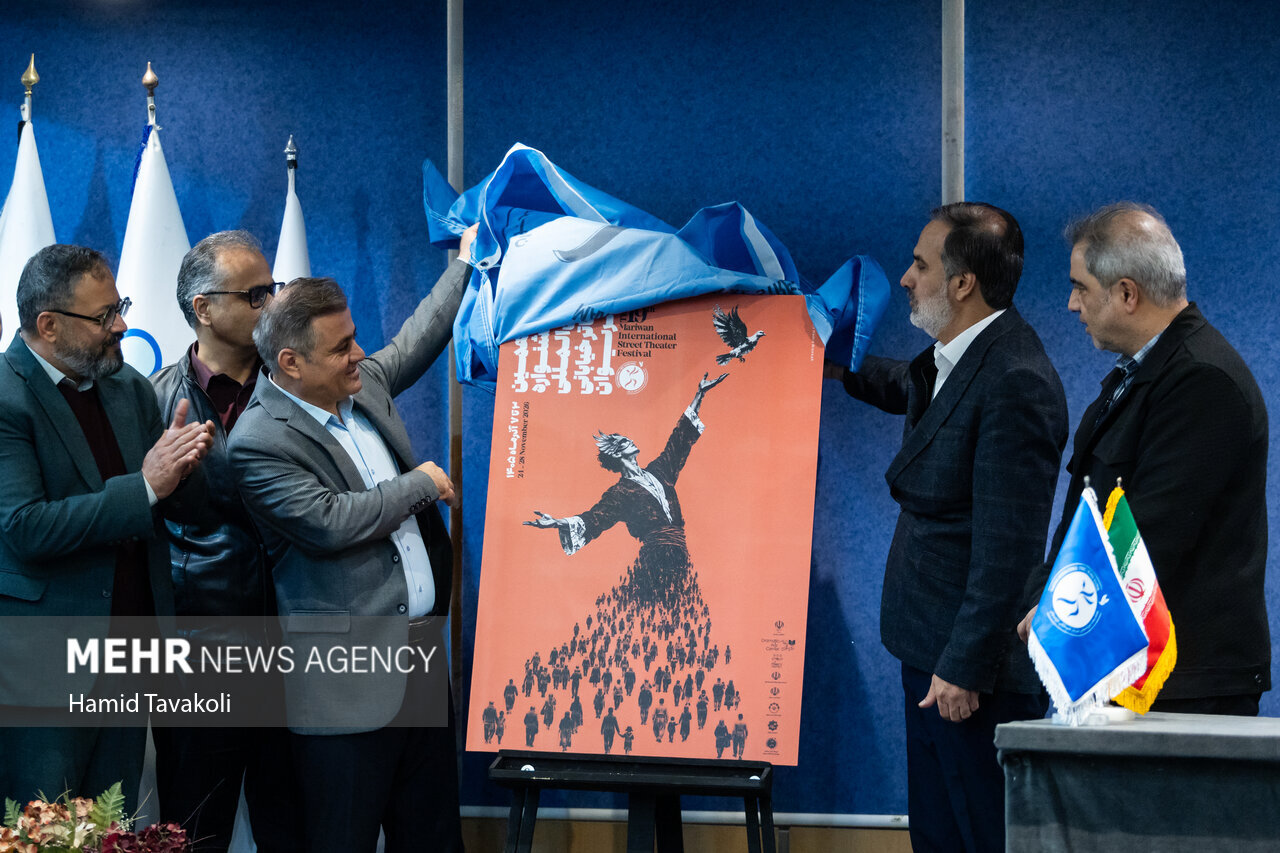
The press conference concluded with the unveiling of the festival poster in the presence of Mehdi Shafiei, deputy minister for artistic affairs, Naderi, Badparva and Hesami.
Marivan City is located in the west of Kordestan province, in the west of Iran. This city shares a 100 kilometers border with Iraqi Kurdistan.
Marivan International Street Theater Festival is one of the most important major artistic events in the field of performing arts in the country. Since 1994, the city of Marivan has been included in the list of cities with independent theater festivals in the country by holding the first memorial of the Marivan theater.
The year 2001 should be considered as the starting point for the performance of street shows in Marivan because the sixth anniversary of the Marivan Regional Theater was held that year. The first national festival of Marivan street theater was held in 2004.
Street theater is a form of theatrical performance and presentation in outdoor public spaces without a specific paying audience. These spaces can be anywhere, including shopping centers, car parks, recreational reserves, college or university campuses, and street corners. They are especially seen in outdoor spaces where there are large numbers of people.
The actors who perform street theater range from buskers to organized theater companies or groups that want to experiment with performance spaces, or to promote their mainstream work. It was a source of providing information to people when there were no sources of providing information like television, radio, etc. Nowadays, sometimes performers are commissioned, especially for street festivals, children’s shows, or parades.
Street theater is a way to make traditional theater accessible for those who may not be able to otherwise attend or afford tickets. The audience typically consists of anyone and everyone who wants to watch and for most performances is free public entertainment.
SAB/
Disclaimer : This story is auto aggregated by a computer programme and has not been created or edited by DOWNTHENEWS. Publisher: tehrantimes.com