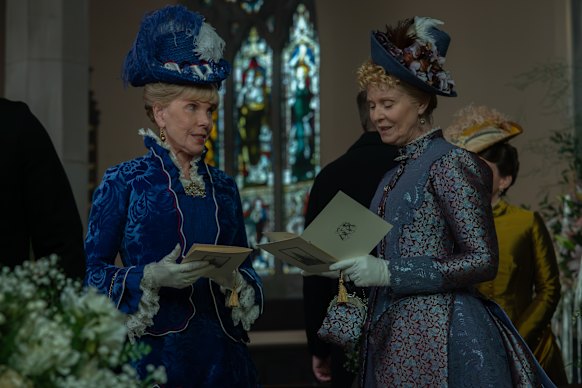
The world of The Gilded Age – the age itself, and the television series which borrows its setting, name and themes – could easily slide into the realm of soap opera, were it not for a persistent political thread that ties many of the show’s stories together.
Series creator Julian Fellowes’ turned Downton Abbey into a polished family drama that dabbled in class war, but the proximity of The Gilded Age to exploding American wealth and the age of robber barons has unexpectedly given it a little more political fire.
“Any time you do a period drama, you’re always in some way looking through the lens of your own time,” says Cynthia Nixon, who plays the once-penniless but now wealthy Ada Brook in the series.
“It is a moment that it is very similar to our period in the same way. Some of it is like women are still fighting for equality, African Americans are still fighting for equality, immigrants are still fighting for equality, working-class people are fighting for a bigger piece of the pie.”
Even more relevant to 2026, adds Nixon, is that “there are these people at the upper echelons of society who, through a combination of quirk and genius and being in the right place at the right time and determination, have made them so much money that they don’t even know what to do with it.
“As their wealth increases, everyone else’s wealth decreases. And this terrible imbalance has got to lead to a restructuring of society or a revolution. Those are really the only two choices.”
When the series opened, Ada Brook was the younger, unmarried sister of family matriarch Agnes van Rhijn, played by Christine Baranski. Their father had squandered the family’s wealth, so Agnes married the emotionally abusive Arnold van Rhijn and spinster Ada had come to live with them as part of the package.
But Ada’s fortunes would change; the show’s third and fourth seasons have seen her transform following the death of her husband, Reverend Luke Forte (Robert Sean Leonard), after discovering he came from a wealthy Boston family and his death left her with a massive inheritance.
The twist means, essentially, that Ada’s power in the structure of the household shifts, as Agnes’s recedes. (Cliff’s note for irregular viewers: Agnes’s son, Oscar [Blake Ritson], had lost the van Rhijn fortune to a swindler.)
What does not change is that Ada and Agnes seem to operate as a kind of two-woman stage drama within the ornate frame of the show. Nixon and Baranski are veteran stage actresses, and Nixon says she relishes the screen time they share.
“When I was first cast in the show, the first thing I heard was [creator] Julian Fellowes, and that was very exciting. The second thing I heard was that it was the 1880s. That was very exciting. And the third thing I heard was Christine Baranski,” says Nixon.
“It’s such a delight to work with her and … she said something when our fortunes reversed – when Oscar lost all her money and then my husband made me a rich woman with his death – she said, the reversal in fortunes is a terrible thing for Agnes as a character, but it’s a wonderful thing for Christine as an actor.
“I think that so much of acting is you throw the ball as hard as you can and the other person catches it and throws it back,” Nixon says. “And when Christine is your acting partner, you don’t have to lob softballs. You can use everything you’ve got.”
The Gilded Age also offers a very specific spin on female power. While the wider world at the time was dominated by men and money, it subtly nods to ways in which women and minorities expressed their power and, in different ways, sometimes controlled their destinies.
“Because doors were closed to women in most professions, particularly women of a certain class were forbidden from working,” Nixon says. “So they took this seemingly ridiculous world of balls and tea parties and afternoon visits and calling cards, and they turned it into an industry that determined who was in and who was out and who had power.
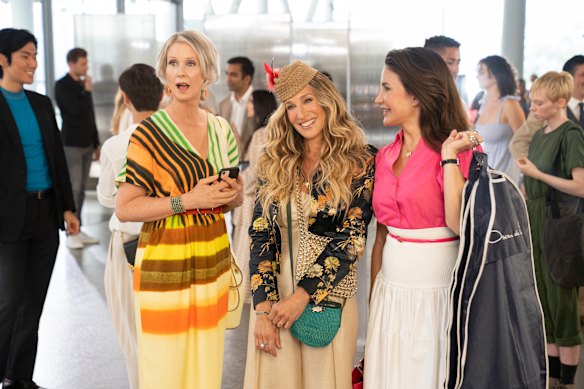
“And having money was not enough,” Nixon adds. “[Shipping dynasty matriarch] Mrs Astor is sort of the original ‘mean girl’ deciding who’s in and who’s out. And god help you if you cross [her] because there’s no help for you.”
Before Nixon was Ada Brook in The Gilded Age she was grieving mother Becca Corbett in Rabbit Hole, a performance that earned her a Tony Award. She delivered an Emmy-nominated performance as Eleanor Roosevelt in the HBO film Warm Springs. And she will forever be connected to Miranda Hobbes, the New York corporate lawyer in Sex and the City and its sequel And Just Like That ….
All of those women, Nixon says, are never too far away, even long after the role has been laid to rest.
“I think particularly for a character that you’re still playing and still working on, on some level, your brain and your body are still thinking about them and still unpacking them,” she says. “I feel like they are definitely with me all the time.”
One very specific thing that surrounds and in some ways defines Nixon’s work is that much of her working life – certainly starring in Sex and the City, And Just Like That … and now The Gilded Age – is the architecture of New York City. For The Gilded Age, in particular, many parts of the city retain the heritage architecture that was built during the actual gilded age.
“Life is like a movie, and you think that the movie started playing when you walked into it, but the movie’s been playing for millions of years,” Nixon says.
“So, of course, I grew up with these amazing Stanford White-designed buildings, the New York Public Library, the Metropolitan Museum of Art [and though I knew his name], it never occurred to me when they were built, why they were built and who commissioned them.
“Now when I walk around, and I see these beautiful houses on Fifth Avenue and other places, I have a much deeper understanding that actually these weren’t just erected as public buildings. People used to, in many cases, live in them. And that is mind-blowing to me.”
The Gilded Age is now streaming on Paramount+.
Want more TV? We’ve got you.
Disclaimer : This story is auto aggregated by a computer programme and has not been created or edited by DOWNTHENEWS. Publisher: www.smh.com.au